


In order to prove the validity of equation (![[*]](http://sepwww.stanford.edu/latex2html/cross_ref_motif.gif) ), it is
convenient to transform it to the coordinates of the initial shot
gathers: s=y-h, r=y+h, and
), it is
convenient to transform it to the coordinates of the initial shot
gathers: s=y-h, r=y+h, and  . The transformed equation takes the form
 |
(145) |
 in a constant velocity medium satisfies
equation ().
in a constant velocity medium satisfies
equation ().
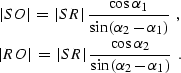
Let S and R be the source and the receiver locations, and O be a
reflection point for that pair. Note that the incident ray SO and
the reflected ray OR form a triangle with the basis on the offset
SR (l=|SR|=|r-s|). Let  be the angle of SO from the
vertical axis, and
be the angle of SO from the
vertical axis, and  be the analogous angle of RO (Figure
). The law of sines gives us the following explicit
relationships between the sides and the angles of the triangle SOR:
be the analogous angle of RO (Figure
). The law of sines gives us the following explicit
relationships between the sides and the angles of the triangle SOR:
 |
(146) | |
| (147) |
 |
(148) |
 is the reflection angle (
 ), and
  is the central ray angle (
 ), which coincides with the local dip angle of
the reflector at the reflection point. Recalling the well-known
relationships between the ray angles and the first-order traveltime
derivatives
), which coincides with the local dip angle of
the reflector at the reflection point. Recalling the well-known
relationships between the ray angles and the first-order traveltime
derivatives
 |
(149) | |
| (150) |
), (), and () into
(), which leads to the simple trigonometric equality
 |
(151) |
) is true for any
and , since

|
ocoray
Figure 2 Reflection rays in a constant velocity medium (a scheme). | 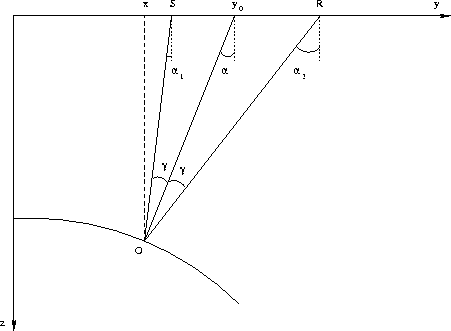 |

Thus we have proved that equation
(), equivalent to (), is valid in constant
velocity media independently of the reflector geometry and the offset.
This means that high-frequency asymptotic components of the waves,
described by the OC equation,
are located on the true reflection traveltime curves.
The theory of characteristics can provide other ways to prove the
kinematic validity of equation (), as described by
Fomel (1994) and Goldin (1994).