


Whether an AGC window or a more careful geometric spreading correction has been applied, two generations of seismic survey will, in general, have different time-varying gain functions applied to them. If not compensated for this may lead to a systematic differential leakage of non-reservoir signal through the difference section. As discussed in the earlier section, any time varying operator should be constrained to vary very smoothly so as not to be biased by production related changes in the reservoir interval.
The simplest approach to amplitude balancing is to scale the data
based on the r.m.s. energy in the two surveys. However, this assumes
that the energy present in the noise fields are the same in both
datasets. Following a similar model to that used to describe the
failings of match-filtering we can consider the two normalized
datasets,  and
and  , to consist of some shared
signal,
, to consist of some shared
signal,  , and uncorrelated components,
  and
and  .
.
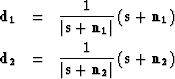
In order to rescale the signals to the same level, we need to apply a
scale factor,  to , such that
 |
(8) |
 |
(9) |
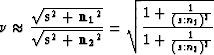
The value of applied to has a large effect on
the amplitude of coherent events in the difference section, and
consequently may significantly effect the interpretation of the 4D
data. Unfortunately, the value of cannot be obtained directly
from the data without an a priori assumption about the nature of
the noise. Also the optimum value of may be time and space
varying, which further complicates its determination.
Fortunately, for seismic data with high signal-to-noise
( ), the equal energy (
 ) balancing will
be valid since
) balancing will
be valid since  will be very small.
 |
(10) |
To date we have been estimating a value for by eye
from difference sections by minizing the coherent energy in the
difference sections. However an alternative approach is to make
a priori estimations of the signal-to-noise ratio's, and use
Equation 9 to calculate .
For the synthetic example described below, the three
independent estimates of were 1.3, 1.235 and 1.25. Knowing the
noise fields exactly, the value obtained with the formula above was
1.28.
In production environments we are expecting to use an F-X decon, wavefield separation method to estimate noise levels present in the two surveys. Alternatively, a amplitude of a marker horizon above the reservoir could be used to scale the datasets to the correct level.