


Match-filtering can simultaneously estimate a correction for static,
phase and spectral differences between surveys. Typically an
operator,  , is designed to minimize the norm of the residual,
 |
(1) |
 and
and  are the regions to be matched.
Rickett (1997) solved for as a time domain convolution operator by minimizing the residual in a least squares (L2) sense. The degree of spectral shaping is then controlled by the length of the time domain operator. By working with a short operator of a similar length to the two wavelets being matched, the operator will provide the right amount of spectral shaping, and will preserve the details of the spectra that are associated with the temporally long reflectivity function.
As well as matching wavelets and static shifts, a match-filter also
has an associated amplitude correction. However this amplitude
correction is biased by the presence of noise in . For
example, if is broken into a wavelet correction,  that preserves the energy in ,
and a scale factor, a, then
that preserves the energy in ,
and a scale factor, a, then
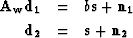
where  is the common signal due to the geology that we are
trying to remove from the difference image,
is the common signal due to the geology that we are
trying to remove from the difference image,  and are the uncorrelated components, and b is a scalar that
captures the different level of signal present in the two regions.
Ideally the operator scalar,
and are the uncorrelated components, and b is a scalar that
captures the different level of signal present in the two regions.
Ideally the operator scalar,

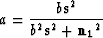
 is minimized
in an L2 sense then
is minimized
in an L2 sense then
 |
(4) |
 |
(5) |

The low value of a manifests itself in the low amplitude of  . This was first noted while match-filtering field data, and was
corrected empirically by a trace renormalization to equalize the
energy in traces between surveys.
. This was first noted while match-filtering field data, and was
corrected empirically by a trace renormalization to equalize the
energy in traces between surveys.