


If a large number of closely spaced parallel events
buried in noise fall in
a window, the calculated filter will consist of the central main spike
plus small contributions from all parallel events.
With a large number of parallel events, the contribution of
any one event parallel to the event being predicted will be small.
For example, data in the Gulf of Mexico generally has many closely
spaced reflections.
If a long prediction filter in time is used with this data,
events far from the output will contribute to the output point,
but since each contribution is small, the spurious events generated
by the filter are unlikely to be a problem.
In an area with only a few reflections that are widely spaced,
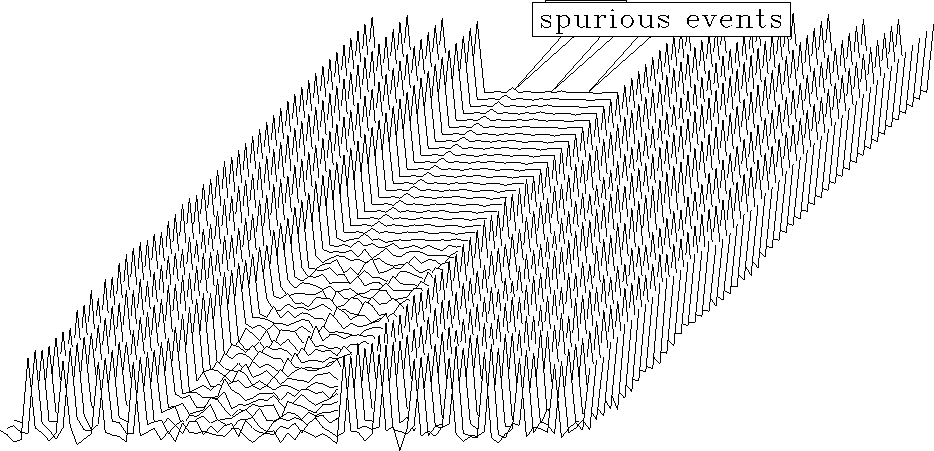
parallel events may generate significant spurious events as
seen in Figures ![[*]](http://sepwww.stanford.edu/latex2html/cross_ref_motif.gif) and .
and .
These demonstrations should not be construed as suggesting
that lateral predictions produce unreliable answers. The spurious
events are low amplitude and will generally be hidden by the
remaining noise.
Furthermore, if many parallel events exist
within a design window, the spurious events generated are
weakened and distributed over time so that the effect is reduced.
Figure shows an f-x prediction over a dataset with
many parallel events.
While many of the expected spurious events are very weak,
a spurious event close to the original events on the left
is almost as strong as those seen in Figure .
I suspect that these phenomena will cause problems only in cases
where a few isolated reflections appear in a background of noise,
and where weak reflections are being sought.
In this case, a t-x prediction rather than an f-x prediction
should be used to avoid generating
events separated from the original events by significant times.
Spurious events that appear as a change of wavelet are less likely
to be interpreted as new events, but may interfere with the interpretation
of subtle stratigraphic changes.
 |


