


This section reviews the discussion in chapter ![[*]](http://sepwww.stanford.edu/latex2html/cross_ref_motif.gif) , where
it was shown that
one effect of the long filter length in time for f-x prediction is the
possible generation of false events.
If strong parallel events are embedded in a background of random noise,
f-x prediction generates weak but significant events parallel
to the original events.
While both t-x and f-x techniques tend to line up noise with
strong events,
f-x prediction actually generates new events with its
long filter length in time.
These spurious events occur
because parallel events in a random noise background
produce an f-x filter where the prediction of one strong event is
influenced by the presence of other parallel events.
An event corrupted by noise can have its prediction improved
by using information from a nearby parallel event if the filter
length in time is long enough to take advantage of the extra information.
The t-x prediction is much less likely to be affected by
the influence of widely separated events
because of its short filter length in time.
, where
it was shown that
one effect of the long filter length in time for f-x prediction is the
possible generation of false events.
If strong parallel events are embedded in a background of random noise,
f-x prediction generates weak but significant events parallel
to the original events.
While both t-x and f-x techniques tend to line up noise with
strong events,
f-x prediction actually generates new events with its
long filter length in time.
These spurious events occur
because parallel events in a random noise background
produce an f-x filter where the prediction of one strong event is
influenced by the presence of other parallel events.
An event corrupted by noise can have its prediction improved
by using information from a nearby parallel event if the filter
length in time is long enough to take advantage of the extra information.
The t-x prediction is much less likely to be affected by
the influence of widely separated events
because of its short filter length in time.
The strength of the spurious events depends on the ratio of the signal to the background noise and the number of parallel events that contribute to the output sample's prediction. With no noise, no spurious events are generated. If there is no signal, or a very weak signal with respect to the noise, no prediction is done and no spurious events are generated. If many events parallel to the signal exist, each event contributes little to the prediction, and the spurious events generated by each of these parallel events will be too small to notice in most practical settings.
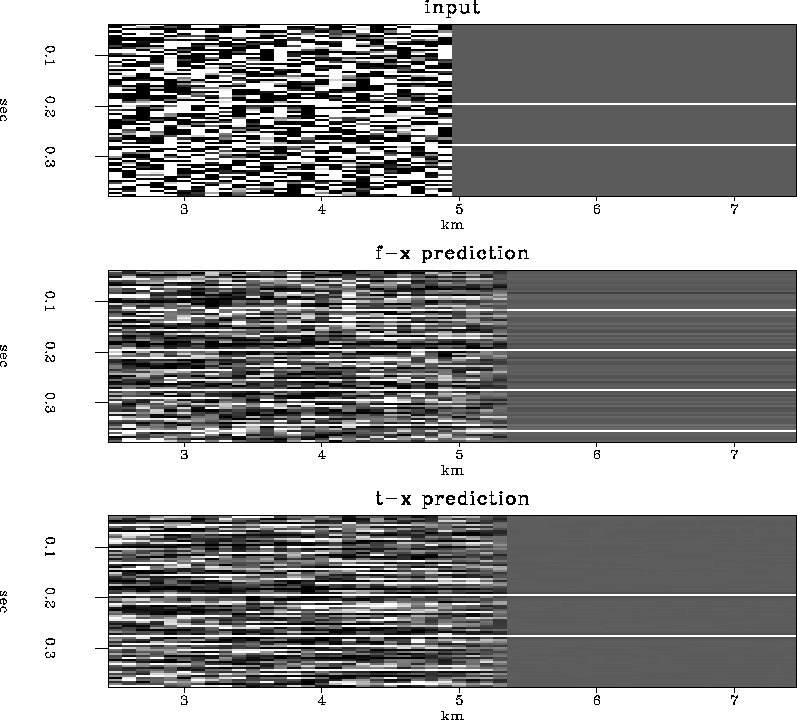
An example of the spurious events generated by f-x prediction
can be seen in Figure .
In this case, two flat events are immersed in noise on the left side
of the displays, and the right side of the display is left noise free
to show the response of the filter. For both f-x and t-x predictions,
only one design window is used.
With f-x prediction, events widely spaced in time can be used to
predict any output point.
For the f-x prediction in Figure , the noise on the
left side of the input allows the predictions to be made using
input from both events, so the equivalent t-x filter has significant
coefficients far in time from the output point.
When this filter is applied to clean data on the right side,
spurious events generated by these widely separated coefficients
are seen.
In the f-x prediction result,
strong events are generated above and below the two
original events, and weak events
line up with the original events on the right side.
The t-x prediction results do not show these erroneous events.
While the f-x prediction may be modified to eliminate this problem
by constraining the filter coefficients to be smooth in frequency,
the t-x prediction does not generate spurious events since its
time length is more naturally controlled.
 |


The false events generated by the f-x prediction generally appear to be
weak.
To give a better idea of the amplitudes of the false events,
the results of the f-x prediction seen in the Figure
are displayed as an elevation plot in Figure .
In real data with an even distribution of noise,
these spurious events are unlikely to be mistaken for real events, since
the remaining noise should hide the errors.
|
twoh
Figure 2 The relative amplitudes of the false events to the original events for the f-x prediction of Figure 1. | 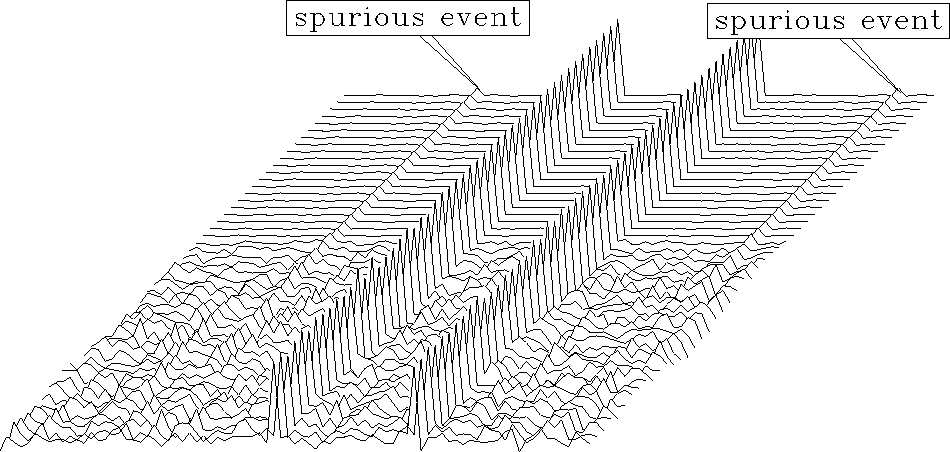 |
Finally, to demonstrate that the f-x prediction and the t-x
prediction show the same effects when a long filter length in
time is used and that the generated events are not
Fourier domain wraparound,
Figure shows a t-x prediction filter
with a time-length of 50 samples. Notice that
the results are similar.
|
twomdlong
Figure 3 The relative amplitudes of the false events to the original events for a t-x prediction with an extremely long filter length in time. | 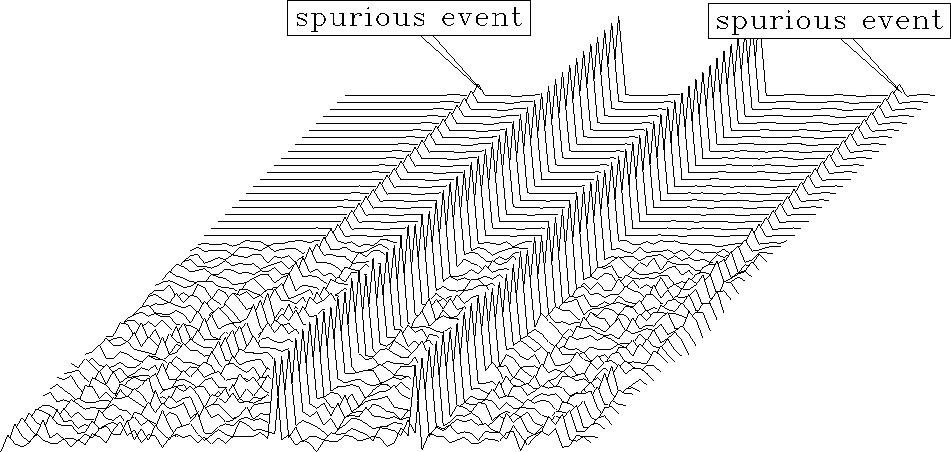 |
A typical f-x prediction program has an advantage over a similar t-x prediction program because the filter length in time is fixed and does not need to be specified. Therefore, this length cannot be accidentally made too short. The cost of not requiring this parameter is creating the risk of generating false events and by passing more noiseAbma and Claerbout (1993).