


The previous examples show spurious events generated at widely spaced times because parallel events affect each other's predictions. These widely spaced events may be removed by shortening the filter length in time. Closely spaced parallel events will produce spurious events with little separation in time. These appear as distortions to the wavelet.
A single event that is extended in time, such as a reflection
with a wavelet convolved with it, suffers distortions, as seen in
Figures ![[*]](http://sepwww.stanford.edu/latex2html/cross_ref_motif.gif) to .
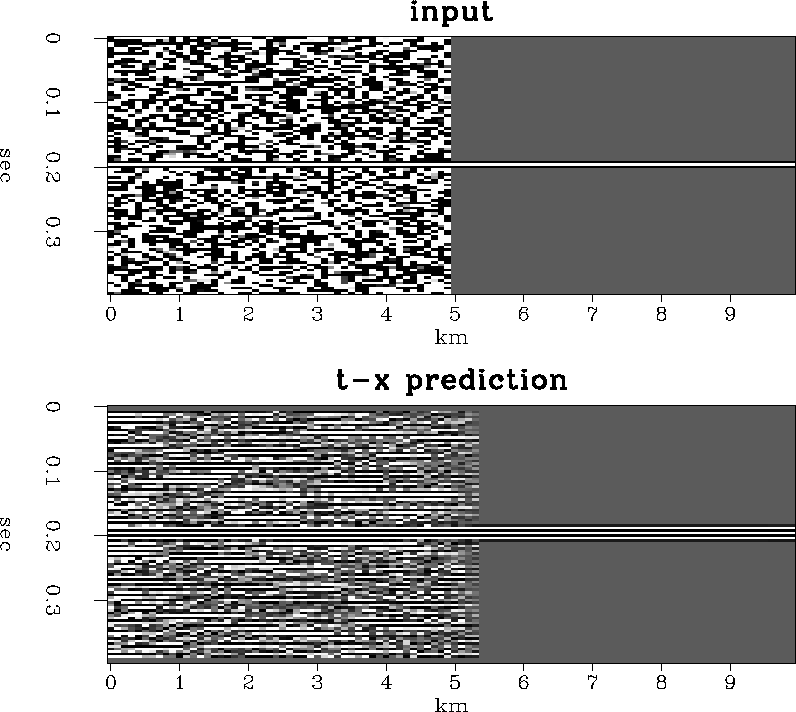
Figure shows an example of lateral prediction with
a single event.
The original event extending over three samples in time is shown
in Figure .
When a prediction filter was applied to the data,
a trace from the noise-free side of the data was extracted and is
shown in Figure .
While Figure shows the t-x prediction result,
f-x prediction produces similar effects.
to .
Figure shows an example of lateral prediction with
a single event.
The original event extending over three samples in time is shown
in Figure .
When a prediction filter was applied to the data,
a trace from the noise-free side of the data was extracted and is
shown in Figure .
While Figure shows the t-x prediction result,
f-x prediction produces similar effects.
 |


Notice that the event in Figure appears similar
to the event in Figure , but is extended in time.
As the level of the noise is decreased,
the spreading of the wavelet in time will decrease.
There will be a trade-off between noise attenuation
and resolution in time that will depend on the level of the noise.
Normally this trade-off is well worth the small sacrifice of resolution,
but the user should be aware that a trade-off is taking place.
|
smultspike
Figure 5 The original trace before prediction filtering. | 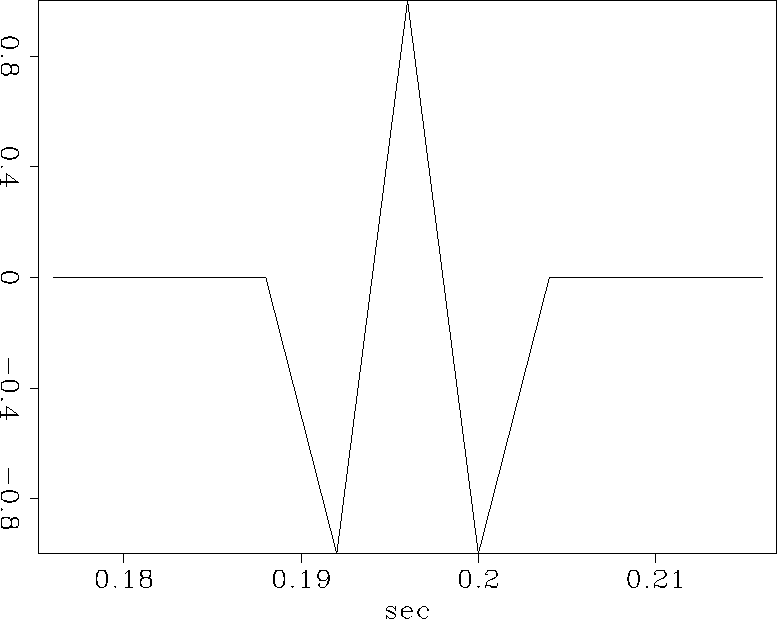 |
|
smultmda
Figure 6 The trace after prediction filtering. | 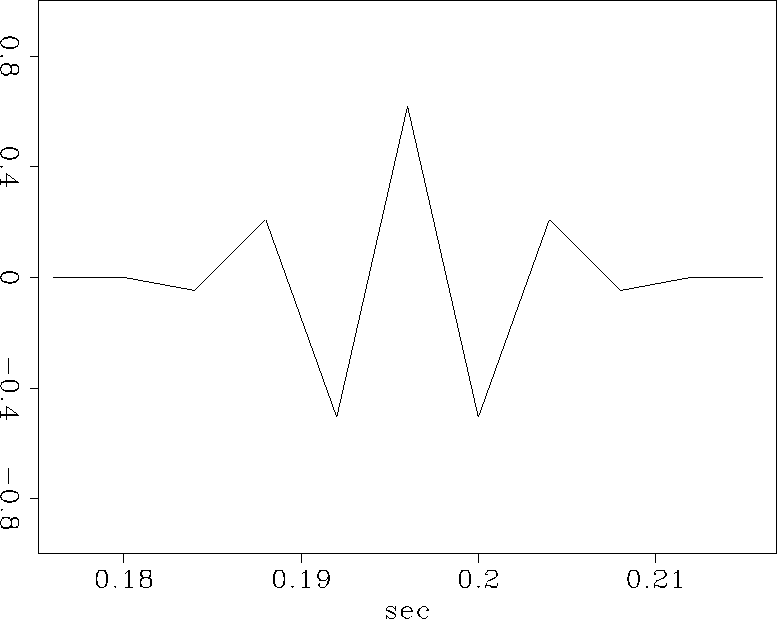 |