


 and noise
  have been characterized only by
the filters
have been characterized only by
the filters  and
and  ,limiting the description of the data by the filters to
the spectrum.
For some applications,
more information must be specified.
In particular, the amplitudes of the seismic data should be considered.
Recordings of seismic data show rapid weakening of the signal
with time
caused by a combination of wavefront spreading and the attenuation
of the earth.
If this weakening of the signal is not compensated for
when an inversion is attempted,
most of the inversion's effort will be expended on the
strong shallow portion of the records.
The weaker deeper portion of the records,
which appears small in the least-squares sense,
will be almost ignored by a least-squares solver.
To equalize the treatments of the shallow and deep portions of the
seismic records, this amplitude difference must be accounted for.
,limiting the description of the data by the filters to
the spectrum.
For some applications,
more information must be specified.
In particular, the amplitudes of the seismic data should be considered.
Recordings of seismic data show rapid weakening of the signal
with time
caused by a combination of wavefront spreading and the attenuation
of the earth.
If this weakening of the signal is not compensated for
when an inversion is attempted,
most of the inversion's effort will be expended on the
strong shallow portion of the records.
The weaker deeper portion of the records,
which appears small in the least-squares sense,
will be almost ignored by a least-squares solver.
To equalize the treatments of the shallow and deep portions of the
seismic records, this amplitude difference must be accounted for.
Another reason to account for the amplitudes is
to take advantage of the extra information contained in
the differences of the expected amplitudes of the noise and signal.
Much noise originates from the surface and will either be of constant
amplitude or weaken at a slower rate than does the signal.
For example, in chapter ![[*]](http://sepwww.stanford.edu/latex2html/cross_ref_motif.gif) the noise is expected to be of constant amplitude,
whereas the signal is expected to weaken as t2,
where t is sample time.
the noise is expected to be of constant amplitude,
whereas the signal is expected to weaken as t2,
where t is sample time.
One method of accounting for the weakening of the signal would
be to gain the input by t2,
but this would strengthen the noise at depth.
A better method would be to account for the amplitude differences
in the inversion itself.
These amplitude differences may be taken advantage of by using them
as part of the characterization of the signal and noise.
As an example,
suppose the noise amplitude falls off as t and the signal amplitude
falls off as t2.
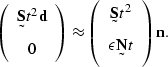
Systems () and () may be modified to become
 |
(56) |
 |
(57) |
 for ,system () becomes
 |
(58) |
) are in fact
matrices that have the values of t and t2 along the diagonal
that correspond
to the time values of the samples of and .For simplicity, I will represent these matrices with
t and t2 here and later in this thesis.
Notice that the assumption of stationarity for and has
been violated somewhat by the time scaling.
This is not necessarily a problem since the filters and involve only the spectrum of the signal and noise.
This spectrum could be assumed to be constant.
The functions t and t2 that balance the contributions
of and in () would presumably be applied to
the data from which and are calculated so the
scaled and n would be stationary.
In system () it is assumed that the filters and are small enough to ignore the variation of and within
the filter caused by the t and t2 scaling.
If this is not true,
there will be a difference between applying the scaling before the
filters and applying the scaling after the filters.