


Next: Frequency-wavenumber domain expression of
Up: Inverse Theory for signal
Previous: Inverse Theory for signal
Claerbout 1995 provides
a geophysical linear inverse structure of
|  |
(43) |
|  |
(44) |
where  ,
,  , and
, and  are linear operators,
 and
and  correspond to a model and to the data,
and
correspond to a model and to the data,
and  is a scale factor determining the relative weights
of these two systems.
The first regression involves how well the model fits the data.
The second regression involves limitations on what the model
is expected to be.
The matrix often enforces a smoothness on the model.
is a scale factor determining the relative weights
of these two systems.
The first regression involves how well the model fits the data.
The second regression involves limitations on what the model
is expected to be.
The matrix often enforces a smoothness on the model.
These are systems of regressions, rather than
systems of equations.
It is not expected that either  or
or  should
ever become exactly zero,
but it is expected that some minimum of these expressions can be found
by adjusting the model .Alternatively,
the regressions in (
should
ever become exactly zero,
but it is expected that some minimum of these expressions can be found
by adjusting the model .Alternatively,
the regressions in (![[*]](http://sepwww.stanford.edu/latex2html/cross_ref_motif.gif) ) and () can be expressed as
the system of equations
) and () can be expressed as
the system of equations
|  |
(45) |
|  |
(46) |
where  and
and  are to be minimized.
Paralleling the arguments in Claerbout 1995,
if is replaced with a filtering operator  that annihilates
any signal s on which it operates so that
that annihilates
any signal s on which it operates so that  , is replaced by the identity matrix
  , is replaced by a filtering operator
  that annihilates
any noise
that annihilates
any noise  on which it operates, so that
  ,and is replaced with the noise that is to be calculated and
removed from the data ,equations () and () become
,and is replaced with the noise that is to be calculated and
removed from the data ,equations () and () become
|  |
(47) |
|  |
(48) |
An alternative method
of getting equations () and () would be
to start from the definitions of the signal annihilation filter and
the noise annihilation filter:
|  |
(49) |
|  |
(50) |
that is, the signal annihilation filter applied to the signal  produces something that is almost zero, and
the noise annihilation filter applied to the noise produces something that is almost zero.
Since the data is defined as the sum of the signal and the noise ,that is,
produces something that is almost zero, and
the noise annihilation filter applied to the noise produces something that is almost zero.
Since the data is defined as the sum of the signal and the noise ,that is,  , in equation () may be replaced with
  .Making this substitution and allowing for a scale factor once more
gives equations () and ().
.Making this substitution and allowing for a scale factor once more
gives equations () and ().
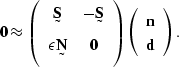
Combining the systems
shown in () and () into a single system gives
|  |
(51) |
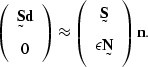
Moving the expressions that depend on the data to the left-hand side
and keeping those that depend on the unknown noise on the right-hand side
gives
|  |
(52) |
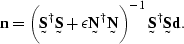
This system may be solved by either minimizing the error
as in Claerbout 1995 or by substituting directly into
the solution for the normal equations.
In either case the solution for is
|  |
(53) |
Once again,  indicates the conjugate-transpose, or adjoint,
which is simply the transpose when all values are real.
indicates the conjugate-transpose, or adjoint,
which is simply the transpose when all values are real.
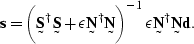
Since the signal may be expressed as ,the solution for the signal is
|  |
(54) |
Next: Frequency-wavenumber domain expression of
Up: Inverse Theory for signal
Previous: Inverse Theory for signal
Stanford Exploration Project
2/9/2001