


As described in chapter ![[*]](http://sepwww.stanford.edu/latex2html/cross_ref_motif.gif) ,
a structure for creating an inverse may be
,
a structure for creating an inverse may be
 |
(76) |
 |
(77) |
 ,
,  , and
, and  are linear operators,
and
are linear operators,
and  and
and  correspond to a model and to the data.
The value of
correspond to a model and to the data.
The value of  is used to weight the relative importance
of () and ().
Replacing with the signal annihilation filter
is used to weight the relative importance
of () and ().
Replacing with the signal annihilation filter  , with
  , the identity matrix, and ignoring
 for the moment gives
an expression
for the moment gives
an expression  for calculating the noise from
the data given the signal annihilation filter .The expression
is not useful in itself for calculating the noise
for calculating the noise from
the data given the signal annihilation filter .The expression
is not useful in itself for calculating the noise  ,since the filter is not perfect and
is unlikely to completely annihilate the
signal to the point where the inversion for could not restore it.
Without additional constraints,
the obvious solution to is
,since the filter is not perfect and
is unlikely to completely annihilate the
signal to the point where the inversion for could not restore it.
Without additional constraints,
the obvious solution to is  .In practice, I have found that,
although the filter could attenuate the signal significantly,
a simple inversion of
.In practice, I have found that,
although the filter could attenuate the signal significantly,
a simple inversion of
 for restores much of the signal
into the calculated noise .What is needed is a constraint to replace in system ().
for restores much of the signal
into the calculated noise .What is needed is a constraint to replace in system ().
The constraint used here to keep signal out of the calculated noise
is that the noise is approximately
the noise estimated from prediction filtering  .This is a reasonable approximation, since
should be somewhat close to the actual noise.
The difference between the actual noise
and the approximated noise
.This is a reasonable approximation, since
should be somewhat close to the actual noise.
The difference between the actual noise
and the approximated noise  should be fairly small and involves only the response of
the noise to the filter .The approximation is weighted as
should be fairly small and involves only the response of
the noise to the filter .The approximation is weighted as  .The value for may be changed to account for the signal-to-noise
ratio of the data.
.The value for may be changed to account for the signal-to-noise
ratio of the data.
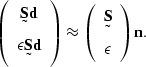
The system of regressions to be solved is now
 |
(78) |
Since this system estimates from the approximation ,it is reasonable to initialize to before entering
the iterative solver.
Another reason for initializing to is that
the filter is generally small and will pass only a
limited range of spatial and temporal frequencies.
In the case of a spike in the data,
inversion for the noise with a small filter does not allow the complete
restoration of the spike.
Because the noise is expected to be almost white
and in some cases dominated by spikes,
initializing to improves the calculation of
and reduces the number of iterations needed.
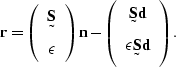
Equation () expressed as a minimization of
the residual  is
is
 |
(79) |
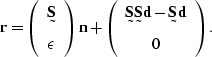
to involves adding
 |
(80) |
) to produce, with some simplification,
 |
(81) |
without regard
to the initial value Claerbout (1995),
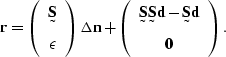
the value of in this equation may be considered as the change
of the calculated noise from the first estimate of the noise .This may be expressed as
 |
(82) |
The results of inversion prediction are sensitive to the value of .At the moment, the optimum value of is uncertain.
It would seem that should decrease as the signal-to-noise
ratio decreases, since the difference between the actual noise and the estimated noise is larger.
However, in the presence of strong noise,
the larger is, the more stable the inversion should be.
If is relatively large, around 1.0,
the amplitudes of the reflections are preserved and spurious events
are somewhat suppressed.
As gets very large, the result approaches the prediction
filter result.
When gets small, the amplitudes of the reflectors are
attenuated, since the signal filter does not perfectly annihilate
the signal before the inversion.
For small , the spurious events tend to return also.
The best value of appears to be different for samples with Gaussian noise than
for samples with uniformly distributed noise.
For most work, it appears that good values of vary
from 0.1 to 3.0.
Small values of remove background noise, but seem
to introduce organized noise into the calculated signal.
For the real data examined,
the background noise increases as increases,
and the continuity of the data increases as decreases.
Further work is needed to determine how the strength and type
of noise affects the value of .
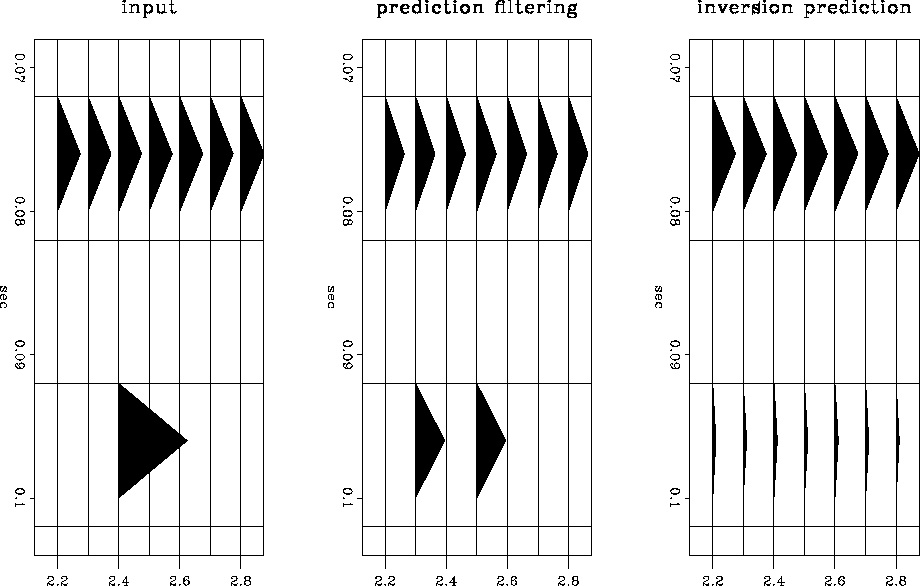
An example of the difference between prediction filtering and
inversion prediction is seen in Figure .
The filter is calculated from the data to predict the flat event.
When is applied to the spike, the filter response can be seen
in the prediction-filter result.
The inversion prediction result has effectively eliminated the filter response.
 |


