


High-amplitude noise produces flaws in prediction-filtering techniques such as t-x and f-x prediction filtering. One flaw is the reduction of reflection amplitudes. Another is the generation of spurious events, as seen in the previous chapter and in Abma 1994. Both these errors are due to the corruption of the signal-prediction filter by the noise in the data from which the filter is calculated.
Another, less obvious, flaw in prediction filtering
is that, even with a filter that
perfectly predicts the signal,
the output of this filtering does not perfectly
separate the signal and noise.
To demonstrate this,
I define  as the available data,
 as the signal, and
  as the noise.
The relationship between the data, the signal, and the noise is
defined to be
as the noise.
The relationship between the data, the signal, and the noise is
defined to be  .Although the prediction of the signal could be stated otherwise,
the prediction is done here with a signal annihilation filter
.Although the prediction of the signal could be stated otherwise,
the prediction is done here with a signal annihilation filter  .The filter is a purely lateral 2- or 3-dimensional filter
as discussed in chapter
.The filter is a purely lateral 2- or 3-dimensional filter
as discussed in chapter ![[*]](http://sepwww.stanford.edu/latex2html/cross_ref_motif.gif) .
If the signal is prefectly predictable,
the filter completely removes the signal
so that
.
If the signal is prefectly predictable,
the filter completely removes the signal
so that  .In fact, only an approximate signal annihilation filter is generally
available so that
.In fact, only an approximate signal annihilation filter is generally
available so that  ,but to simplify the following discussion,
will be assumed for now.
When the data is filtered by the exact signal annihilation filter,
the result is
,but to simplify the following discussion,
will be assumed for now.
When the data is filtered by the exact signal annihilation filter,
the result is  , which becomes
  , since
.Since prediction filtering defines the noise as
, since
.Since prediction filtering defines the noise as  ,a filtered version of the noise
  is obtained from the prediction filtering
instead of the actual noise .
is obtained from the prediction filtering
instead of the actual noise .
Prediction filtering makes the
assumption that the noise is unaffected by
the signal annihilation filter .The difference between and may also be seen as
an inconsistency between definitions of the noise in the
expressions  and
and  Soubaras (1994).
For weak noise and large filters,
the assumption that the noise is unaffected by
the signal annihilation filter is reasonable.
For strong noise and short filters,
the response of the noise to the filter is important.
Although prediction filters may be made as large as desired,
Chapters and show that
large filters allow more noise to pass into the signal
and that filters that are large along the time axis tend to
create spurious events.
For very large noises,
the filter response is alway significant.
Soubaras (1994).
For weak noise and large filters,
the assumption that the noise is unaffected by
the signal annihilation filter is reasonable.
For strong noise and short filters,
the response of the noise to the filter is important.
Although prediction filters may be made as large as desired,
Chapters and show that
large filters allow more noise to pass into the signal
and that filters that are large along the time axis tend to
create spurious events.
For very large noises,
the filter response is alway significant.
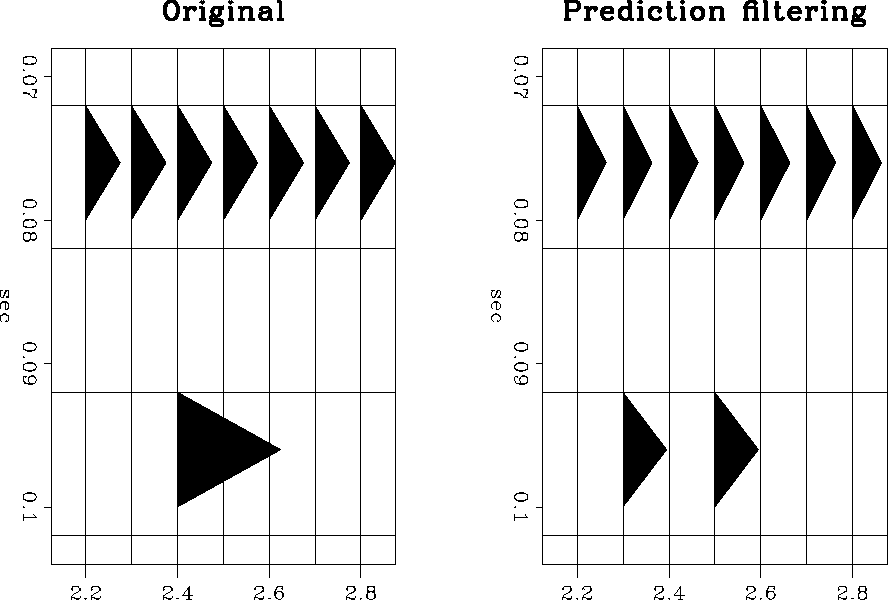
An example of the filter response to noise is shown
in Figure .
In the original data seen in this figure,
the signal is a flat event and the noise
is an isolated spike.
Since the prediction filter is applied in two directions,
the response of the signal annihilation filter can be
seen on both sides of the spike's position in the
prediction-filter result.
The prediction-filtering result also shows a small amplitude loss
in the flat event.
The corruption of the signal annihilation filter by
the spike causes this amplitude loss.
 |


Getting a more accurate calculation of the noise requires
solving the expression when .If the exact signal annihilation filter is not available
and ,
the noise must be solved for from the regression  .Similar expressions have been used for noise removal
by Claerbout and Abma 1994
and Abma and Claerbout 1994.
In the next section I will present a solution to .
.Similar expressions have been used for noise removal
by Claerbout and Abma 1994
and Abma and Claerbout 1994.
In the next section I will present a solution to .