


![[pdf]](icons/pdf.png)
|
|
|
|
| Poroelastic measurements resulting in complete data sets for granular and other anisotropic porous media | |
|

The relationship of coefficient to the other coefficients is easily established because
I have already discussed the main issue, which involves determining the role of the various other
constants contained in the Skempton (1954)
coefficient  . I have quoted this result in (17).
Again, from (22), I find that
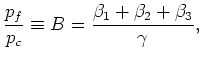 is the confining pressure.
Thus, the scalar coefficient is determined immediately and given by
is the confining pressure.
Thus, the scalar coefficient is determined immediately and given by
I have now determined the physical/mechanical significance of all the coefficients in the poroelastic matrix (22). These results are as general as possible without considering poroelastic symmetries that have less than orthotropic symmetry, while also taking advantage of my assumption that I do typically know (or can often determine) the three directions of the principal axes of symmetry.
|
|
|
|
| Poroelastic measurements resulting in complete data sets for granular and other anisotropic porous media | |
|



