![[pdf]](icons/pdf.png)
|
|
|
|
| Poroelastic measurements resulting in complete data sets for granular and other anisotropic porous media | |
|
The matrix in (22) is in compliance form and
has extremely simple poroelastic behavior in the sense
that all the fluid mechanical effects
appear only in the single coefficient  . I can simplify the
notation a little more by lumping some coefficients together,
combining the
. I can simplify the
notation a little more by lumping some coefficients together,
combining the  submatrix in the upper left corner of the matrix
in (22) as
submatrix in the upper left corner of the matrix
in (22) as  , and defining the column vector
  by
by
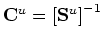
The resulting 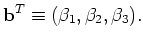 matrix and its inverse are now related by:
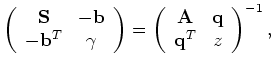 by introducing three components: (a) scalar
![$ z = \left[\gamma - {\bf b}^T{\bf C}{\bf b}\right]^{-1}$](img118.png) ,
(b) column vector
,
(b) column vector
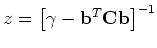 ,
and (c) undrained stiffness matrix (i.e., the
pertinent one connecting the principal strains to principal stresses)
,
and (c) undrained stiffness matrix (i.e., the
pertinent one connecting the principal strains to principal stresses)
 ,
since
,
since  is drained stiffness and
 is
clearly undrained stiffness by construction.
This result is the same as that of Gassmann (1951) for anisotropic porous media,
although his results were presented in a form somewhat harder to scan
than the form shown here.
is
clearly undrained stiffness by construction.
This result is the same as that of Gassmann (1951) for anisotropic porous media,
although his results were presented in a form somewhat harder to scan
than the form shown here.
Also, note the important fact that the observed decoupling of the fluid effects occurs only in the compliance form (22) of the equations, and never in the stiffness (inverse) form for the poroelasticity equations.
From these results, it is not hard to show that
, together with the three distinct orthotropic  coefficients, for
  .
.
renewedcommandarraystretch1.2
par
begincenter
sc Table 1. Reuss (R), Voigt (V), and self-consistent effective (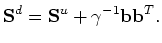 )
bulk moduli of various common anisotropic materials cite[]berryman05:
Water ice, cadmium, zinc, graphite,
)
bulk moduli of various common anisotropic materials cite[]berryman05:
Water ice, cadmium, zinc, graphite,
 -quartz, corundum,
barium titanate, rutile,
aluminum, copper, magnesia, spinel.
Full references for the data used in both sc Tables 1 and 2 are provided
in citeberryman05. Units of bulk modulus
-quartz, corundum,
barium titanate, rutile,
aluminum, copper, magnesia, spinel.
Full references for the data used in both sc Tables 1 and 2 are provided
in citeberryman05. Units of bulk modulus  are GPa.
par
begintabular|c|c|c|c|c|c| hlinehline
Material & Symmetry &  &
&  &
&  &
& 
hline
H O & Hexagonal & 8.89 & 8.89 & 8.89 & 1.00
Cd & Hexagonal & 48.8 & 54.7 & 58.1 & 1.19
Zn & Hexagonal & 61.6 & 70.9 & 75.1 & 1.22
Graphite & Hexagonal & 35.8 & 88.0 & 286.3 & 8.00
hline
AlO & Trigonal & 253.5 & 253.7 & 253.9 & 1.002
-SiO & Trigonal & 37.6 & 37.8 & 38.1 & 1.01
hline
TiO & Tetragonal & 209 & 213 & 218 & 1.04
BaTiO & Tetragonal & 163.1 & 179.3 & 186.8 & 1.15
hline
Al & Cubic & 76.3 & 76.3 & 76.3 & 1.00
MgO & Cubic & 162.4 & 162.4 & 162.4 & 1.00
MgAlO & Cubic & 196.7 & 196.7 & 196.7 & 1.00
Cu & Cubic & 138.0 & 138.0 & 138.0 & 1.00
hlinehline
endtabular
endcenter
par
subsectionDeducing coefficients from measurements: Anisotropic example with homogeneous grains
par
Now, further progress is made by considering the Reuss average again for both of the orthotropic
drained and undrained compliances:
beginequation
frac1K_R^d equiv sum_i,j = 1,2,3 s^d_ij,
labeleq:drainedKR
endequation
and
beginequation
frac1K_R^u equiv sum_i,j = 1,2,3 s^u_ij.
labeleq:undrainedKR
endequation
These effective moduli are the Reuss averages of the nine compliances in the upper left
of the full (including the uncoupled shear components)
 compliance matrix for the two cases, respectively, when the pore fluid is allowed
to drain from the porous system, and when the pore fluid is trapped by a jacketing
material and therefore undrained.
par
1.2
compliance matrix for the two cases, respectively, when the pore fluid is allowed
to drain from the porous system, and when the pore fluid is trapped by a jacketing
material and therefore undrained.
par
1.2
)
shear moduli of various common materials [see Berryman (2005)]:
Water ice, cadmium, zinc, graphite,
-quartz, corundum,
barium titanate, rutile,
aluminum, copper, magnesia, and spinel.
Units of shear modulus  are GPa.
The anisotropy parameter
are GPa.
The anisotropy parameter 
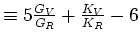 [from Ranganathan and Ostoja-Starzewski (2008a,b)].
| Material | Symmetry |  |
 |
 |
 |
|
| HO |
Hexagonal | 3.48 | 3.52 | 3.55 | 1.02 | 0.10 |
| Cd | Hexagonal | 22.1 | 24.3 | 26.4 | 1.19 | 1.14 |
| Zn | Hexagonal | 34.1 | 40.6 | 44.8 | 1.31 | 1.77 |
| Graphite | Hexagonal | 9.2 | 52.6 | 219.4 | 23.8 | 121.0 |
|
AlO |
Trigonal | 160.7 | 163.1 | 165.5 | 1.03 | 0.15 |
| -SiO |
Trigonal | 41.0 | 44.0 | 47.6 | 1.16 | 0.81 |
|
TiO |
Tetragonal | 99.5 | 114.5 | 124.9 | 1.26 | 1.34 |
| BaTiO |
Tetragonal | 47.4 | 53.6 | 59.8 | 1.26 | 1.46 |
| Al | Cubic | 26.0 | 26.2 | 26.3 | 1.01 | 0.05 |
| MgO | Cubic | 123.9 | 126.3 | 128.6 | 1.04 | 0.20 |
| MgAlO |
Cubic | 98.6 | 109.0 | 118.0 | 1.20 | 1.00 |
| Cu | Cubic | 40.0 | 46.3 | 51.3 | 1.28 | 1.41 |
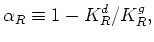
Although the significance of the formula in the anisotropic case is somewhat different now, I find again that
 coefficient (Skempton, 1954) is given by
 and
and  is not an approximation.
In fact it is important now in the anisotropic case (but not in the isotropic cases considered earlier
as long as the grains were also homogeneous) to make this distinction between the Reuss and Voigt averages.
Making this choice of notation will help demonstrate useful analogies between the rigorous
anisotropic formulas and the isotropic ones. I have prepared the way for these analogies
by using the Reuss averages in earlier notation, even though they were mostly redundant
in those isotropic examples.
is not an approximation.
In fact it is important now in the anisotropic case (but not in the isotropic cases considered earlier
as long as the grains were also homogeneous) to make this distinction between the Reuss and Voigt averages.
Making this choice of notation will help demonstrate useful analogies between the rigorous
anisotropic formulas and the isotropic ones. I have prepared the way for these analogies
by using the Reuss averages in earlier notation, even though they were mostly redundant
in those isotropic examples.
First note that, from (42) and (44),
it follows that
 -- also see (36).
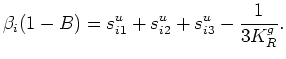
So I can now rearrange (39) to give the formal relationship
-- also see (36).
So I can now rearrange (39) to give the formal relationship
, for .
But, by taking appropriate sums of (46), I find that
exactly
in terms of presumed known quantities. In the present case, the Skempton coefficient ,
however, was not assumed to be known,
since for homogeneous grains I can compute relatively easily, and then follows
since I also know 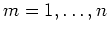 . [For the case of heterogeneous or anisotropic grains, the necessary
introduction of the additional variable
. [For the case of heterogeneous or anisotropic grains, the necessary
introduction of the additional variable  requires still more measured data,
and it turns out that the next easiest quantity to measure is itself -- as was already shown
in the isotropic case.] So, all three 's (which are themselves drained constants)
and are now precisely determined. All the remaining drained compliances
requires still more measured data,
and it turns out that the next easiest quantity to measure is itself -- as was already shown
in the isotropic case.] So, all three 's (which are themselves drained constants)
and are now precisely determined. All the remaining drained compliances  can then be found directly
from (46).
Note that all the steps in this inversion procedure are linear;
there was no need to solve any quadratic equation in this formulation
of the undrained-to-drained inversion problem. There is also no iteration,
and no fitting steps are required in this procedure.
can then be found directly
from (46).
Note that all the steps in this inversion procedure are linear;
there was no need to solve any quadratic equation in this formulation
of the undrained-to-drained inversion problem. There is also no iteration,
and no fitting steps are required in this procedure.
|
|
|
|
| Poroelastic measurements resulting in complete data sets for granular and other anisotropic porous media | |
|