next up previous [pdf]

Next: Polar coordinate example Up: Shragge: RADCIG Previous: Numerical Examples

Eliminating Spatial Dependency

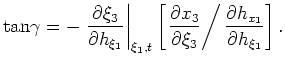
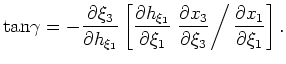
This section presents a method for eliminating the spatial dependency of generalized ADCIG transforms through a judicious stretching of the subsurface offset axis. Revisiting how one can introduce a stretch using equation 11, one obvious restriction to make is maintaining uniform Cartesian spatial sampling. I accomplish this by enforcing $ \frac{\partial h_{x_1}}{\partial {x_1}}=1$ such that

$\displaystyle {\rm tan}\gamma = - \frac{\partial \xi_3}{\partial h_{\xi_1}}\lef...
...partial x_3}{\partial \xi_3}\right/ \frac{\partial x_1}{\partial \xi_1}\right].$ (24)

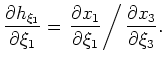
The next step is to specify the relationship between $ h_{\xi_1}$ and $ \xi_1$ that enables us to calculate $ \frac{\partial h_{\xi_1}}{\partial {\xi_1}}$. One useful ansatz solution is

$\displaystyle \frac{\partial h_{\xi_1}}{\partial {\xi_1}}= \left. \frac{\partial x_1}{\partial \xi_1}\right/ \frac{\partial x_3}{\partial \xi_3}.$ (25)

Substituting equation 25 into equation 24 generates the following ADCIG

$\displaystyle {\rm tan}\gamma = - \frac{\partial \xi_3}{\partial h_{\xi_1}}.$ (26)

Equation 25 implies that if we can define an appropriate coordinate system stretch for each $ \boldsymbol{\xi}$ location, we may still recover the reflection opening angle using Fourier-based techniques.

Subsections
next up previous [pdf]

Next: Polar coordinate example Up: Shragge: RADCIG Previous: Numerical Examples

2009-04-13