


![[pdf]](icons/pdf.png)
|
|
|
|
| Angle-domain common-image gathers in generalized coordinates | |
|
 represent? One way to evaluate this quantity is use a partial derivative
expansion
represent? One way to evaluate this quantity is use a partial derivative
expansion
 |
(8) |
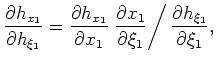 - a scale factor of the transformation between
 and
and  usually given by
 such that
 ;
;
 - the partial derivative mapping between the two
coordinate systems derivable from equations 4; and
- the partial derivative mapping between the two
coordinate systems derivable from equations 4; and
 a scale factor of the transformation between
 and
and  normally defined as
 such that
 , but permitted to have a parametric
form
, but permitted to have a parametric
form
 .
.
![$\displaystyle \left[\begin{array}{c}
h_{x_1} \\ h_{\xi_1}
\end{array}\right] = ...
...partial h_{x_1}}{\partial {x_1}}=\frac{\partial h_{\xi_1}}{\partial {\xi_1}}=1,$](img38.png) |
(10) |
|
|
|
|
| Angle-domain common-image gathers in generalized coordinates | |
|
![$\displaystyle {\rm tan}\gamma = - \frac{\partial \xi_3}{\partial h_{\xi_1}} \le...
...al h_{x_1}}{\partial {x_1}} \frac{\partial x_1}{\partial \xi_1}\right) \right].$](img37.png)
![$\displaystyle {\rm tan}\gamma =- \frac{\partial \xi_3}{\partial h_{\xi_1}} \lef...
...partial x_3}{\partial \xi_3}\right/ \frac{\partial x_1}{\partial \xi_1}\right].$](img39.png)