 |
 |
 |
 | Angle-domain common-image gathers in generalized coordinates |  |
![[pdf]](icons/pdf.png) |
Next: Conclusions
Up: Eliminating Spatial Dependency
Previous: Eliminating Spatial Dependency
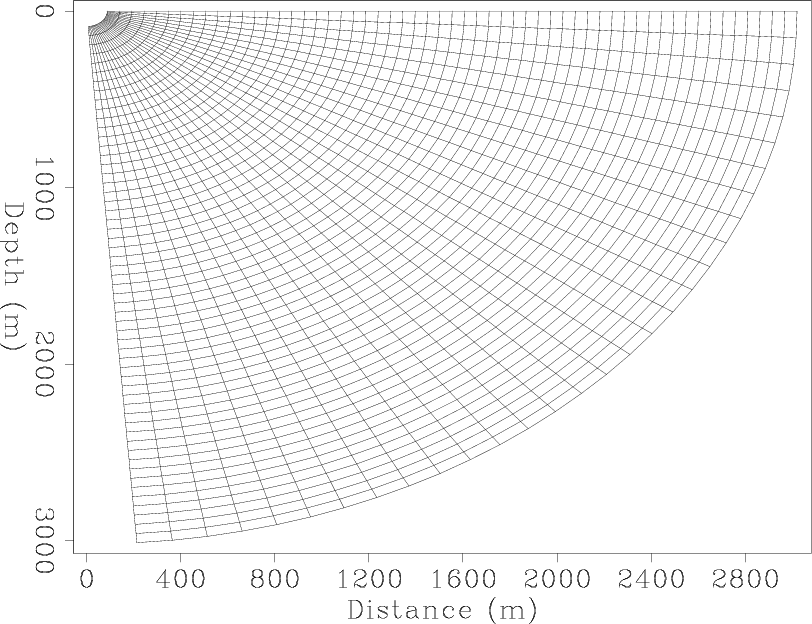
The polar coordinate system, where the extrapolation direction is
oriented in the angular rather than the radial direction (see
figure 7), is defined by
![$\displaystyle \left[ \begin{array}{c}
x_1\\
x_3
\end{array} \right] =
\left[ \...
... \, {\rm cos} \,\xi_3 \\
a\,\xi_1\, {\rm sin} \,\xi_3 \\
\end{array} \right].$](img59.png) |
|
|
(27) |
The partial derivative transformation matrix between the two systems
is
![$\displaystyle \left[ \begin{array}{cc}
\frac{\partial x_1}{\partial \xi_1}& \fr...
...\
a \, {\rm sin} \, \xi_3 & a \,\xi_1\, {\rm cos} \, \xi_3
\end{array}\right],$](img60.png) |
|
|
(28) |
leading to the following differential travel-time equations
![$\displaystyle \left[ \begin{array}{c}
\frac{\partial t}{\partial h_{\xi_1}}\\
...
...a \\
a \,\xi_1 \, {\rm cos} \,\xi_3 \, {\rm cos} \,\gamma
\end{array} \right].$](img61.png) |
|
|
(29) |
Inserting equations 28 into equation 24
generates the expression for polar coordinate ADCIGs
![$\displaystyle {\rm tan}\gamma = \frac{\partial \xi_3}{\partial h_{\xi_1}}\left[\xi_1 \frac{\partial h_{\xi_1}}{\partial {\xi_1}}\right].$](img62.png) |
(30) |
Thus, one cannot calculate ADCIGs directly in a polar coordinate
system unless the spatial dependency is judiciously eliminated.
The polar coordinate system provides an example where ADCIGs contain a
geometric dependence on
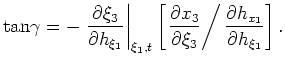 . Inserting the geometric
factors
. Inserting the geometric
factors
 and
and
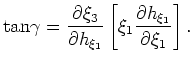 from above into
equation 25 leads to
from above into
equation 25 leads to
 |
(31) |
Integrating along surfaces of constant  yields
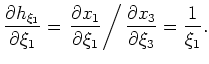 |
(32) |
Equation 32 defines the subsurface axis stretch required to
directly calculate ADCIGs by Fourier-based approaches.
One question is how best to perform this stretch. One approach would be
to perform linear shifting and then regrid that result to an natural
log grid. However, the computational overhead renders this method
less-than-ideal, especially for situations where estimating
 directly by slant-stack processing is more efficient.
However, this remains an open research topic.
directly by slant-stack processing is more efficient.
However, this remains an open research topic.
PC
Figure 7. Example of a polar coordinate system. [NR]
|
|
![[png]](icons/viewmag.png)
|
|---|
|
|
|
|
| Angle-domain common-image gathers in generalized coordinates | |
|
Next: Conclusions
Up: Eliminating Spatial Dependency
Previous: Eliminating Spatial Dependency
2009-04-13