


![[pdf]](icons/pdf.png)
|
|
|
|
| Angle-domain common-image gathers in generalized coordinates | |
|
The numerical examples presented herein were generated using a
shot-profile migration algorithm with extrapolation operators accurate
to roughly 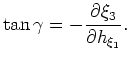 (Lee and Suh, 1985). For each profile I did
the following: i) computed 31 subsurface shifts at each extrapolation
step; ii) calculated ADCIGs using the procedure described in
Sava and Fomel (2003); and iii) interpolated the single-shot ADCIG
output to the global image volume.
(Lee and Suh, 1985). For each profile I did
the following: i) computed 31 subsurface shifts at each extrapolation
step; ii) calculated ADCIGs using the procedure described in
Sava and Fomel (2003); and iii) interpolated the single-shot ADCIG
output to the global image volume.
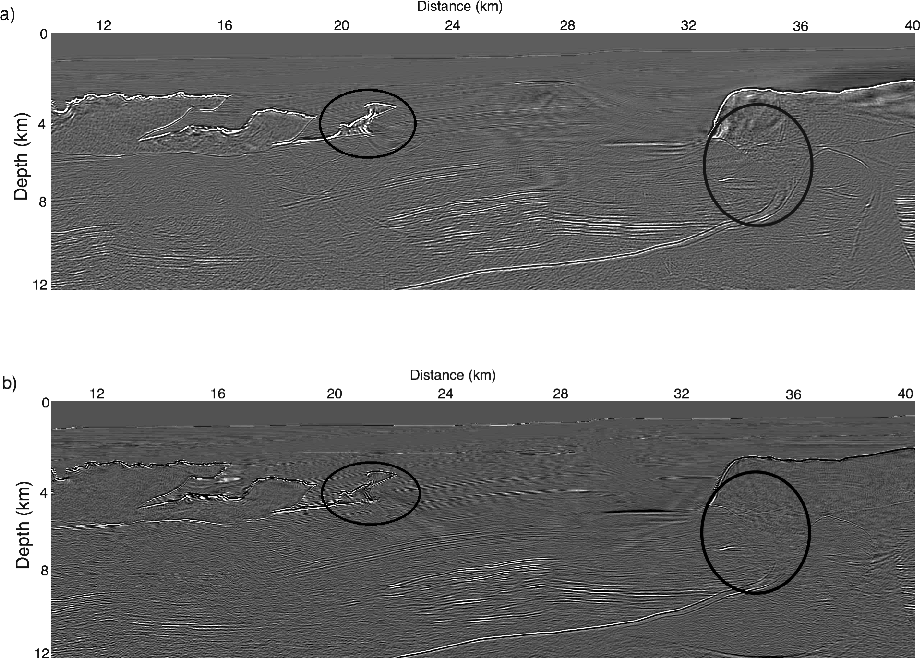
The top and bottom panels of figure 4 show the image volumes for the elliptic and Cartesian coordinate systems, respectively. I indicate a number of locations where the elliptic coordinate system produces superior images.
|
|---|
|
Images
Figure 4. Comparative BP velocity model images for the elliptic (top panel) and Cartesian (bottom panel) coordinate systems.[CR] |
|
|
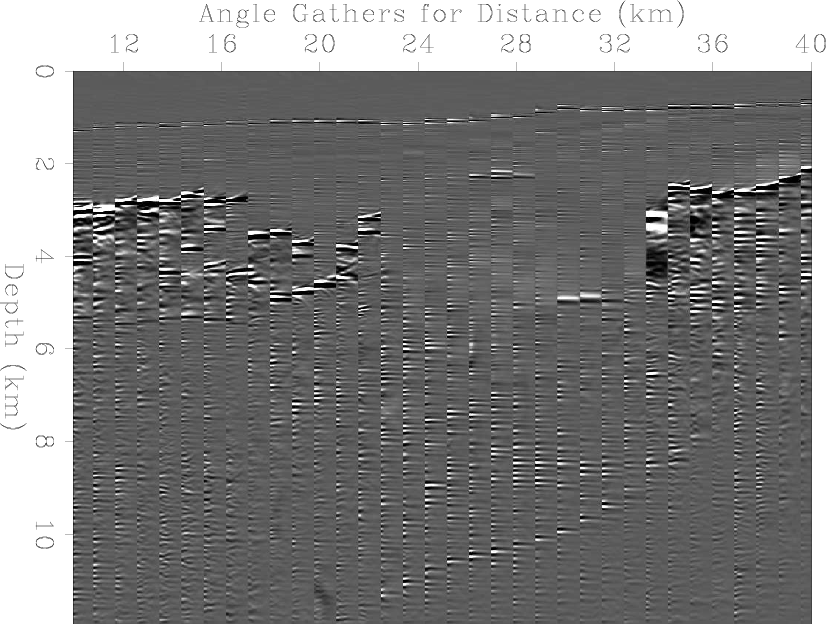
![$ [-60^\circ <
\gamma < 60^\circ]$](img55.png) .
.
|
|---|
|
EllipticADCIG
Figure 5. ADCIGs corresponding to the images in figure 4 calculated in the elliptic coordinates.[CR] |
|
|
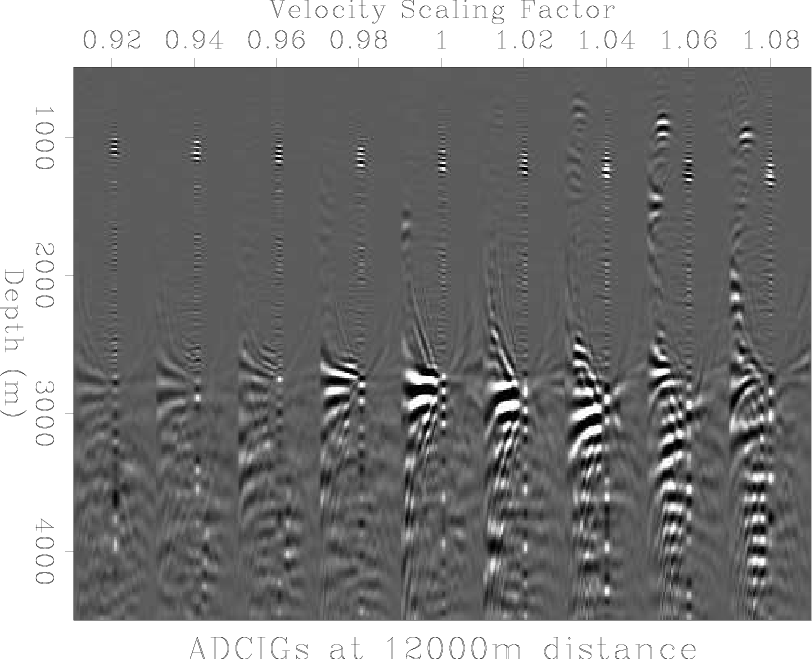
A second test that illustrates the validity of this approach is to examine how the ADCIGs change when the velocity profile is altered. For this test, we rescale the BP synthetic velocity profile by factors from 0.92x to 1.08x in increments of 0.02x and migrate a single shot-profile. Figure 6 presents the elliptic coordinate ADCIG results for an ADCIG and shot point coincidentally located at 12000 m.
|
|---|
|
Nice
Figure 6. Single shot-profile migration ADCIGs for a coincident ADCIG and source point at 12000 m. Note that the image is best focused when the correct velocity is used, and frowns and smiles are observed when migration velocity is used. [ER] |
|
|
|
|
|
|
| Angle-domain common-image gathers in generalized coordinates | |
|