


One important observation about the Lorentz field is that its polarity reverses between sequential hammer strikes, such that approximately half of the raw hammer gathers show one polarity, and the other half show the opposite polarity. The stacks shown in Figures 2d and 3c are made from shot gathers selected on the basis of the polarity of the Lorentz field. The other gathers would produce a stack with a Lorentz field arrival with opposite polarity. A stack of all of the shot gathers would show very little Lorentz energy as it tends to stack out.
Data collected by the circular electrode array using the
sledgehammer on the aluminum hammer
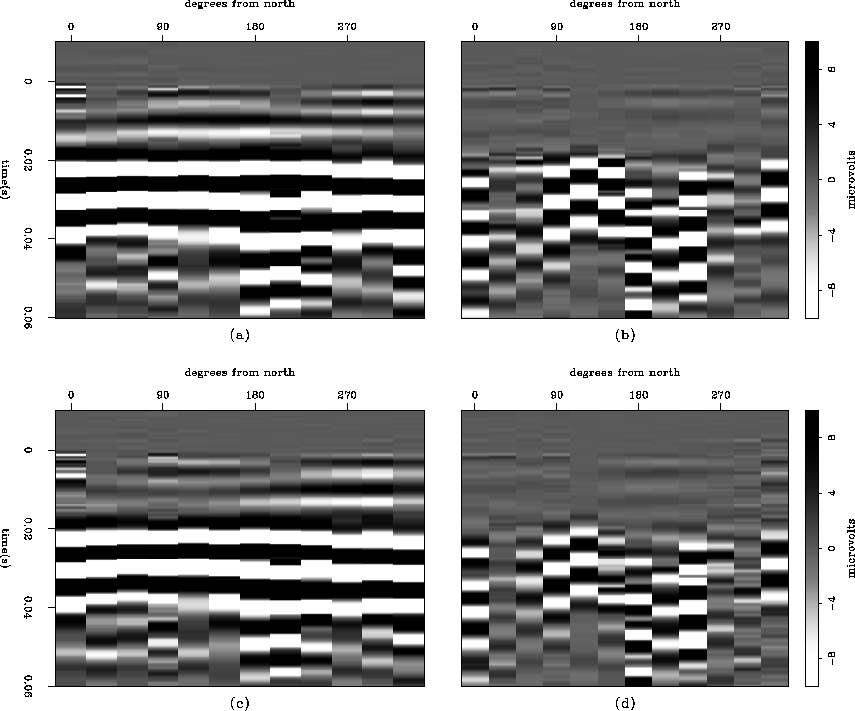
plate are shown in Figure 6. Figure
6a and b are the radial and tangential parts of a
partial stack of hammer strikes, and 6c and d are the
radial and tangential parts of a stack of the other hammer strikes. These
two sets of impacts were selected from the individual hammer strike
gathers based on the presence and polarity
of the events that appear at a time of  0.001 seconds at
certain radial positions (90-180 and 240-330) in the
radial component and 90 out of phase (0-90 and
180-270) in the tangential component. Note
that the polarity of these arrivals is reversed between the two stacks (Figure
6a and b, versus Figure 6c and d).
0.001 seconds at
certain radial positions (90-180 and 240-330) in the
radial component and 90 out of phase (0-90 and
180-270) in the tangential component. Note
that the polarity of these arrivals is reversed between the two stacks (Figure
6a and b, versus Figure 6c and d).
 |
0.001
s in each gather. a) Radial component of stack of selected
hammer strikes. Note Lorentz energy at 0.001 s at certain radial
positions. b) Tangential component of the same stacked gathers,
with faint Lorentz energy at 0.001 s at positions orthogonal to the
energy in a). c) Radial component of a stack of other shot gathers,
with similar energy at 0.001 s but with reversed polarity
relative to a). d) Tangential component of stack of the same
gathers as c), again showing Lorentz energy at positions orthogonal to the
energy in c).
![[*]](http://sepwww.stanford.edu/latex2html/movie.gif)

The radial pattern of these arrivals suggests that they are due to a
horizontal electric dipole oriented a few tens of degrees west of
north, with the orientation of the dipole reversed between the
two sets of gathers. Because the field occurs only for hammer impacts
on a metal plate, we assume that it is caused by the metal plate, and
that it is the Lorentz field (Equation 3). Because the
orientation of the dipole reverses phase between
sequential hammer impacts, we must assume that it is caused by a
component of  that can reverse from one strike
to the next. The earth's
magnetic field
that can reverse from one strike
to the next. The earth's
magnetic field  is essentially constant (oriented toward
magnetic north, and inclined at an angle of 60 from
horizontal), so we must look
to
is essentially constant (oriented toward
magnetic north, and inclined at an angle of 60 from
horizontal), so we must look
to  for this reversal. Although the dominant component of
is vertical, there is also a small horizontal component due
to the imperfect impact of the hammer on the rounded top of the
aluminum block. For the case of the in-line data (Figure
2d and Figure 3c), the aluminum
cylinder is oriented along the electrode receiver line, and thus the
hammer strikes will tend to cause horizontal motion perpendicular to
the line. If we take the cross product of this velocity with the
vertical component of , we get a horizontal electric field
for this reversal. Although the dominant component of
is vertical, there is also a small horizontal component due
to the imperfect impact of the hammer on the rounded top of the
aluminum block. For the case of the in-line data (Figure
2d and Figure 3c), the aluminum
cylinder is oriented along the electrode receiver line, and thus the
hammer strikes will tend to cause horizontal motion perpendicular to
the line. If we take the cross product of this velocity with the
vertical component of , we get a horizontal electric field
 oriented along the electrode line, just as we observe. The
orientation of the horizontal component of will vary from
strike to strike, but will generally be perpendicular to the electrode
transect line, in one of two primary polarities. We conclude that the
observed electric field is due to the horizontal component of the
hammer plate velocity crossed with the vertical component of the
earth's magnetic field.
oriented along the electrode line, just as we observe. The
orientation of the horizontal component of will vary from
strike to strike, but will generally be perpendicular to the electrode
transect line, in one of two primary polarities. We conclude that the
observed electric field is due to the horizontal component of the
hammer plate velocity crossed with the vertical component of the
earth's magnetic field.
|
circ_amps
Figure 7 Comparison between real and modeled Lorentz energy as a function of radial position. a) Amplitude (solid=radial, dashed=tangential) patterns extracted from the stacks in Figure 6a and b. b) Amplitudes extracted from stacks in Figure 6c and d. c) Amplitude pattern modeled for a dipole oriented 50 west of north. | 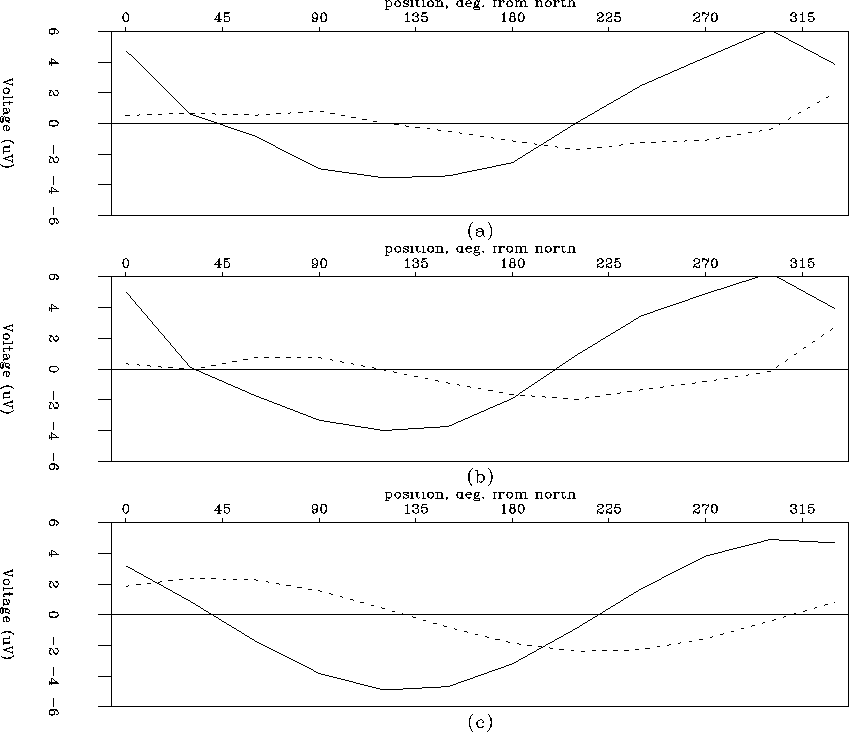 |
Next we extract the amplitudes of the observed arrivals and compare
them with modeled amplitudes. Figure 7a shows the
amplitude of the Lorentz field event shown in Figure 6a and
b, while Figure 7b shows the amplitude of the
Lorentz in Figure 6c and d. The radial component is
plotted as a solid line and the tangential component as a dashed
line. The amplitude in Figure 7a corresponds with the
third of the three phases of the Lorentz field arrival in Figure
6a (0.0042 to 0.0065 seconds) while the amplitude in
Figure 7b was extracted from the second of the three
main phases of the Lorentz event in Figure 6b (0.0025
to 0.0045 seconds), thus the two amplitude patterns are in-phase while
the two displayed Lorentz events are 180 out-of-phase. We use
Equation (4) to model a horizontal dipole at the source
point, and find that a best fit is achieved with a dipole oriented
50 west of north. This alignment corresponds with the
alignment of the hammer plate and the person swinging the hammer, not
with magnetic north, confirming our interpretation that the horizontal
of the hammer plate and the vertical component of the
earth's field are responsible for the Lorentz field. The
horizontal component of does not seem to play a role in the
creation of this field.
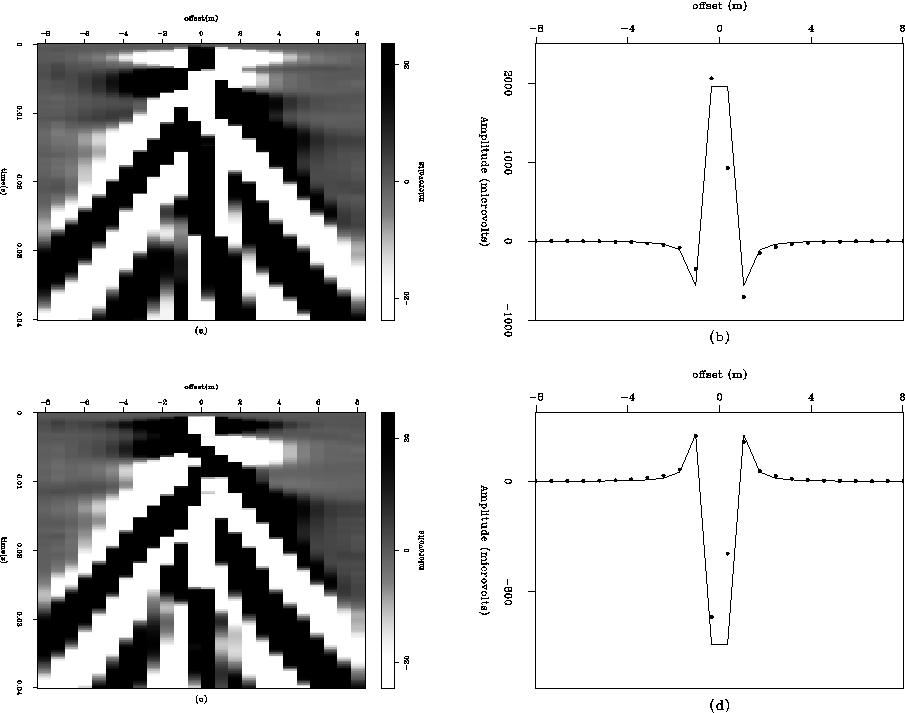 |
0.001 s, the direct field at 0.005 s, and
modeled and real amplitudes. a) Stacked data shown in Figure
2d, but with lower-frequency bandpass filter (20
to 800 Hz). b) Real amplitudes (dots) of Lorentz field arrival of
data in a), and modeled amplitudes (solid
line) corresponding with the metal hammer plate acting as an electric
dipole oriented along the electrode array. c) Stack of other
selected shot gathers (those with Lorentz field arrival opposite in
polarity to stack in part a). d) Real (dots) and modeled (solid
line) amplitudes for metal plate as a horizontal dipole as predicted
by the Lorentz equation.
We can gain further knowledge about the Lorentz field by extracting amplitudes from the in-line data (Figure 2d). Figure 8a and c show stacks of two different sets of impacts collected with the metal hammer plate processed with a broad bandpass filter (20 to 800 Hz); the data in Figure 8a is the same stack as in Figure 2d. Both of these data plots show a strong flat arrival at about 0.002 seconds which we interpret as the Lorentz field, followed by another flat event with reversed polarity on opposite sides of the shot point. This second arrival is the direct field. Amplitudes extracted from these stacks for the Lorentz field are show in Figure 8b and d as dots. Modeled amplitudes for a horizontal electric dipole matching the hammer plate (charge separation of 0.2m between ends of the dipole, lateral offset of 0.25m from the receiver line) are plotted as solid lines. Only the magnitude and polarity of the modeled dipole is varied between the two plots. The central two traces show polarity opposite that of the rest of the Lorentz field because they are located along the horizontal dipole and so are measuring the field off of its main axis, where the field is opposite to the direction of the dipole.