


 |
 0.01 s.
![[*]](http://sepwww.stanford.edu/latex2html/movie.gif)

In orer to develop our understanding of the source-related electric fields that may be observed in electroseismic data, we begin with the simplest possible data collection scenario, and add complexity one step at a time. In this way we can better identify the impact of each individual element of electroseismic data collection.
 |
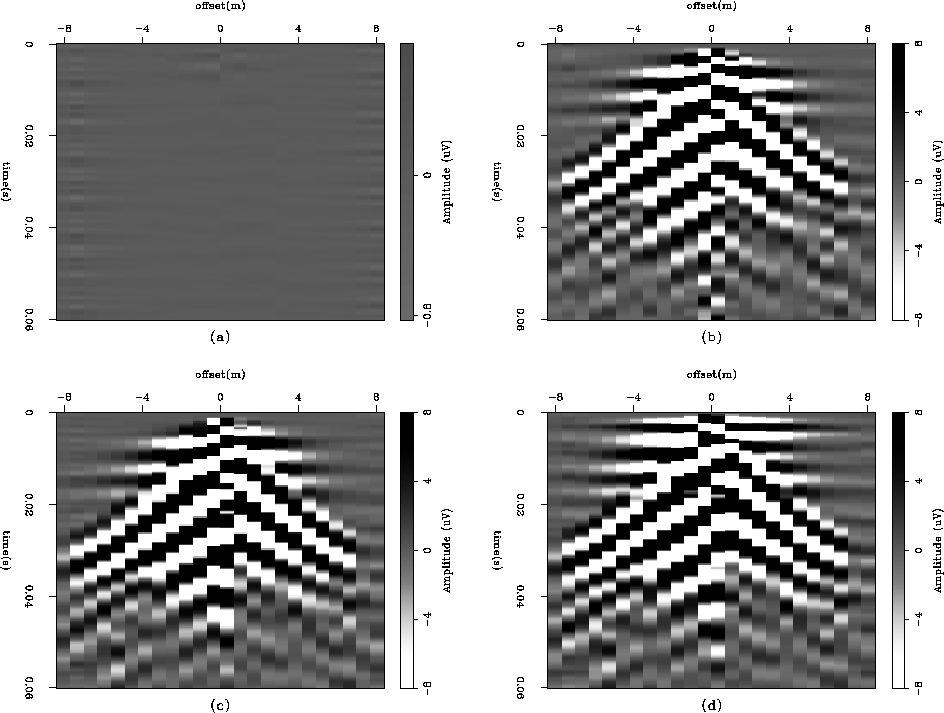
The series of gathers shown in Figure 2 was collected at the vineyard field site described in detail by Haines and Guitton (2002). The site is a small meadow at a vineyard in St. Helena, CA. The soil is fairly homogeneous and clay-rich, and extends to a depth of at least 3m. Although the homogeneity has been disrupted by the construction of two sand-filled trenches, the data in Figure 2 were collected away from the trenches such that they should have no impact on the displayed data. The data were collected with a source point in the center of an array of 24 electrode pairs at a spacing of 0.7m. The distance across each pair of electrodes (the dipole width) is 1.05m. All gathers are the result of stacking individual impacts of the source (frequently a sledgehammer) on a metal or plastic hammer plate. Generally 25 or 30 impacts were recorded separately and then those that do not show any strong electrical noise in the time window of interest are stacked to produce the gathers shown. Final gathers are generally the result of stacking between 10 and 25 individual impacts.
The simplest possible data collection example is carried out by
manually triggering the recording seismograph. Figure
2a shows data collected by hitting the trigger
switch against a stationary object. Thus the data represent
electrical background noise and the lack of any coherent energy
demonstrates that the trigger mechanism
produces no electrical noise. Next we add a level of complexity by putting
seismic energy into the ground, but with no moving metal objects.
Figure 2b shows data collected using the impact of
a wooden source (a fence post) on a plastic hammer plate. We now see
the expected dipping coseismic energy (with seismic moveout). We also
observe flat (no moveout) energy in the upper 17 ms of the
record. This energy appears to show the amplitude pattern of a
dipole and reversed polarity on opposite sides of the shot point. If
the site geology included any shallow interfaces, we might
conclude that this flat energy was the electroseismic interface
response. However, it does not, so we interpret this energy as the
electroseismic direct field. We will re-visit this interpretation
in the next section. We add another level of complexity by using a
metal sledgehammer on the plastic hammer plate (Figure
2c) and observe that the result is very similar to
that of Figure 2b. Thus we can conclude that the
moving metal hammer head does not create a noticeable electric field.
We move one step further by employing a metal hammer plate (an
aluminum cylinder 0.2m long and 0.15m in diameter,
positioned with its axis horizontal). We now observe (Figure
2d) an additional form of flat energy in the upper
10 ms of the record. It shows no moveout, and an amplitude
pattern suggestive of a dipole. But unlike the interface response and the
direct field, this energy shows the same polarity on the two sides of
the shot point. Thus we conclude that this energy is due to a
horizontal electric dipole oriented along the electrode transect
line. The Lorentz field (Equation 3) offers the most likely explanation
for the observed energy. The motion ( ) of the conductive hammer plate
in the Earth's magnetic field (
) of the conductive hammer plate
in the Earth's magnetic field ( ) produces an electric field
 . We further examine this field later in this contribution.
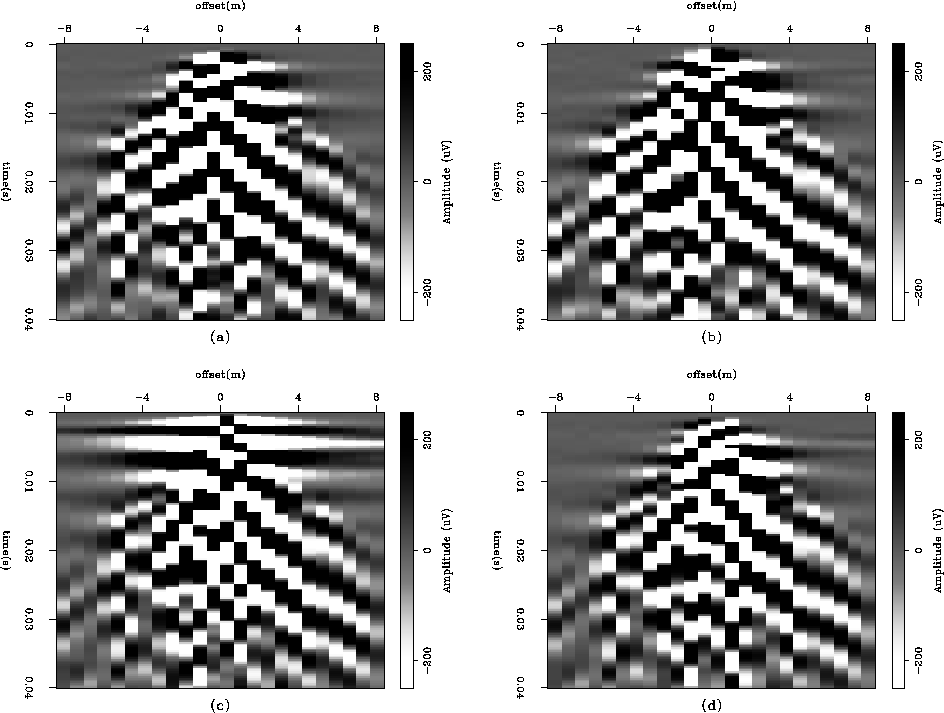
In order to gain more certainty in our interpretations, we examine data from a separate field site. The data in Figure 3 were collected at the Thompson tree farm in the Santa Cruz mountains of California. The site is remote from cultural noise (both electrical and seismic) and has a subsurface geology that we consider to be free of any distinct interfaces in the upper few meters. Figure 3a shows a gather collected using a wooden source on a plastic hammer plate with dipping coseismic energy and (faint) flat direct field energy clearly visible. The gather in Figure 3b looks very similar, and was collected using a metal sledgehammer on the plastic hammer plate. Figure 3c shows data collected with a metal hammer on the aluminum hammer plate, and it shows the strong Lorentz electric field as well as the dipping coseismic energy. The gather in Figure 3d was also collected with the hammer on the aluminum hammer plate, but in this case the plate was insulated from the earth by a thin layer of wool material. The Lorentz field is not observed, demonstrating the need for electrical contact between the metal hammer plate and the earth for observation of this field. Thus a metal hammer plate may be used for electroseismic work if it is insulated from the earth.