Next: Conclusions
Up: Amplitude effects
Previous: Effects of migration operator
Having obtained satisfactory AVA results with my downward continuation
migration operator, I moved on to test my geophysically Regularized Inversion
with model Preconditioning (RIP). For my first test, I set  to
zero. Although this essentially sets the model styling goal of
fitting goals (5) to zero, I am preconditioning the
problem so I am still regularizing the inversion
through the
to
zero. Although this essentially sets the model styling goal of
fitting goals (5) to zero, I am preconditioning the
problem so I am still regularizing the inversion
through the  in the data fitting goal. Using this formulation,
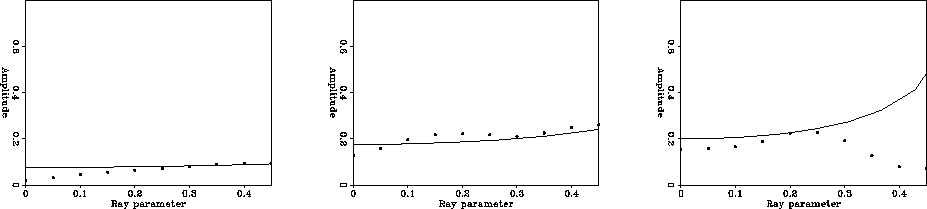
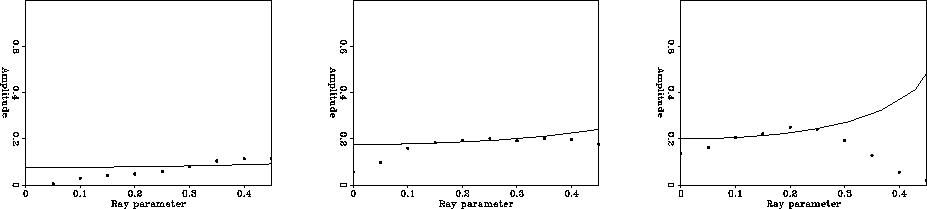
I ran tests using 5, 10 and 15 iterations. The results after 5 iterations
can be seen in
Figure 3.
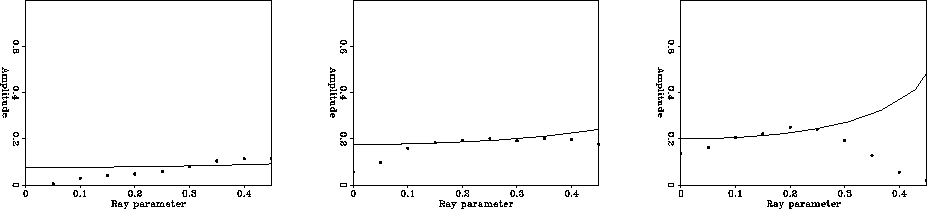
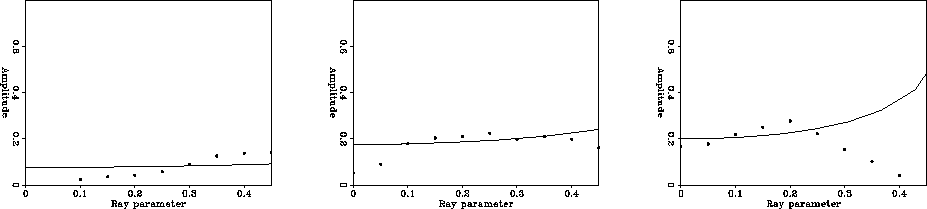
The results after 10 iterations are shown in Figure 4
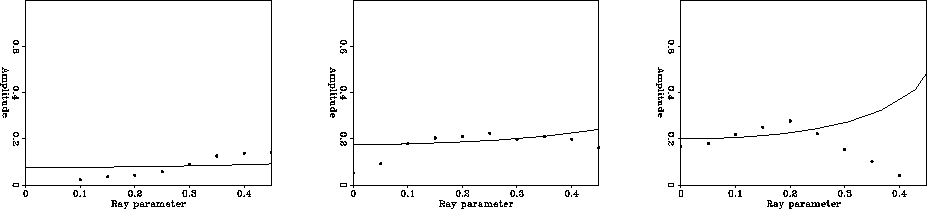
and the results after 15 iterations are shown in
Figure 5.
in the data fitting goal. Using this formulation,
I ran tests using 5, 10 and 15 iterations. The results after 5 iterations
can be seen in
Figure 3.
The results after 10 iterations are shown in Figure 4
and the results after 15 iterations are shown in
Figure 5.
For all three exercises, we notice that the shallowest interface
(left panels) has developed an artificial increasing trend. This
is partly due to an edge effect at the small ph, and partially
due to the effects of the regularization. It is more pronounced
for this interface because the true AVA trend is expected to be almost
flat. The edge effect at small ph is present for the
other two interfaces as well.
Looking at the results for the second interface (center panels of
Figures 3
through 5), it appears that our results
after regularized inversion are more accurate than the result we saw
from the migration (center panel of Figure 2).
For the second interface, other than the edge effect at small ph,
the AVA trend is quite accurate after 5, 10 and 15 iterations.
The best result for the second interface appears to be that after
10 iterations. The result after 15 iterations is deteriorating
slightly as the inversion is trying harder to accomodate artifacts that
exist in the data.
The results for the deepest interface (right panels of
Figures 3 through 5)
are also better than the result from the migration (right panel of
Figure 2). They have the same problems at
large ph due to survey geometry, and have the edge effect
at small ph seen for the other interfaces, but the AVA trend
between these two extremes is close to the expected trend. Due to the
known problem at large ph, I have actually chosen to
turn the regularization operator off halfway along the ph
axis to keep the inversion from spending all of its effort trying to
correct the sudden decrease in amplitude. Once again,
it seems that the AVA trend in the result after 10 iterations is the
best.
ava.comp.5it0eps
Figure 3 Amplitude variation with ph
for geophysical regularization with 5 iterations and  .Left panel shows the results for the shallowest interface as seen in
Figure 1, center panel for the second interface, and
right panel for the deepest interface. The
solid line shows the theoretical value and the dots show the values
obtained after inversion.
.Left panel shows the results for the shallowest interface as seen in
Figure 1, center panel for the second interface, and
right panel for the deepest interface. The
solid line shows the theoretical value and the dots show the values
obtained after inversion.
 ava.comp.10it0eps
Figure 4 Amplitude variation with ph
for geophysical regularization with 10 iterations and .Left panel shows the results for the shallowest interface as seen in
Figure 1, center panel for the second interface, and
right panel for the deepest interface. The
solid line shows the theoretical value and the dots show the values
obtained after inversion.
ava.comp.15it0eps
Figure 5 Amplitude variation with ph
for geophysical regularization with 15 iterations and .Left panel shows the results for the shallowest interface as seen in
Figure 1, center panel for the second interface, and
right panel for the deepest interface. The
solid line shows the theoretical value and the dots show the values
obtained after inversion.
To examine the effect of a stronger regularization, I next set
to .002. This means that the data fitting goal still influences the
resulting model more than the regularization, but now the regularization
is acting through the model styling goal as well as the data fitting goal.
This value for was selected based on previous trial-and-error
experiments in which poor illumination was a problem
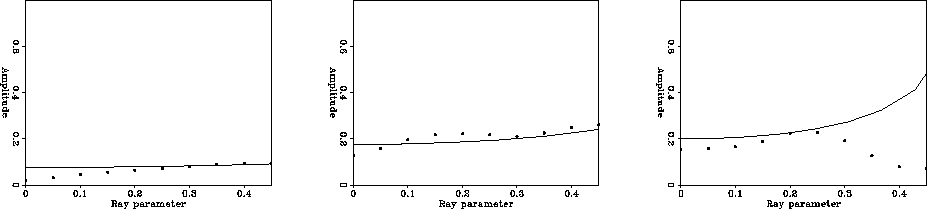
Clapp (2003). The results after 5 iterations of this test
can be seen in Figure 6.
The results after 10 and 15 iterations are in
Figures 7 and 8,
respectively. Since there are no sudden, large amplitude changes along
the ph axis, this stronger regularization should not affect the results
much more than the inversion results with . As expected, these
results
are similar to the results with . We see the same
unfortunate edge effect at small ph for all of the interfaces
in all three experiments (5, 10 and 15 iterations). We also see
the effects of the survey geometry on the deepest interface (right
panels of Figures 6-8),
where I have once again elected to turn off the regularization operator.
Overall, the increased strength of regularization has not affected the
AVA trends of any of the interfaces any more than the previous
inversion experiment.
ava.comp.5it002eps
Figure 6 Amplitude variation with ph
for geophysical regularization with 5 iterations and  .Left panel shows the results for the shallowest interface as seen in
Figure 1, center panel for the second interface, and
right panel for the deepest interface. The
solid line shows the theoretical value and the dots show the values
obtained after inversion.
.Left panel shows the results for the shallowest interface as seen in
Figure 1, center panel for the second interface, and
right panel for the deepest interface. The
solid line shows the theoretical value and the dots show the values
obtained after inversion.
ava.comp.10it002eps
Figure 7 Amplitude variation with ph
for geophysical regularization with 10 iterations and .Left panel shows the results for the shallowest interface as seen in
Figure 1, center panel for the second interface, and
right panel for the deepest interface. The
solid line shows the theoretical value and the dots show the values
obtained after inversion.
ava.comp.15it002eps
Figure 8 Amplitude variation with ph
for geophysical regularization with 15 iterations and .Left panel shows the results for the shallowest interface as seen in
Figure 1, center panel for the second interface, and
right panel for the deepest interface. The
solid line shows the theoretical value and the dots show the values
obtained after inversion.
Next: Conclusions
Up: Amplitude effects
Previous: Effects of migration operator
Stanford Exploration Project
5/23/2004