


Iterative least-squares inversion can be expressed simply as the conjugate-gradient minimization of this objective function:
 |
(1) |
where boldL is a linear modeling operator, boldd is the data, and
boldm is the model. In this paper, L is the adjoint of the
downward continuation migration operator explained by
Prucha et al. (1999b). This
migration algorithm produces a model with the axes depth (z), common
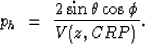
reflection point (CRP), and offset ray parameter (ph). Offset
ray parameter is related to the reflection angle  (where is half of the opening angle between incident and reflected rays) by:
 |
(2) |
where  is the local dip and V(z,CRP) is the local
velocity at the reflection point.
is the local dip and V(z,CRP) is the local
velocity at the reflection point.
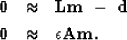
The minimization can be expressed more concisely as a fitting goal:
 |
(3) |
 |
(4) | |
The first expression in (4) is the ``data fitting goal,''
meaning that it is
responsible for making a model that is consistent with the data. The
second expression is the ``model styling goal,'' meaning that it allows us
to impose some idea of what the model should look like using the
regularization operator  . The strength of the regularization
is controlled by the regularization parameter
. The strength of the regularization
is controlled by the regularization parameter  .
.
Unfortunately, the inversion process described by fitting goals (4)
can take many iterations to produce a satisfactory result.
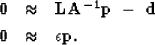
We can reduce the necessary number of iterations by making the problem
a preconditioned one. We use the preconditioning transformation
 Fomel et al. (1997); Fomel and Claerbout (2003) to give us these
fitting goals:
Fomel et al. (1997); Fomel and Claerbout (2003) to give us these
fitting goals:
 |
(5) | |
 is obtained by mapping the multi-dimensional regularization
operator to helical space and applying polynomial division
Claerbout (1998). This makes our imaging method a Regularized Inversion with
model Preconditioning (RIP).
is obtained by mapping the multi-dimensional regularization
operator to helical space and applying polynomial division
Claerbout (1998). This makes our imaging method a Regularized Inversion with
model Preconditioning (RIP).