


I first investigated the effects of my downward continuation migration
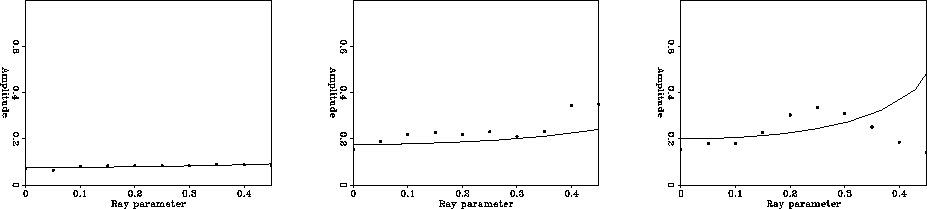
operator on the AVA. I migrated the synthetic data using the correct
velocity model and extracted my calculated amplitudes along each of the
three interfaces. These results can be seen in Figure 2.
In each of the panels, the solid
line represents the theoretical AVA values and the dots show the AVA
values obtained after migration. The horizontal axis is shown in
offset ray parameter (ph), which is not an intuitively obvious physical
unit. Based on the relationship in equation (2), the range
of opening angles for the shallowest interface (left panel of
Figure 2) is  , the range
for the second interface (center panel of Figure 2)
is
, the range
for the second interface (center panel of Figure 2)
is  , and the range for the deepest interface
(right panel of Figure 2) is
, and the range for the deepest interface
(right panel of Figure 2) is  .
Overall, the results for each of the
three interfaces are good. The calculated values for the second
and third interfaces are not as consistent as the shallowest
interface, partly due to the presence of more migration artifacts
at depth. In the case of the deepest interface, it is also an effect
of the survey geometry: we cannot
expect the deep event to have reliable amplitude information at large
ph (larger than an opening angle of 36o) because the
common midpoint and offset ranges of the seismic data are limited,
so energy reflecting at large angles from the deep event are lost. However,
the overall trends of all of the calculated AVA values are fairly
accurate.
.
Overall, the results for each of the
three interfaces are good. The calculated values for the second
and third interfaces are not as consistent as the shallowest
interface, partly due to the presence of more migration artifacts
at depth. In the case of the deepest interface, it is also an effect
of the survey geometry: we cannot
expect the deep event to have reliable amplitude information at large
ph (larger than an opening angle of 36o) because the
common midpoint and offset ranges of the seismic data are limited,
so energy reflecting at large angles from the deep event are lost. However,
the overall trends of all of the calculated AVA values are fairly
accurate.
 |
