


 to match the well logs
 :
:
and the well log data should vanish.
 and
and  as closely as
possible - in magnitude and also in relative shape.
.
as closely as
possible - in magnitude and also in relative shape.
.This method is strictly a vertical correction. It is naïve to assume that the misfit between the seismic horizon and the well logs is purely vertical, but well log measurements place no direct horizontal constraints on the output model. However, in the ``Future Work'' section I discuss how simple anisotropy can manifest itself in seismic data through vertical misfit, and how, through a simple inversion scheme, we may be able to quantify the degree of anisotropy.
We can directly measure the vertical discrepancy between  and
at the well locations, (xw,yw):
and
at the well locations, (xw,yw):
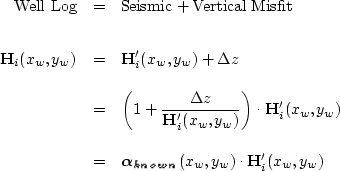 |
||
| (105) |
 (x,y), whose value is already known at the well locations
(
(x,y), whose value is already known at the well locations
( (x,y)).
 |
(106) | |
| (107) |
 is the ``well location selector'' operator, similar to
 in Equation (
![[*]](http://sepwww.stanford.edu/latex2html/cross_ref_motif.gif) ).
I choose the 2-D Laplacian,
).
I choose the 2-D Laplacian,  , as the regularization operator,
because the vertical misfit is in general not dependent on the geology of the
horizon which we're trying to update. Therefore we opt for the isotropic
smoothing qualities of , rather than those of a PEF. However,
as a future project I suggest implementing this methodology in a recursive
layer-stripping scheme. In this case, making the regularization operator
dependent on the geometrical and physical properties of the overlying horizons
makes sense, though the details have not yet been formalized.
, as the regularization operator,
because the vertical misfit is in general not dependent on the geology of the
horizon which we're trying to update. Therefore we opt for the isotropic
smoothing qualities of , rather than those of a PEF. However,
as a future project I suggest implementing this methodology in a recursive
layer-stripping scheme. In this case, making the regularization operator
dependent on the geometrical and physical properties of the overlying horizons
makes sense, though the details have not yet been formalized.
This problem is grossly underdetermined ( 15 known values vs. 1600
points in model space), so even for a good choice of
15 known values vs. 1600
points in model space), so even for a good choice of  ,
convergence is slow - too slow, in fact, to make this method practical for
application to
real-world problems. To solve this problem, I use
preconditioning, defined as any change of variables which speeds convergence
of an iterative scheme.
,
convergence is slow - too slow, in fact, to make this method practical for
application to
real-world problems. To solve this problem, I use
preconditioning, defined as any change of variables which speeds convergence
of an iterative scheme.
In general, the preconditioning operator  is defined by
 |
(108) |
 is the model variable and
  is the so-called
``preconditioned variable.'' The choice of is arbitrary.
However, () proposes a simple, yet highly effective
choice for : the inverse of the regularization operator.
Our regularization operator (
is the so-called
``preconditioned variable.'' The choice of is arbitrary.
However, () proposes a simple, yet highly effective
choice for : the inverse of the regularization operator.
Our regularization operator ( ) is 2-D convolution, so its
inverse is obtained by 2-D deconvolution - in general an ill-defined
process. But the Helix Transform () comes to the
rescue, allowing us to use the simple 1-D algorithm to perform 2-D
deconvolution.
) is 2-D convolution, so its
inverse is obtained by 2-D deconvolution - in general an ill-defined
process. But the Helix Transform () comes to the
rescue, allowing us to use the simple 1-D algorithm to perform 2-D
deconvolution.
First wrap onto a helix, then unroll it to create a long 1-D filter,
as shown in Figure .
Through the process of spectral factorization, we compute a minimum phase
filter  whose autocorrelation is :
 .
Since is minimum phase, successive convolution with and
.
Since is minimum phase, successive convolution with and
 is
multiplication with lower and upper diagonal matrices, respectively.
Therefore, the inverse operation, deconvolution, is matrix inversion:
is
multiplication with lower and upper diagonal matrices, respectively.
Therefore, the inverse operation, deconvolution, is matrix inversion:
 ,
which can be done very quickly in this case with simple backsubstitution,
an
,
which can be done very quickly in this case with simple backsubstitution,
an  operation! For more
details on the spectral factorization methods used at SEP, see
(), or more recently, ().
operation! For more
details on the spectral factorization methods used at SEP, see
(), or more recently, ().
 |
. Adapted from a
Mathematica drawing by Sergey Fomel.

Now that we can compute the preconditioner  with confidence,
repose the original problem. First apply the following change of variables:
with confidence,
repose the original problem. First apply the following change of variables:
 |
(109) |
) into Equations () and
() to obtain
 |
||
| (110) |
We solve for iteratively, then convert back to
via equation
. Figure shows the resultant
(x,y)
for both the shallow and deep horizons. Does preconditioning work? Yes!
In this example, the rate of convergence is increased by two orders of magnitude
by preconditioning, e.g., roughly 1000 versus 10 CD iterations.
 |
 , for the shallow and deep horizons.


Now we compute the final output model, 
 |
(111) |
and , respectively.
 |
 |