


![[*]](http://sepwww.stanford.edu/latex2html/cross_ref_motif.gif) and are not
defined at many x and y locations.
So to create
and are not
defined at many x and y locations.
So to create  , we must fill all the interior ``holes'' in the irregular picked seismic
horizons and also extrapolate them to the edges of the grid.
, we must fill all the interior ``holes'' in the irregular picked seismic
horizons and also extrapolate them to the edges of the grid.
A human attempting to fill and extrapolate the data by hand would first discern, then manually extend, its dominant trends into the empty regions. Unfortunately, the human approach is a ``non-linear'' one; tough to reproduce and even tougher to encode into a computer algorithm. However, by computing a 2-D Prediction Error Filter (PEF) from the irregular picked seismic horizon, we encapsulate the spatial spectrum of the known data, and thus systematically extrapolate by imposing this spectrum on the output model. () discusses a closely related example using sparse side-scan sonar bathymetry data.
First we must contend with a detail:
the data used to estimate a PEF must obey the stationarity assumption.
In other words, the spectrum of the data must
be spatially invariant in order to encapsulate the inverse spectrum
with a single PEF. Though the spatial spectra of the irregular picked
seismic horizons in this example are roughly constant, the stationarity
assumption is commonly violated for real-world problems.
I make use of data ``patching'' to subdivide
the data into smaller regions where the assumption is
assumed to hold, and then estimate a PEF from the data contained in
each patch (). The dashed lines on Figures
and
delimit the four equal-sized patches I use in this example.
The problem of finding  and
and
 is underdetermined,
since we have only 578 known seismic data values, but 1600 model
points. However, the classical least squares solution to the problem
is valid only for overdetermined () systems.
To convert this underdetermined
problem to an overdetermined one, we must constrain the
output model with additional regression equations, a process known as
regularization. Normally the regularization operator imposes
a ``minimum-energy,'' or other similarly ``safe'' constraint on the free
model variables,
but adds little or no meaningful statistical information to the problem.
However, by using a PEF as the regularization operator, we impose
a fundamental statistical property of the known data on the
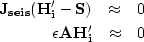
model. In symbols, the problem can be stated
through the following least squares ``fitting goals.''
is underdetermined,
since we have only 578 known seismic data values, but 1600 model
points. However, the classical least squares solution to the problem
is valid only for overdetermined () systems.
To convert this underdetermined
problem to an overdetermined one, we must constrain the
output model with additional regression equations, a process known as
regularization. Normally the regularization operator imposes
a ``minimum-energy,'' or other similarly ``safe'' constraint on the free
model variables,
but adds little or no meaningful statistical information to the problem.
However, by using a PEF as the regularization operator, we impose
a fundamental statistical property of the known data on the
model. In symbols, the problem can be stated
through the following least squares ``fitting goals.''
 |
(103) | |
| (104) |
In Equations () and (), the output
is . The `` '' means that we minimize
the squared L2 norm of the residual.
Equation () forces
'' means that we minimize
the squared L2 norm of the residual.
Equation () forces  to
match the irregular picked seismic horizon
to
match the irregular picked seismic horizon  , where it is known.
 is known-data ``selector'' operator, which effectively ignores the
difference
is known-data ``selector'' operator, which effectively ignores the
difference  wherever does not exist.
 is a
so-called ``damping factor,'' which weights the effective strength
of the regularization equations () relative to the
``data-matching'' equations (). The operator
is a
so-called ``damping factor,'' which weights the effective strength
of the regularization equations () relative to the
``data-matching'' equations (). The operator  is convolution with the patch-variant PEF. The problem is solved iteratively,
using a conjugate direction-type (CD) algorithm.
is convolution with the patch-variant PEF. The problem is solved iteratively,
using a conjugate direction-type (CD) algorithm.
The result is shown in Figure .
Now that we have the surfaces and
.
 |
and . Bottom:
contour plots of surfaces shown above. Note that the predominant
trend in both figures is roughly ``east-north-east'', consistent with
the trends predicted by the patch-variant PEF.


