


When solving for the signal with equation (![[*]](http://sepwww.stanford.edu/latex2html/cross_ref_motif.gif) ) using
an initial estimate of the signal being the data,
the common event now appears in the calculated signal, as is seen in
Figure .
When solving for the noise with equation () using
an initial estimate of the noise being the data,
the common event now appears in the calculated noise, as seen in
Figure .
) using
an initial estimate of the signal being the data,
the common event now appears in the calculated signal, as is seen in
Figure .
When solving for the noise with equation () using
an initial estimate of the noise being the data,
the common event now appears in the calculated noise, as seen in
Figure .
|
separ7san
Figure 5 The calculated signal and noise using an initial solution of the data for the signal. | 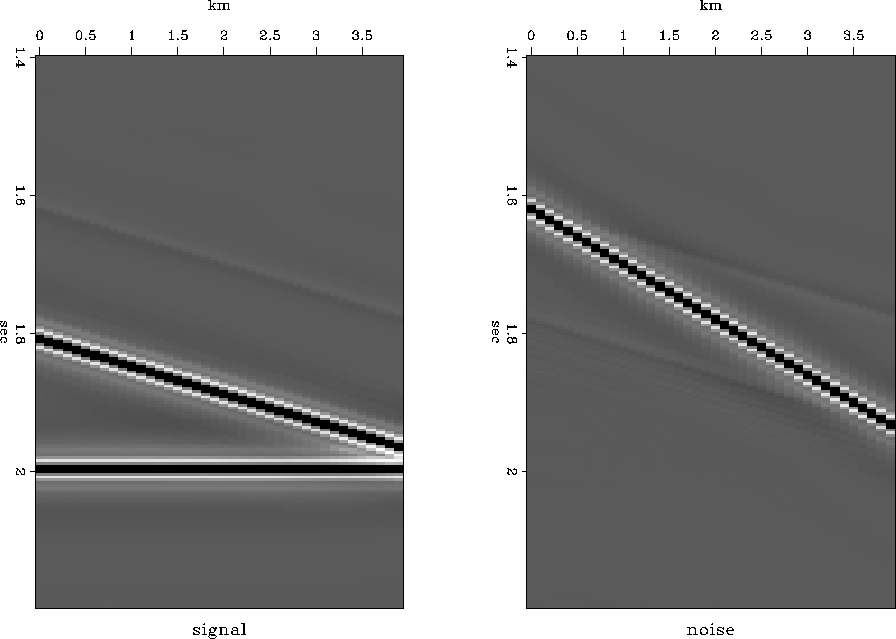 |


|
separ7nas
Figure 6 The calculated signal and noise using an initial solution of the data for the noise. | 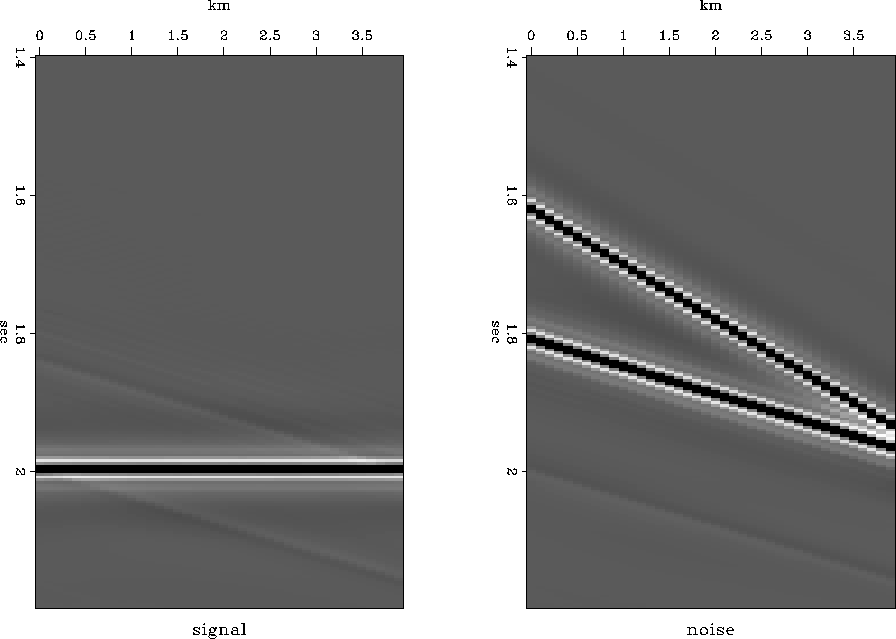 |
The initial estimates for the signal and noise
are not limited to zero and the data.
If there is no reason to believe that the data in the null space
of the operators  or
or  should belong to either the noise or
the data,
a more symmetrical approach would be to use one-half the data
as the initial estimates of
both the signal and noise.
should belong to either the noise or
the data,
a more symmetrical approach would be to use one-half the data
as the initial estimates of
both the signal and noise.
In real data, the separation between the signal operator and
the noise operator is likely to be less clear than it is in
these examples. True null spaces, where an event is completely zeroed,
are less likely in the presence of noise.
The separation of events that are suppressed by both filters, but
not in the null space, is considered next.