


In the following discussion,
three assumptions are made to separate signal and noise
from data.
First, the data is defined to be a simple sum of the signal and noise;
that is,  ,
,
 being the observed data,
  the signal, and
  the noise.
Next, there exists a filter
the noise.
Next, there exists a filter  that predicts the signal,
 .Finally, there exists a filter
  that predicts the noise,
 .The methods of getting and will be covered later.
The assumed noise filter requires a change in
the definition of the noise from
the previous chapters,
where unpredictable noise was separated from a predictable
signal.
Although it will be shown later that unpredictable noise may be
removed with the techniques to be discussed here, more
emphasis is given now to coherent noise.
Three conditions are expected to be met by the final solution for the signal and noise:
 |
(85) |
 |
(86) |
 |
(87) |
![[*]](http://sepwww.stanford.edu/latex2html/cross_ref_motif.gif) ) is just a definition of how signal and noise combine
make the data.
Equations () and () characterize
the expected properties of the signal and noise.
These might be considered more as levelers than as equations,
since the result of either
) is just a definition of how signal and noise combine
make the data.
Equations () and () characterize
the expected properties of the signal and noise.
These might be considered more as levelers than as equations,
since the result of either  or
or  is very unlikely to be zero.
The final solution for the signal and the noise is expected
to minimize, in the least-squares sense, both and .
is very unlikely to be zero.
The final solution for the signal and the noise is expected
to minimize, in the least-squares sense, both and .
Using equations () to (),
two systems of regressions may be generated,
one to calculate the noise and one to calculate the signal.
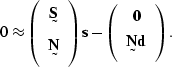
To calculate the signal, replaces  in
equation (),
which is then combined with equation ()
to give a single system of regressions
in
equation (),
which is then combined with equation ()
to give a single system of regressions
 |
(88) |
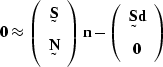
A similar manipulation produces a calculation of the noise
 |
(89) |
Once the signal is calculated, the noise is simply  .If the noise is calculated, the signal is
  .
.