


A common problem in solving the previous systems is that high-amplitude noise overwhelms least-squares inversion techniques. Removing the worst of the noise before calculating a signal filter and before attempting to separate signal and noise can significantly improve the results. When doing the inversion after removing data, the samples that have been removed must be accounted for, otherwise the zeroed samples will be just another noise contaminating the process.
To allow for the zeroed samples,
the previous inversions are recast to predict missing data while
separating signal from the noise.
This prediction of missing data is implemented by defining the data  as the sum of the known data
  and the missing data
  , or
, or  .The missing data is then calculated along with the signal
  and
noise
and
noise  .These substitutions change the previous systems to
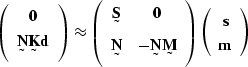 |
(3) |
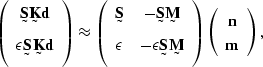 |
(4) |
 and
and  ,
,  and
and  being masks for the data describing
the known and missing data positions such that
being masks for the data describing
the known and missing data positions such that  ,where
  is the identity matrix.
An important additional
advantage of this extension to the previous inversions
is that data missing because of acquisition problems may also
be estimated.
Prediction filtering techniques have long been attempted in prestack
data
but have often failed because of missing data.
Using the predictions from systems (![[*]](http://sepwww.stanford.edu/latex2html/cross_ref_motif.gif) ) and ()
allows these missing traces to be predicted while producing results that
are not affected by missing traces that are
otherwise treated as valid data.
) and ()
allows these missing traces to be predicted while producing results that
are not affected by missing traces that are
otherwise treated as valid data.