


One problem with noise removal by filtering is that the response
of the noise to the filter is left in the signal.
As an example, consider a model of the recorded data as the sum of
signal and noise, or  , where
  is the recorded data,
 is signal, and
  is noise.
If a signal-prediction filter
is noise.
If a signal-prediction filter  is calculated from the data such that
 ,and the noise is assumed to be what is left after the filter is applied,
 ,is inconsistent with the original model of .Instead the output of the filter is
  , since
  ,assuming that
  .
.
An alternative to accepting this filtering result
is to set up the problem as a matrix inversion.
If the signal is predicted by a filter , such that  ,the noise is predicted by a filter
  , such that
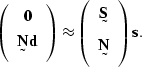
  ,and the recorded data is a sum of the signal and noise, ,then the signal may be predicted with a system of regressions such as
 |
(1) |
and have been previously calculated.
Since and are not available before system (![[*]](http://sepwww.stanford.edu/latex2html/cross_ref_motif.gif) ) is solved,
and must be approximated somehow from the available data.
In most of the cases in this thesis, can be calculated by
assuming the noise is unpredictable laterally or that may be
calculated from some subset of the full dataset.
may be calculated from some subset of the full dataset where
the noise is expected to dominate.
) is solved,
and must be approximated somehow from the available data.
In most of the cases in this thesis, can be calculated by
assuming the noise is unpredictable laterally or that may be
calculated from some subset of the full dataset.
may be calculated from some subset of the full dataset where
the noise is expected to dominate.
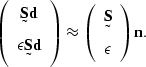
If is difficult to estimate, or if the noise is unpredictable,
an alternative to the previous system of regressions is
 |
(2) |
.
The calculated signal in this case is  .Here the assumption is made that the actual noise is close to the
noise predicted by the prediction filtering process.
.Here the assumption is made that the actual noise is close to the
noise predicted by the prediction filtering process.