


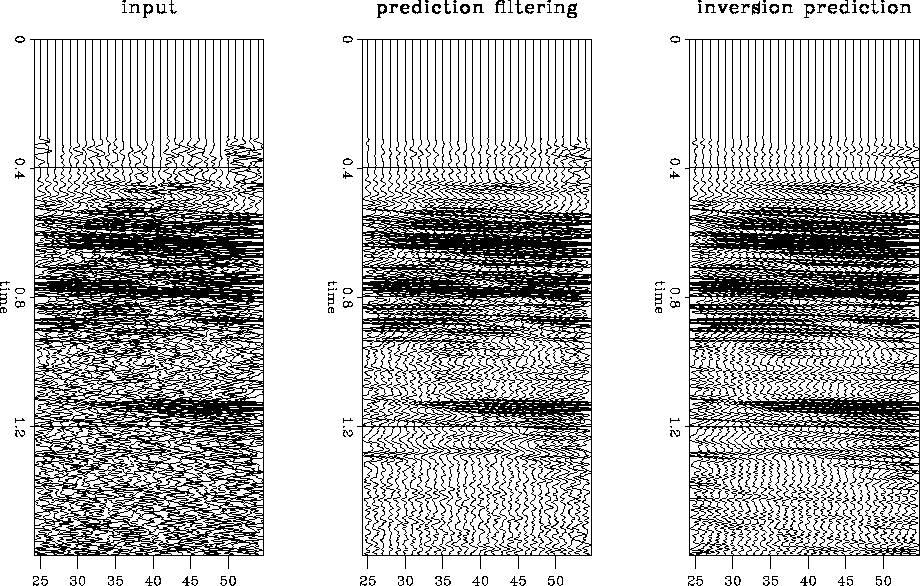
Real data processed with the prediction prediction show results similar to the synthetic examples. It is difficult to confirm which result is better without independent information. Wavelet distortion is difficult to recognize in complex real data. Even so, the reflection amplitudes appear to be improved on the inversion prediction results when compared to the prediction-filtering results.
The first section in Figure ![[*]](http://sepwww.stanford.edu/latex2html/cross_ref_motif.gif) shows the input,
a 2-dimensional line from a 3-dimensional survey.
The second section in Figure
shows the result of applying a prediction filter
to the data in the first panel.
The results are significantly better than the input.
The third section in Figure
show the results of the inversion prediction.
The amplitudes on the inversion results
are better preserved than the prediction-filter results.
It is difficult to judge whether the events between 1.2 and 1.6 seconds are
organized noise or weak reflections attenuated by the
t-x prediction filter,
but they are likely to be organized noise similar to that seen in the synthetic
examples.
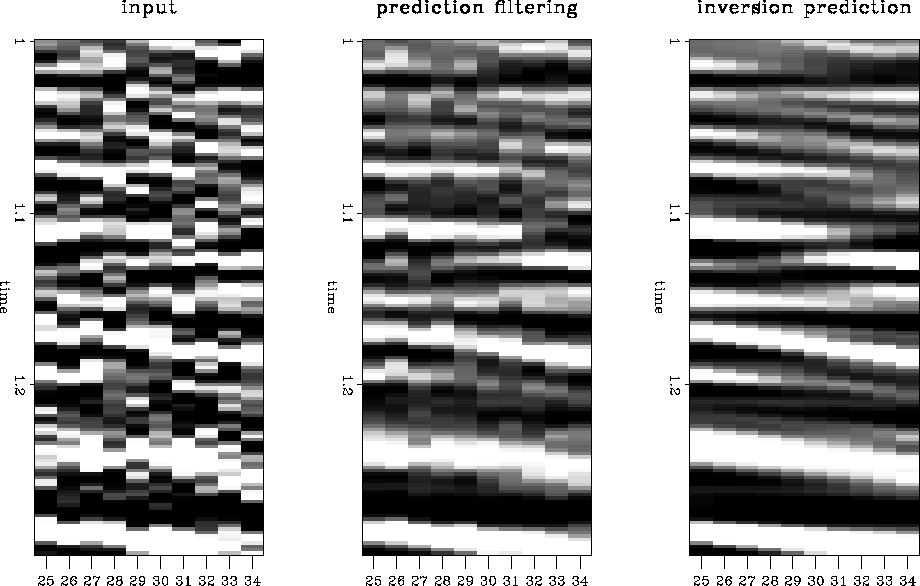
Figure shows a close-up of the data in Figure .
The results of the inversion prediction are more appealing than
the t-x prediction-filtering results.
shows the input,
a 2-dimensional line from a 3-dimensional survey.
The second section in Figure
shows the result of applying a prediction filter
to the data in the first panel.
The results are significantly better than the input.
The third section in Figure
show the results of the inversion prediction.
The amplitudes on the inversion results
are better preserved than the prediction-filter results.
It is difficult to judge whether the events between 1.2 and 1.6 seconds are
organized noise or weak reflections attenuated by the
t-x prediction filter,
but they are likely to be organized noise similar to that seen in the synthetic
examples.
Figure shows a close-up of the data in Figure .
The results of the inversion prediction are more appealing than
the t-x prediction-filtering results.
 |


 |