


Claerbout1992a presented a proof attributed to John Burg that shows a one-sided, or Burg, filter, when calculated to minimize the energy of a signal, will have a spectrum that is the inverse of the signal. Thus, when the filter is applied to the signal, the result is white. Claerbout extends this proof to a one-sided two-dimensional filter in his later workClaerbout (1995). These properties are useful in predicting the behavior of a filter, so it is with a certain reluctance that shapes other than the one-sided, or Burg, filters are used.
Nevertheless, other shapes have particular advantages. Claerbout's steep-dip deconvolutionClaerbout (1993) uses filters that allow the prediction and removal of steeply dipping events such as ground roll, but preserves reflections. The filter used in this case is a two-dimensional filter similar to the following:
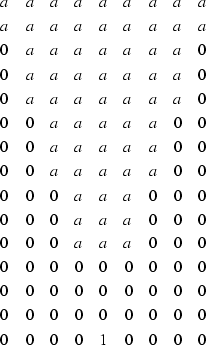 |
(59) |
 |
(60) |
Another example of a shaped filter is one that is often used in this thesis. This is that of a purely lateral prediction filter. Burg's two-dimensional filter
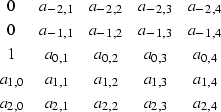 |
(61) |
![[*]](http://sepwww.stanford.edu/latex2html/cross_ref_motif.gif) )
is:
)
is:
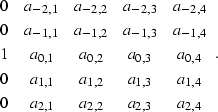 |
(62) |
Eliminating predictions from within a trace is important because the filter coefficients corresponding to prediction within a trace tend to overwhelm the predictions done from trace to trace. Also, since the assumption that signal is consistent from trace to trace has been made, only the trace-to-trace predictions are wanted. When doing these trace-to-trace, or purely lateral predictions, these intra-trace predictions are undesired, and so should be eliminated.
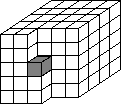
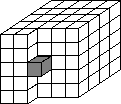
A three-dimensional version of Burg's filter appears in Figure .
The corresponding purely-lateral filter is shown in Figure .
Once again, the coefficients within the trace are eliminated.
 |


 |
Filtering with purely-lateral filters also brings up a fundamental difference between how the time axis and how the spatial axes are treated in seismic processing. Along the time axis, the unpredictable information is important, so predictable information, such as source wavelets and reverberations from multiple reflections are eliminated. Traditionally, this has been done by prediction-error filtering, or deconvolution. Along the spatial axes, the important information consists of predictable events, and unpredictable information is generally assumed to be noise. This difference comes from both the sedimentary character of most of the geology considered in seismic exploration and from the geometry of surface-seismic recording, where both the sources and detectors are at the surface. Any energy recorded that appears above a certain angle is evanescentClaerbout (1985) and does not contain information about the desired reflection events.
Changes to the filter shapes allows events to be predicted to
be separated better. As an example, in chapter ,
noise which is expected to be confined to a single trace
is predicted by one-dimensional
filters.
The signal, on the other hand, is predicted by a purely-lateral
two- or three-dimensional filter.
The success of the inversion depends on how well these differently
shaped filters predict the different phenomena.