![[pdf]](icons/pdf.png)
|
|
|
|
| Poroelastic measurements resulting in complete data sets for granular and other anisotropic porous media | |
|
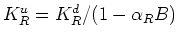
I was able to deduce  from our knowledge of
  ,
, 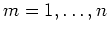 ,
,  , and
, and  in
subsection 2.2. But even though I am still assuming the system is isotropic, I have now
introduced some additional degrees of freedom by permitting the grains and pores to be heterogeneous.
It is clear that I cannot deduce if I just have the same amount of information as before.
In particular, it does seem fairly straightforward to measure , as I have already described
its meaning in the earlier discussion and even given formulas for it -- if I have information about
the constituents and their volume fractions, or alternatively about the principal components of elastic
compliance and/or stiffness matrices. But I have another variable now, which is the pore modulus
in
subsection 2.2. But even though I am still assuming the system is isotropic, I have now
introduced some additional degrees of freedom by permitting the grains and pores to be heterogeneous.
It is clear that I cannot deduce if I just have the same amount of information as before.
In particular, it does seem fairly straightforward to measure , as I have already described
its meaning in the earlier discussion and even given formulas for it -- if I have information about
the constituents and their volume fractions, or alternatively about the principal components of elastic
compliance and/or stiffness matrices. But I have another variable now, which is the pore modulus  ,
and this bulk modulus is not so easy either to model or to measure directly (Lockner and Stanchits, 2002). However, by adding one more piece of information --
namely the second Skempton coefficient
,
and this bulk modulus is not so easy either to model or to measure directly (Lockner and Stanchits, 2002). However, by adding one more piece of information --
namely the second Skempton coefficient
 ,
which is a fact that should typically be known in poroelastic systems --
then it turns out that I can solve for both and . Again, I assume that
and are known. But now I also assume that
,
which is a fact that should typically be known in poroelastic systems --
then it turns out that I can solve for both and . Again, I assume that
and are known. But now I also assume that  is also known experimentally.
Working through the algebra, I find that
is also known experimentally.
Working through the algebra, I find that
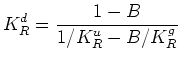 ],
and similarly that
to simplify
the final formula.
],
and similarly that
to simplify
the final formula.
These forms are very useful for many applications in poroelasticity, but so far they apply only to the fully isotropic case. I show next that a very similar set of formulas applies to the anisotropic cases under consideration. I am able to attain greater clarity at this point by switching to the more general anisotropic problem, where it can seen more easily how poroelastic reciprocity comes directly into play.
|
|
|
|
| Poroelastic measurements resulting in complete data sets for granular and other anisotropic porous media | |
|