 |
 |
 |
 | 3D shot-profile migration in ellipsoidal coordinates |  |
![[pdf]](icons/pdf.png) |
Next: Extrapolation Algorithm
Up: Shragge and Shan: Ellipsoidal
Previous: Relationship to elliptically anisotropic
A general approach to 3D implicit finite-difference propagation is to
approximate the square-root by a series of rational functions
(, )
 |
(A-11) |
where
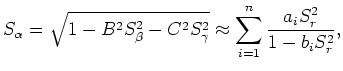 for
for
 , term
 , and
, and 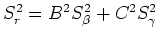 is the order of the
coefficient expansion. At this point, we do not address the
anisotropy generated by the
is the order of the
coefficient expansion. At this point, we do not address the
anisotropy generated by the  and
and  coefficients, as they can be
implemented through additional slowness model stretches.
coefficients, as they can be
implemented through additional slowness model stretches.
One procedure for finding an optimal set of coefficients is to solve
the following optimization problem (, ),:
![$\displaystyle {\rm min} \int_{0}^{{\rm sin} \phi} \left[ \sqrt{1-S_r^2} - \sum_{i=1}^{n} \frac{a_i S_r^2}{1 - b_i S_r^2} \right]^2 {\rm d}S_r,$](img72.png) |
(A-12) |
where 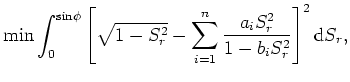 is the maximum optimization angle. We generated the
following results using a 4th-order approximation and coefficients
found in Table 1 (Lee and Suh, 1985).
is the maximum optimization angle. We generated the
following results using a 4th-order approximation and coefficients
found in Table 1 (Lee and Suh, 1985).
Table 1:
Coefficients used in 3D implicit finite-difference
wavefield extrapolation.
Coeff. order  |
Coeff.  |
Coeff.  |
| 1 |
0.040315157 |
0.873981642 |
| 2 |
0.457289566 |
0.222691983 |
|
Subsections
|
|
|
|
| 3D shot-profile migration in ellipsoidal coordinates | |
|
Next: Extrapolation Algorithm
Up: Shragge and Shan: Ellipsoidal
Previous: Relationship to elliptically anisotropic
2009-04-13