![[pdf]](icons/pdf.png)
|
|
|
|
| Exact seismic velocities for TI media and extended Thomsen formulas for stronger anisotropies | |
|
Thomsen's weak anisotropy formulation (Thomsen, 1986), being a collection of approximations
designed specifically for use in velocity analysis for exploration geophysics,
is clearly not exact. Approximations incorporated into the formulas
become most apparent for angles  greater than about 15
 from the vertical,
especially for compressional and vertically polarized shear wave velocities
from the vertical,
especially for compressional and vertically polarized shear wave velocities
 and
and
 , respectively. For VTI media, angle is
measured from the
, respectively. For VTI media, angle is
measured from the  -vector pointing directly into the earth.
For reference purposes, I include here the exact velocity formulas for;
quasi-P, quasi-SV, and SH seismic waves at all angles in a VTI elastic medium.
These results are available in many places
(Postma, 1955; Musgrave, 1959, 2003; Rüger, 2002; Thomsen, 2002),
but were taken directly from Berryman (1979)
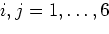
with only some minor changes of notation; specifically, the  ,
, ,
, ,
, ,
, ,
, notation for stiffnesses
has been translated to the Voigt
notation for stiffnesses
has been translated to the Voigt  stiffness notation wherein
  ,
,  ,
,
 ,
,  ,
,  , and
, and  . The results are:
 and
and
 are closely related since they are actually
the two solutions of a quadratic equation having the form:
are closely related since they are actually
the two solutions of a quadratic equation having the form:
 should be made consistently for both
  and
and  .
.
For VTI symmetry, the stiffness matrix is defined for
 by
by
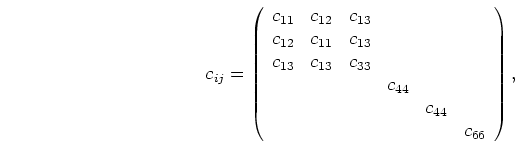 .
In an isotropic system (which is a more restrictive case than our current
interests),
.
In an isotropic system (which is a more restrictive case than our current
interests),
 ,
,
 ,
and
,
and
 , where
  and
and  are
the usual Lamé constants. The definition in equation 6 makes use of the Voigt notation,
i.e.,
are
the usual Lamé constants. The definition in equation 6 makes use of the Voigt notation,
i.e.,  matrix instead of 4th order tensor,
wherein Voigt single indices
matrix instead of 4th order tensor,
wherein Voigt single indices
 correspond to the pairs of tensor
indices 11,22,33,23,31,12, respectively.
And it relates stress
correspond to the pairs of tensor
indices 11,22,33,23,31,12, respectively.
And it relates stress  to strain
  via
via
 ,
,
 ,
,
 , and
, and
 (no summation over repeated indices is assumed here) for
  . For VTI symmetry,
we typically take
. For VTI symmetry,
we typically take  (the vertical) as the axis of symmetry. But, for
HTI symmetry, we may choose index direction
(the vertical) as the axis of symmetry. But, for
HTI symmetry, we may choose index direction  to be some other physical
direction (such as horizontal directions
to be some other physical
direction (such as horizontal directions  or
or  , or some linear
combination thereof); having done this, equations 2-4 apply strictly only in
the vertical plane perpendicular to the fracture plane, while a small amount of
vector analysis is then required to obtain the velocity values at all azimuthal angles
, or some linear
combination thereof); having done this, equations 2-4 apply strictly only in
the vertical plane perpendicular to the fracture plane, while a small amount of
vector analysis is then required to obtain the velocity values at all azimuthal angles
 away from the fracture plane.
Expressions for phase velocities in Thomsen's weak anisotropy
limit can be found in many places, including Thomsen (1986, 2002)
and Rüger (2002).
The pertinent expressions for phase velocities in VTI media
as a function of angle ,
measured as previously mentioned from the vertical direction, are
 ,
and
,
and
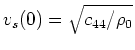 , where
 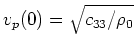 ,
,  , and
, and  are two stiffnesses of the cracked medium and the mass density of the isotropic
host elastic medium. [For the specific physical examples that follow involving models
of fractured reservoirs, I assume that the cracks contain insufficient volume
to affect the overall mass density significantly.]
The three Thomsen (1986) seismic
parameters appearing in equations 7-9 for weak anisotropy with VTI symmetry are
are two stiffnesses of the cracked medium and the mass density of the isotropic
host elastic medium. [For the specific physical examples that follow involving models
of fractured reservoirs, I assume that the cracks contain insufficient volume
to affect the overall mass density significantly.]
The three Thomsen (1986) seismic
parameters appearing in equations 7-9 for weak anisotropy with VTI symmetry are
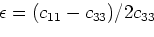
 ,
,
 ,
and
,
and
 is a measure of the shear wave anisotropy and birefringence.
Parameter
is a measure of the shear wave anisotropy and birefringence.
Parameter  is a measure of the quasi-P wave anisotropy.
Parameter
is a measure of the quasi-P wave anisotropy.
Parameter  controls the complexity of the shape of the wave fronts for
quasi-P and quasi-SV waves; e.g., when
controls the complexity of the shape of the wave fronts for
quasi-P and quasi-SV waves; e.g., when
 the wave fronts are
elliptical in shape, whereas for all TI anisotropic systems having
the wave fronts are
elliptical in shape, whereas for all TI anisotropic systems having
 ,
the wave front will deviate from being elliptical, and it is in such cases that ray
arrival triplications may occur.
,
the wave front will deviate from being elliptical, and it is in such cases that ray
arrival triplications may occur.
All three of these parameters , , can play important
roles in the velocities given by equations 7-9
when the anisotropy is large, as would be the case in fractured reservoirs when the
crack densities are high enough. If crack densities are very low, then the SV shear wave will
actually have no dependence on angle of wave propagation. Note that the
so-called anellipticity parameter (Dellinger et al., 1993; Fomel, 2004; Tsvankin, 2005, p. 253),
 , vanishes when
 --
which (as will be shown) does happen to a very good approximation for low crack densities.
Then, the results are anisotropic but have the special (elliptical) shape to the wave front
mentioned previously.
--
which (as will be shown) does happen to a very good approximation for low crack densities.
Then, the results are anisotropic but have the special (elliptical) shape to the wave front
mentioned previously.
For each of these phase velocities, the derivation of Thomsen's approximation has
included a step that removes the square on the left-hand side of equations
1, 2, and 4 --
obtained by expanding a square root of the right hand side. This step introduces a
factor of  multiplying the
  terms on the right
hand side, and -- for example -- immediately explains how equation 8
is obtained from equation 4. The other two equations for and
, i.e.,
equations 7 and 8,
involve additional approximations. More of the details about the nature of these
approximations are elucidated by first obtaining an alternative approximate formulation.
terms on the right
hand side, and -- for example -- immediately explains how equation 8
is obtained from equation 4. The other two equations for and
, i.e.,
equations 7 and 8,
involve additional approximations. More of the details about the nature of these
approximations are elucidated by first obtaining an alternative approximate formulation.
|
|
|
|
| Exact seismic velocities for TI media and extended Thomsen formulas for stronger anisotropies | |
|
![\begin{displaymath}
v_p^2(\theta) = \frac{1}{2\rho}\left\{\left[\left(c_{11}+c_{...
...t(c_{33}+c_{44}\right)\cos^2\theta\right]
+ R(\theta)\right\}
\end{displaymath}](img37.png)
![\begin{displaymath}
v_{sv}^2(\theta) = \frac{1}{2\rho}\left\{\left[\left(c_{11}+...
...(c_{33}+c_{44}\right)\cos^2\theta\right]
- R(\theta)\right\},
\end{displaymath}](img38.png)
![\begin{displaymath}
R(\theta) = \sqrt{\left[\left(c_{11}-c_{44}\right)\sin^2\the...
...t]^2
+ 4\left(c_{13}+c_{44}\right)^2\sin^2\theta\cos^2\theta}
\end{displaymath}](img39.png)
![\begin{displaymath}
v_{sh}^2(\theta) = \frac{1}{\rho}\left[c_{44}
+ (c_{66}-c_{44})\sin^2\theta\right].
\end{displaymath}](img40.png)


\sin^2\theta\cos^2\theta\right),
\end{displaymath}](img68.png)