


![[pdf]](icons/pdf.png)
|
|
|
|
| Exact seismic velocities for TI media and extended Thomsen formulas for stronger anisotropies | |
|
Thomsen's weak anisotropy formulation (Thomsen, 1986) was originally designed for
media having vertical transversely isotropic (VTI) symmetry, but clearly applies equally well
to any other TI media (for example HTI) with only very minor technical changes related to
how the orientation of the axis of symmetry is labelled in Cartesian coordinates.
This formulation is also independent of the natural mechanism producing the anisotropy,
whether it be due to layering, or horizontal fractures, or randomly oriented vertical
fractures, or some other source.
So the method has wide applicability for use in exploration problems. However, when
the approximate results of the Thomsen's original formulation are compared to known exact results for the
same VTI media, it is easy to see that there are some deficiencies. In particular,
for VTI media, the vertically polarized (SV) shear wave will always have a peak
(or possibly a trough, for some fairly rare types of anisotropic media)
somewhere in the range
 . Thomsen's weak anisotropy
formulation always puts this extreme point (either minimum or maximum)
exactly at
. Thomsen's weak anisotropy
formulation always puts this extreme point (either minimum or maximum)
exactly at
 . However, as I show here, the
 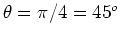 angular location never actually occurs for any interesting degree of VTI anisotropy; instead
 (by which I mean the extreme point approaches but never reaches
 ) for extremely weak anisotropy -- e.g., very low horizontal crack density is one
example of this. In an effort to determine whether it might be possible to improve
on Thomsen's approximation, I have found that a relatively
small modification of Thomsen's formulas places the extreme
) for extremely weak anisotropy -- e.g., very low horizontal crack density is one
example of this. In an effort to determine whether it might be possible to improve
on Thomsen's approximation, I have found that a relatively
small modification of Thomsen's formulas places the extreme  point at nearly the right
angular location, and also typically (though not universally) improves the overall fit of both
point at nearly the right
angular location, and also typically (though not universally) improves the overall fit of both
 and
and  to the exact VTI curves. The ultimate cost of this
improvement is negligible since the data required to estimate the location of the extreme point are
exactly the same as the data used to determine Thomsen's other parameters for weak anisotropy.
The method can also be used with only minor technical modifications for media having horizontal
transversely isotropic (HTI) symmetry,
such as reservoirs having aligned vertical fractures. The paper focuses on the general theory
and uses other recent work relating fracture influence parameters (Sayers and Kachanov, 1991;
Berryman and Grechka, 2006) to provide some useful examples of the applicability of the new method.
Other choices of the various possible applications of the new method will appear in later publications.
to the exact VTI curves. The ultimate cost of this
improvement is negligible since the data required to estimate the location of the extreme point are
exactly the same as the data used to determine Thomsen's other parameters for weak anisotropy.
The method can also be used with only minor technical modifications for media having horizontal
transversely isotropic (HTI) symmetry,
such as reservoirs having aligned vertical fractures. The paper focuses on the general theory
and uses other recent work relating fracture influence parameters (Sayers and Kachanov, 1991;
Berryman and Grechka, 2006) to provide some useful examples of the applicability of the new method.
Other choices of the various possible applications of the new method will appear in later publications.
The main result of the
paper -- from which all the subsequent results follow -- is a new, more compact, and
more intuitive way of writing the quantity  [appearing here in
equation 12]. This quantity has its extreme value at almost the same location as
that of the quasi-SV-wave phase velocity, and this angular location is very easy to
determine.
[appearing here in
equation 12]. This quantity has its extreme value at almost the same location as
that of the quasi-SV-wave phase velocity, and this angular location is very easy to
determine.
The following section reviews the standard results for wave speeds in a VTI
medium, and also presents the Thomsen weak anisotropy results. The next
section presents the analysis leading to the extended (i.e., improving on Thomsen) anisotropy formulation,
which allows the wave speed formulas to reflect more accurately the correct
behavior near the extremes (greatest excursions from the values at normal incidence
and near horizontal incidence). Then, the next section shows how to determine the value of
 (the incidence angle that determines where the extreme
  -wave behavior occurs) from
the same data already used in Thomsen's formulas. Furthermore, normal moveout corrections are
recomputed for the new formulation, and it is found that the results are identical
to those for Thomsen formulation; thus, no new corrections are needed near normal
incidence. Finally, to illustrate the results, models of VTI and HTI reservoirs having vertical fractures
are computed using the new wave speed formulation and compared to prior results.
Appendix A computes the quasi-SV-wave speed at
-wave behavior occurs) from
the same data already used in Thomsen's formulas. Furthermore, normal moveout corrections are
recomputed for the new formulation, and it is found that the results are identical
to those for Thomsen formulation; thus, no new corrections are needed near normal
incidence. Finally, to illustrate the results, models of VTI and HTI reservoirs having vertical fractures
are computed using the new wave speed formulation and compared to prior results.
Appendix A computes the quasi-SV-wave speed at
 exactly, and also at two
levels of approximation in order to have values to check against the corresponding results in the
main text. Appendix B discusses how to get HTI results simply and directly from VTI results,
both for the exact wave speeds and for the new approximate wave speed formulas.
The final section of the main text presents an overview and suggests some possible applications of the
results.
exactly, and also at two
levels of approximation in order to have values to check against the corresponding results in the
main text. Appendix B discusses how to get HTI results simply and directly from VTI results,
both for the exact wave speeds and for the new approximate wave speed formulas.
The final section of the main text presents an overview and suggests some possible applications of the
results.
|
|
|
|
| Exact seismic velocities for TI media and extended Thomsen formulas for stronger anisotropies | |
|