


![[pdf]](icons/pdf.png)
|
|
|
|
| |
|
In this section I introduce the seismic line I use to test the apex-shifted Radon
transform. The line is from the Gulf of Mexico and was shot over a large salt body.
The presence of the salt creates
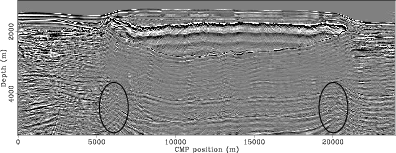
a host of multiples that obscure any genuine subsalt reflections, as shown in the
angle stack of Figure 14.
Most multiples are surface-related peg-legs with a leg
related to the water bottom, shallow reflectors or the top of salt. Below
the edges of the salt
we also encounter diffracted multiples ( , CMP position
6000 m below 4000 m depth in Figure 14).
, CMP position
6000 m below 4000 m depth in Figure 14).
|
|---|
|
angle-stack
Figure 14. Angle stack of migrated ADCIGs of 2D seismic line in the Gulf of Mexico. Notice that multiples below the salt obscure any primary reflections. The ovals highlight diffracted multiples. |
|
|
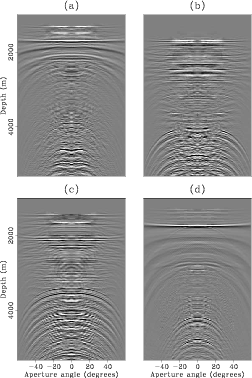
Figure 15 shows four ADCIGs obtained with wave-equation
migration as described by ().
Notice that although the data is marine, the ADCIGs show positive and negative
aperture angles. I used reciprocity to simulate negative offsets and interpolation
to compute the two shortest-offset traces not present in the
original data. The CMP gathers were then migrated and converted to angle gathers.
The purpose of having both positive and negative aperture angles is
to see more clearly the position of the apexes of the diffracted multiples.
The top two ADCIGs correspond to lateral positions directly below the
edges of the salt body (CMP positions 6744 m and 22056 m in
Figure 14). Notice how the apexes of the diffracted multiples
are shifted away from zero aperture angle (, the seagull-looking
event at about 4600 m in panel (a)).
For comparison, the bottom panels in Figure 15 show two ADCIGs that do
not have diffracted multiples. Figure 15(c) corresponds to an ADCIG below
the sedimentary section (CMP 3040 m in Figure 14) and
Figure 15(d) to an ADCIG below the salt body (CMP position 12000
m in Figure 14). In these ADCIGs all the multiples are
specularly-reflected and thus have their apexes at zero aperture angle.
|
|---|
|
cags
Figure 15. Angle domain common image gathers. (a) under the left edge of the salt, CMP at 6744 m; (b) under the right edge of the salt, CMP at 22056 m; (c) below the sedimentary section, CMP at 3040; (d) below the salt body, CMP at 12000 m. |
|
|
|
|
|
|
| |
|