


Geophysical RIP acts along the 25#25 (or angle) axis, therefore it may affect any amplitude variation with angle (AVA) that should exist due to rock properties rather than illumination problems. Although it is technically possible to extract information about rock properties from the actual magnitude of the amplitudes for a given event, generally AVA analysis is more concerned with the trend of the amplitude variation along the event. In this section, I will use a simple synthetic model to examine the effect of geophysical RIP on AVA trends.
The synthetic model used here is a simple 4 flat layer model, with
different velocity contrasts at each of the three interfaces
![[*]](http://sepwww.stanford.edu/latex2html/cross_ref_motif.gif) .
The velocity for the top layer is 1.5 km/s, the second layer is
1.75 km/s, the third layer is 2.5 km/s and the deepest layer is
3.75 km/s. I created the synthetic data for this model with finite
difference modeling.
.
The velocity for the top layer is 1.5 km/s, the second layer is
1.75 km/s, the third layer is 2.5 km/s and the deepest layer is
3.75 km/s. I created the synthetic data for this model with finite
difference modeling.
|
ampvel
Figure 23 Velocity model to test the effect of geophysical RIP on AVA. | 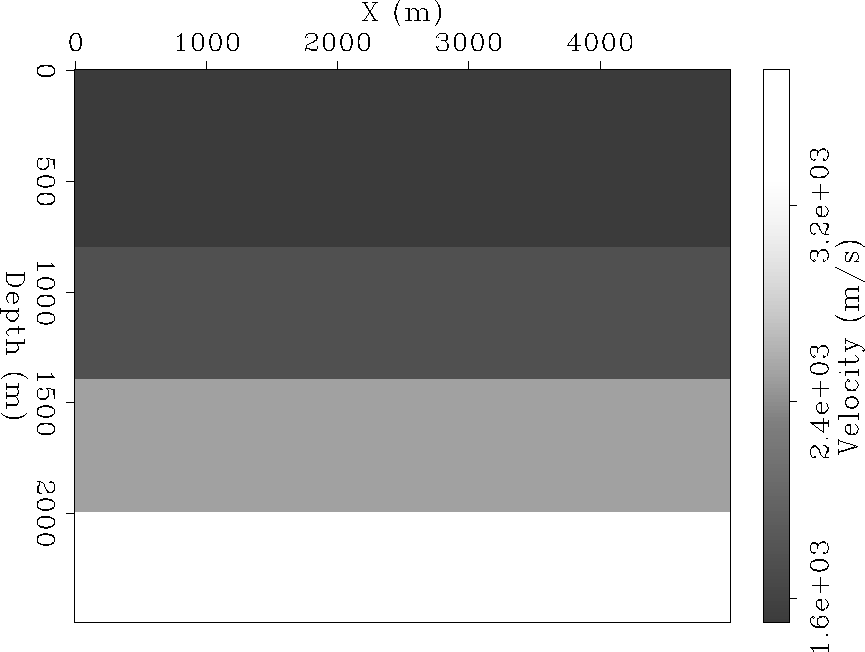 |


For this simple model, it is clear that we have no illumination problems. There is no need to use RIP at all. Applying geophysical RIP can only affect the AVA, without improving the image at all. Therefore, this model is a ``worst case scenario'' for the geophysical RIP scheme.
Effects of migration operator
I first investigated the effects of my downward-continuation migration
operator on the AVA. I migrated the synthetic data using the correct
velocity model and extracted my calculated amplitudes along each of the
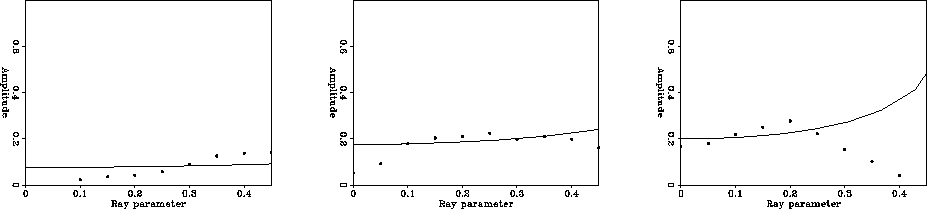
three interfaces. These results can be seen in Figure .
In each of the panels, the solid line represents the theoretical AVA values
(calculated following the example of ()) and the dots show
the AVA values obtained after migration. The horizontal axis is shown in
offset ray parameter (ph).
Based on the relationship in equation (), the range
of opening angles for the shallowest interface (left panel of
Figure ) is 68#68, the range
for the second interface (center panel of Figure )
is 69#69, and the range for the deepest interface
(right panel of Figure ) is 70#70.Overall, the results for each of the
three interfaces are good. The calculated values for the second
and third interfaces are not as consistent as the shallowest
interface, partly due to the presence of more migration artifacts
at depth. In the case of the deepest interface, it is also an effect
of the survey geometry: we cannot
expect the deep event to have reliable amplitude information at large
ph (larger than an opening angle of 36o) because the
common midpoint and offset ranges of the seismic data are limited,
so energy reflecting at large angles from the deep event are lost.
Additionally, I have neglected the 71#71weighting factor explained by () and (),
so the amplitudes after migration should have a stronger upward trend
than theoretically expected.
However, the overall trends of all of the calculated AVA values are fairly
accurate.
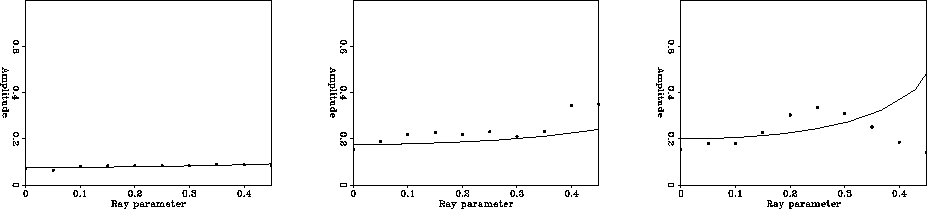 |
, center panel for the second interface, and
right panel for the deepest interface. The
solid line shows the theoretical value and the dots show the values
obtained from the image after downward-continuation migration.
Effects of RIP
Having obtained satisfactory AVA results with my downward-continuation
migration operator, I moved on to test my geophysically Regularized Inversion
with model Preconditioning (RIP). For this test, I set 40#40 to
zero. Although this essentially sets the model styling goal of
fitting goals () to zero, I am preconditioning the
problem so I am still regularizing the inversion
through the 72#72 in the data fitting goal. Using this formulation,
I ran tests using 5, 10 and 15 iterations. The results after 5 iterations
can be seen in
Figure .
The results after 10 iterations are shown in Figure
and the results after 15 iterations are shown in
Figure .
For all three exercises, we notice that the shallowest interface (left panels) has developed an artificial increasing trend. This is partly due to an edge effect at the small ph, and partially due to the effects of the regularization. It is more pronounced for this interface because the true AVA trend is expected to be almost flat. The edge effect at small ph is present for the other two interfaces as well.
Looking at the results for the second interface (center panels of
Figures
through ), it appears that our results
after regularized inversion are more accurate than the result we saw
from the migration (center panel of Figure ).
For the second interface, other than the edge effect at small ph,
the AVA trend is quite accurate after 5, 10 and 15 iterations.
The best result for the second interface appears to be that after
10 iterations. The result after 15 iterations is deteriorating
slightly as the inversion is trying harder to accommodate artifacts that
exist in the data.
The results for the deepest interface (right panels of
Figures through )
are also better than the result from the migration (right panel of
Figure ). They have the same problems at
large ph due to survey geometry, and have the edge effect
at small ph seen for the other interfaces, but the AVA trend
between these two extremes is close to the expected trend. Due to the
known problem at large ph, I have actually chosen to
turn the regularization operator off halfway along the ph
axis to keep the inversion from spending all of its effort trying to
correct the sudden decrease in amplitude. Once again,
it seems that the AVA trend in the result after 10 iterations is the
best.
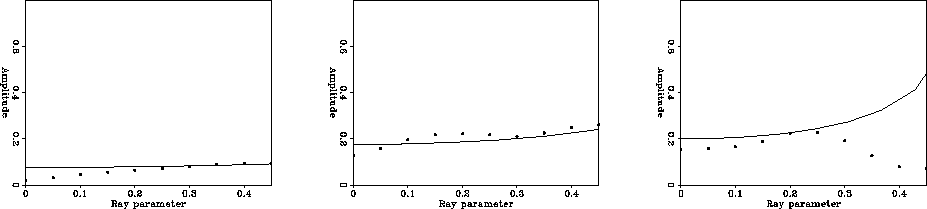 |
, center panel for the second interface, and
right panel for the deepest interface. The
solid line shows the theoretical value and the dots show the values
obtained after inversion.
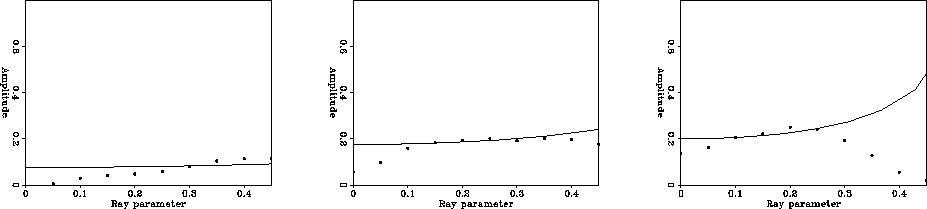 |
, center panel for the second interface, and
right panel for the deepest interface. The
solid line shows the theoretical value and the dots show the values
obtained after inversion.
 |
, center panel for the second interface, and
right panel for the deepest interface. The
solid line shows the theoretical value and the dots show the values
obtained after inversion.
The geophysical RIP scheme does affect the amplitudes along the ph axis, but it can be designed in a way that does not destroy the AVA information. If AVA analysis is desired, the strength of regularization and the number of iterations becomes even more important than if we are just concerned with imaging. Since geophysical RIP is most useful where illumination problems exist, the choice of regularization strength and the number of iterations becomes a balancing act between compensating for the poor illumination which interferes with AVA analysis and preserving the AVA trends.