


It is clear that the
geological inversion is strongly dependent on the regularization operator.
Since this operator may be constructed from picked reflectors, it is important
to know what happens if the reflector is not picked well. To examine this,
I created a regularization operator from the ``reflectors'' picked in
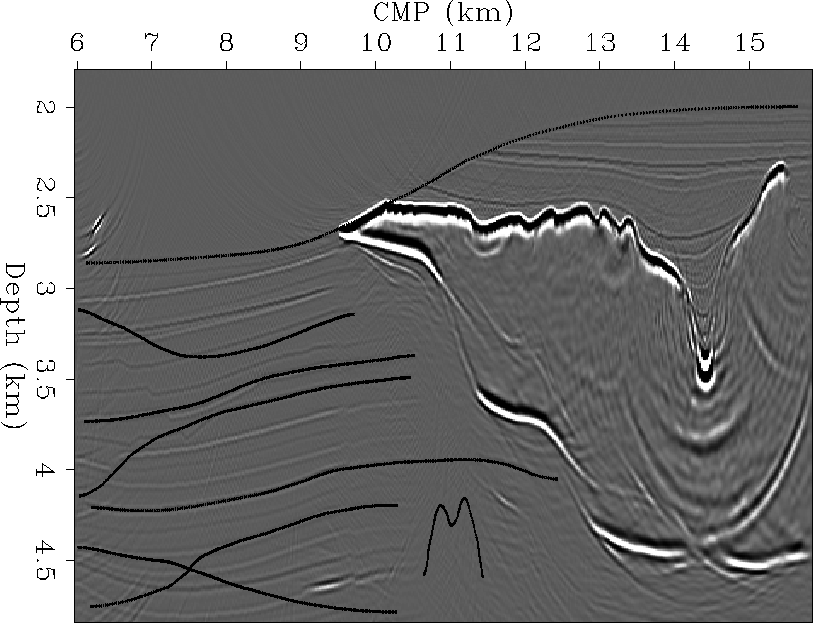
Figure ![[*]](http://sepwww.stanford.edu/latex2html/cross_ref_motif.gif) . In this figure, note that the picked reflectors
cross the correct dips at the depths between 3 and 3.4 kilometers and 3.7
and 4.1 kilometers. They cross themselves at depth 4.5 kilometers. The
picked reflector beginning at depth 3.75 km follows the correct dip for
the most part, but ignores the slight change in dip at the fault at CMP position
7.2 km. The water bottom has been correctly picked. The picked reflector
beginning at depth 4.2 km follows the correct dip, but continues well into
the shadow zone where it may or may not be correct. Also within the shadow
zone is a completely absurd picked reflector put there to see if any event
can be created there. Finally, note that the top and bottom of the salt
have not been picked at all. This will leave the preconditioning operator
in the salt area to be interpolated from the picked reflectors. In this
section, I will refer to the dips and reflectors from the migration result
as ``real'' or ``correct'' and the dips and reflectors used for the
inversion as ``picked.''
. In this figure, note that the picked reflectors
cross the correct dips at the depths between 3 and 3.4 kilometers and 3.7
and 4.1 kilometers. They cross themselves at depth 4.5 kilometers. The
picked reflector beginning at depth 3.75 km follows the correct dip for
the most part, but ignores the slight change in dip at the fault at CMP position
7.2 km. The water bottom has been correctly picked. The picked reflector
beginning at depth 4.2 km follows the correct dip, but continues well into
the shadow zone where it may or may not be correct. Also within the shadow
zone is a completely absurd picked reflector put there to see if any event
can be created there. Finally, note that the top and bottom of the salt
have not been picked at all. This will leave the preconditioning operator
in the salt area to be interpolated from the picked reflectors. In this
section, I will refer to the dips and reflectors from the migration result
as ``real'' or ``correct'' and the dips and reflectors used for the
inversion as ``picked.''
 |


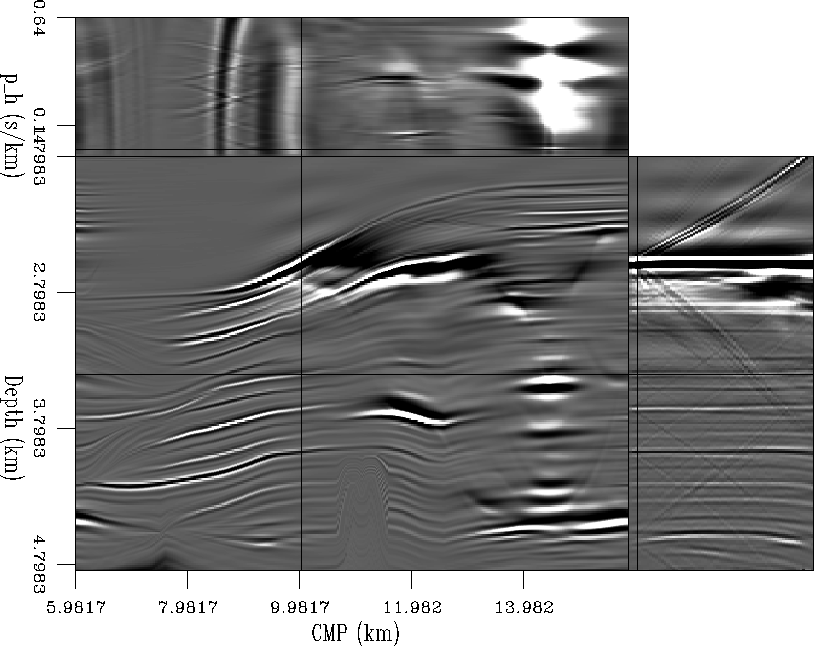
The result of using this regularization operator for geological RIP
is seen in Figure . As expected, the result isn't
good. In the areas where the picked dips were considerably wrong, such
as at the left side between 3 and 3.4 kilometers and 3.7 and 4.1 kilometers,
there are almost no events at all in the result. This is also true
for the ``M'' shaped picked reflector in the shadow zone area. In these
areas, the data fitting goal from equation () has rejected
the attempted regularization, essentially canceling out all of the image.
However, elsewhere in the shadow zone, where the picked dips are
reasonable, there is good continuation of the real events underneath
the salt.
In the area where the picked reflectors cross, there is a similar canceling
of energy, but it is reassuring to see that the inversion has handled the
crossing dips without becoming unstable. Finally, it is clear that
not picking the salt boundaries has caused major problems. Since no
picked dips were provided in the area of the salt, the steering filter
interpolated the dip of the water bottom down through this region. The
result shows strong events where the dip of the water bottom is similar to
that of the salt boundaries, but very low energy elsewhere, once again
due to the rejection of the regularization by the data fitting goal.
 |
This experiment showed that the
inversion will reject dips that are incorrectly picked where data exists.
The data fitting goal ()
assures that picked dips that generate an event which
interferes with the data are rejected. Picked dips that generate an event
that doesn't interfere with existing data are allowed. Picked dips that
cross, or meet at a point can be accommodated by the inversion. It is
necessary to pick reflectors wherever the dominant dip changes.