Next: RIP in practice
Up: Regularized least-squares inversion
Previous: Regularization schemes and operators
The model regularization schemes I am proposing are designed to
compensate for the seismic energy that is lost due to complex
subsurfaces. Much of the energy is lost because it is directed
outside of the bounds of the seismic survey. The regularized
model is in essence expanding the data space through the data fitting goal
(![[*]](http://sepwww.stanford.edu/latex2html/cross_ref_motif.gif) ). To demonstrate this, I use the simple synthetic dataset
with a single reflector below a low velocity lens. The velocity model
can be seen in Figure and the result of
downward-continuation migration is in Figure .
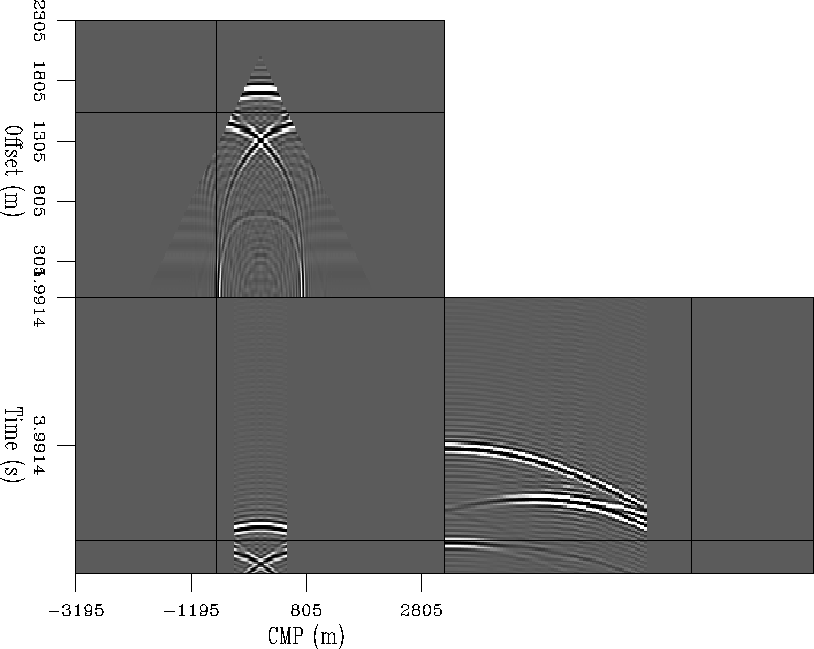
The actual synthetic
data can be seen in Figure . The data is displayed as a
flattened cube with a time slice at the top, a common offset panel in
the lower left and a common midpoint (CMP) gather in the lower right.
The triangular shape of the data as viewed in the time slice is caused
by the finite extents of the survey. The missing energy that has left
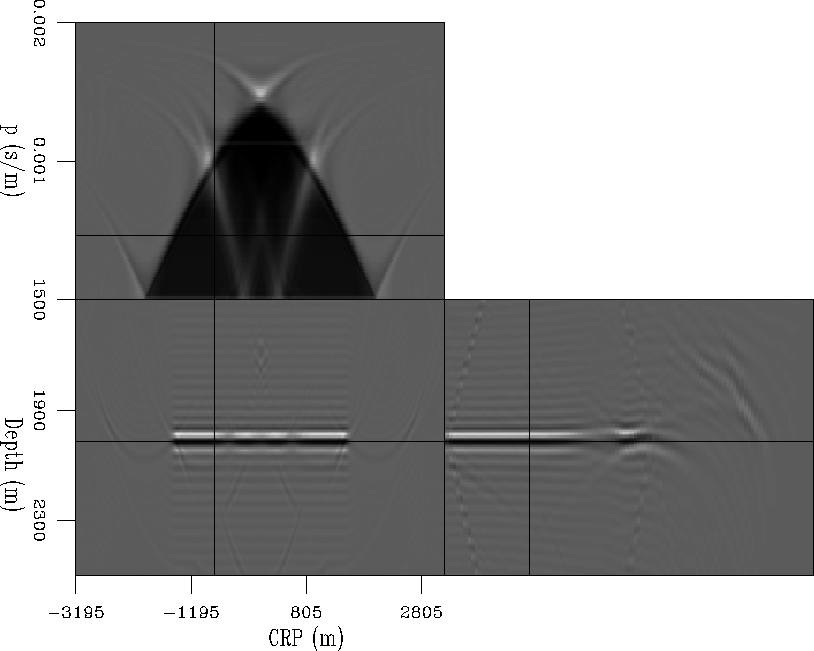
the bounds of the survey is manifested as holes in the CIGs as seen in the
migration result (Figure ). Theoretically, if the survey
was larger in extent, this energy would be recorded and the migration
would not have holes.
). To demonstrate this, I use the simple synthetic dataset
with a single reflector below a low velocity lens. The velocity model
can be seen in Figure and the result of
downward-continuation migration is in Figure .
The actual synthetic
data can be seen in Figure . The data is displayed as a
flattened cube with a time slice at the top, a common offset panel in
the lower left and a common midpoint (CMP) gather in the lower right.
The triangular shape of the data as viewed in the time slice is caused
by the finite extents of the survey. The missing energy that has left
the bounds of the survey is manifested as holes in the CIGs as seen in the
migration result (Figure ). Theoretically, if the survey
was larger in extent, this energy would be recorded and the migration
would not have holes.
dat.data
Figure 8 The recorded data corresponding to a
synthesized seismic survey over the velocity model in
Figure . The triangular shaped extent of the data seen in
the time slice (top) is caused by the limited survey geometry.


 symes.mig
Figure 9 The result of migrating the data in
Figure . Note the holes in the CIGs indicating
poor illumination caused by seismic energy being directed outside of the
survey area.
Regularized inversion with model preconditioning (RIP) tries to create a
model in which we compensate for the lost seismic energy. In this case,
we are in essence reconstructing the energy that leaves the survey bounds.
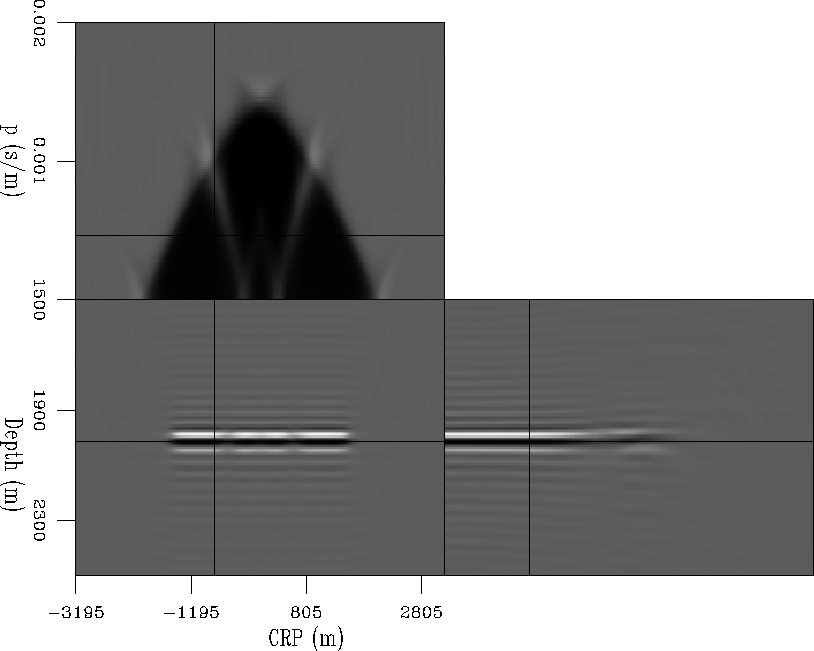
Performing 3 iterations of geophysical RIP fills in the holes in the CIGs
(Figure ). To examine the effects of this on the
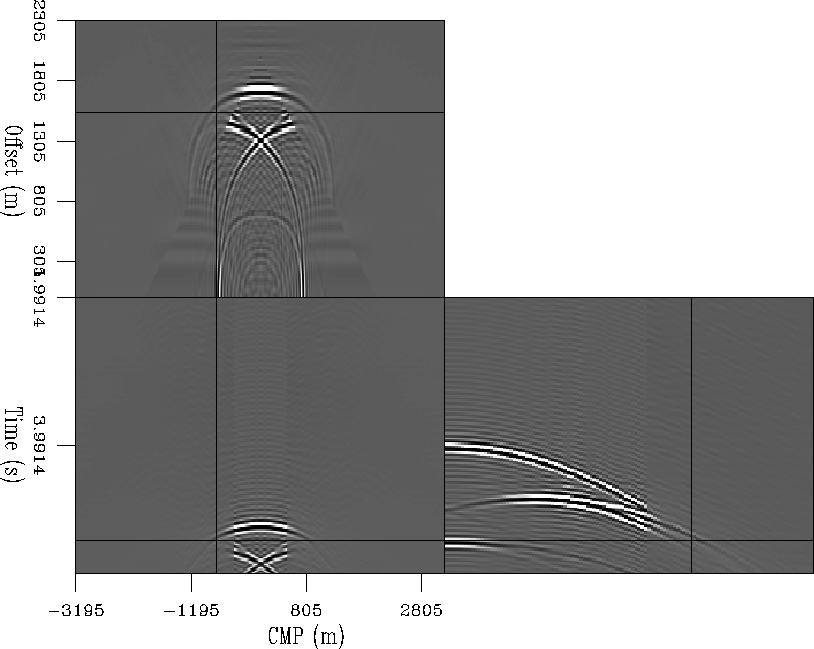
data space, we apply the adjoint of downward-continuation migration to
this result. Figure shows the data space
associated with the result of RIP. Comparing this with
Figure , the triangular shape of the original data is
still visible, but data has actually been extended beyond its original
extents, albeit at a lower amplitude. Hence, model regularization is
actually expanding the data space.
symes.1dprec3it
Figure 10 Result after 3 iterations of geophysical
RIP. The holes in the CIGs seen in Figure have been
largely filled in.
dat.data_extended.3it1eps
Figure 11 The ``expanded'' data after
3 iterations of geophysical RIP. The regularization of the model space
has filled in areas from which the seismic data was directed outside of
the survey area. This has ``extended'' the data beyond the limits seen
in Figure .
Next: RIP in practice
Up: Regularized least-squares inversion
Previous: Regularization schemes and operators
Stanford Exploration Project
10/31/2005