


Although the angle domain allows us to avoid multipathing, in complex media
it will still be plagued by problems such as poor illumination. Poor
illumination can be caused by energy being lost by leaving the survey area,
energy becoming evanescent at boundaries such as salt interfaces, and
focusing/defocusing caused by the complex overburden. In the angle domain,
energy leaving the survey may do so at some middle range of reflection
angles. Figure ![[*]](http://sepwww.stanford.edu/latex2html/cross_ref_motif.gif) demonstrates this with raytracing through
a simple
velocity model provided by The Rice Inversion Project. The maximum
offset recorded in this model is 3000 meters, so rays that are separated
by more than 3000 meters at the surface represent energy that is lost.
The velocity model
consists of one horizontal layer beneath a strong low velocity lens. It
is clear that some of the energy is leaving the bounds of the survey. This
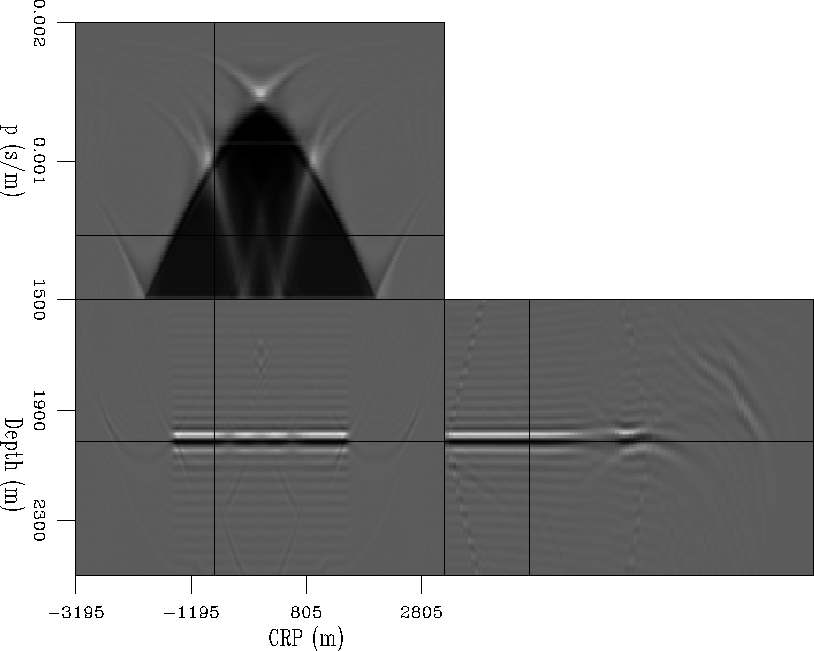
will result in the shadow zones in the common ray parameter section and the
holes in the angle domain CIG seen in Figure .
The poor illumination can be seen most clearly in the depth slice
(top panel of Fig. ). If there were no illumination problem,
the triangle would be solid black. The white streaks through the triangle
are caused by the lost energy.
demonstrates this with raytracing through
a simple
velocity model provided by The Rice Inversion Project. The maximum
offset recorded in this model is 3000 meters, so rays that are separated
by more than 3000 meters at the surface represent energy that is lost.
The velocity model
consists of one horizontal layer beneath a strong low velocity lens. It
is clear that some of the energy is leaving the bounds of the survey. This
will result in the shadow zones in the common ray parameter section and the
holes in the angle domain CIG seen in Figure .
The poor illumination can be seen most clearly in the depth slice
(top panel of Fig. ). If there were no illumination problem,
the triangle would be solid black. The white streaks through the triangle
are caused by the lost energy.
|
symesray
Figure 6 Raytracing through a velocity model with a strong low velocity lens. The maximum offset recorded in this model is 3000 meters, so rays that are separated by more than 3000 meters at the surface represent energy that is lost. | 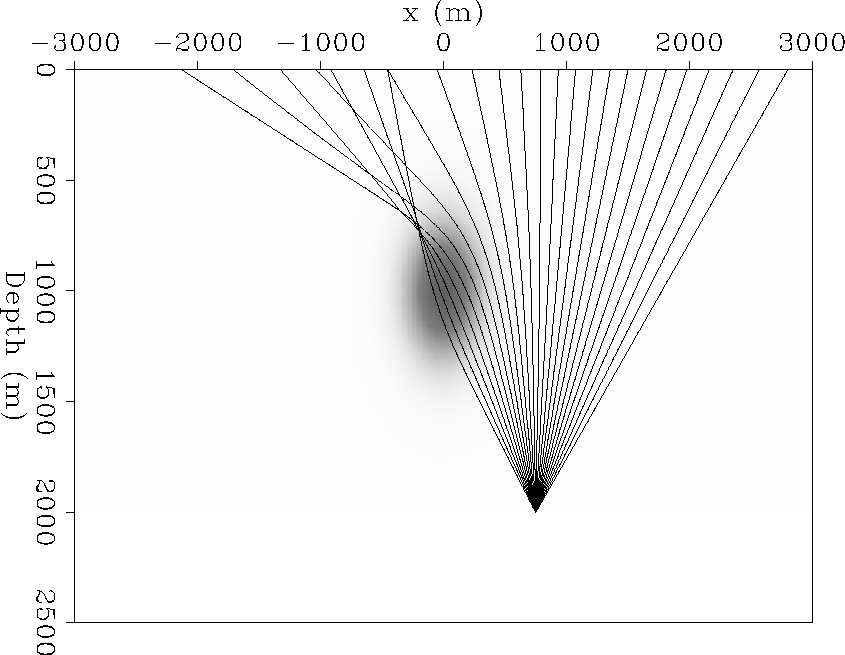 |


|
holey
Figure 7 Migration result from the velocity model shown in Figure . The common phx
section (left panel) has shadow zones positive and negative 600m in CRP.
The ADCIG (right panel) has clear ``holes'' in the
events caused by energy leaving the bounds of the survey, as demonstrated
by Figure . The depth slice (top panel) shows the
illumination problem as white streaks through the black triangle.
|  |