


 )is to take the image obtained with the background
slowness and improve it by applying an image enhancement
operator.
There are many techniques that can be used to obtain an
enhanced image.
)is to take the image obtained with the background
slowness and improve it by applying an image enhancement
operator.
There are many techniques that can be used to obtain an
enhanced image.
In principle, both focusing in space (along the midpoint axis) and focusing in offset are velocity indicators, and they should be used together to achieve the highest accuracy. In this paper, however, we emphasize migration velocity analysis using only focusing of diffractions along the spatial axes.
In our current implementation, we use prestack
Stolt residual migration Sava (2003); Stolt (1996)
as the image enhancement operator ( ).
This residual migration operator applied to the background image
creates new images (
).
This residual migration operator applied to the background image
creates new images ( ), functions of a scalar parameter (
 ),
which represents the ratio of a new slowness model relative
to the background one:
),
which represents the ratio of a new slowness model relative
to the background one:
![\begin{displaymath}
\r = {\bf K}\left(\rho \right)\left[\r_b \right]\;.\end{displaymath}](img37.gif) |
(8) |
) and the background image ( ):
):
 |
(9) |
and ,can get out of phase, such that they risk
violating the requirements of the first-order
Born approximation Sava and Biondi (2004a).
For example, we might end up subtracting unfocused
from focused diffractions at different locations in the image.
We address this challenge by using linearized image perturbations .
We run residual migration for a large number of parameters
and pick at every location the value where the image
is best focused. Then we estimate at every
point the gradient of the image relative to the parameter
and construct the image perturbations using the following relation:
![\begin{displaymath}
\Delta \r\approx \left. {\bf K}^{'} \right\vert _{\rho=1} \left[\r_b \right]\Delta \rho \;,\end{displaymath}](img40.gif) |
(10) |
 .
.
The main benefit of constructing image perturbations with
equation (10) is that we avoid the danger of subtracting
images that are out of phase. In fact, we do not subtract images
at all, but we simply construct the image perturbation that corresponds
to a particular map of residual migration parameters ().
In this way, we honor the information from residual migration,
but we are safe relative to the limits of the first-order Born
approximation.
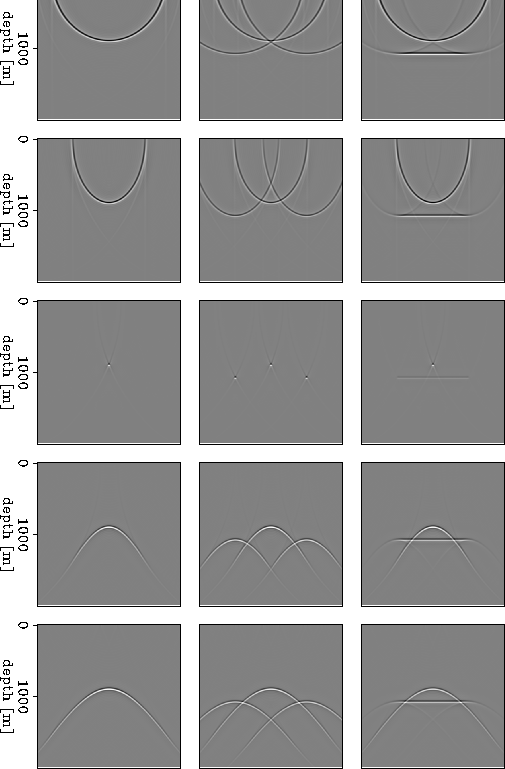
Figures 1 and 2 illustrate the migration velocity analysis methodology using residual migration and linearized image perturbations.
 |
 .The middle row corresponds to the correct velocity,
when all diffractors are focused.
.The middle row corresponds to the correct velocity,
when all diffractors are focused.

Figure 1 shows three simple models with diffractors and reflectors with a constant velocity v=2000 m/s. We use these three models to illustrate different situations: an isolated diffractor at location x=2000 m and depth z=900 m, (Figure 1, left), the same diffractor flanked by other diffractors at z=1100 m (Figure 1, middle), and finally the same diffractor next to a short reflector at z=1100 m (Figure 1, right).
We migrate each synthetic datum with an incorrect velocity, v=1800 m/s,
and then run residual migration with various velocity ratios
from  to
to  .From top to bottom, each row corresponds to a different velocity ratio
as follows: 0.7, 0.8, 0.9, 1.0, 1.1.
For all residual migration examples, we have eliminated the vertical
shift induced by the different velocities, such that only the
diffraction component of residual migration is left. Thus, we can better
compare focusing of various events without being distracted by their
vertical movement.
.From top to bottom, each row corresponds to a different velocity ratio
as follows: 0.7, 0.8, 0.9, 1.0, 1.1.
For all residual migration examples, we have eliminated the vertical
shift induced by the different velocities, such that only the
diffraction component of residual migration is left. Thus, we can better
compare focusing of various events without being distracted by their
vertical movement.
The images at  are the best focused images.
Since both the backgrounds and the perturbations
are constant, the images focus at a single ratio parameter.
The ratio difference between the original images at
are the best focused images.
Since both the backgrounds and the perturbations
are constant, the images focus at a single ratio parameter.
The ratio difference between the original images at  and the best focused images at is
  .In general, the images focus at different ratios at different
locations; therefore
.In general, the images focus at different ratios at different
locations; therefore  is a spatially variable function.
Using the background images and the measured , we compute
the linearized image perturbations (Figure 2, top), and using the
WEMVA operator we compute the corresponding slowness perturbations
after 15 linear iterations (Figure 2, bottom).
The image perturbations closely resemble
the background image (Figure 1, fourth row from top),
with a  phase shift and appropriate scaling
with the measured .
phase shift and appropriate scaling
with the measured .
For all models in Figures 1 and
2, we measure focusing on a single event
(the main diffractor at x=2000 m and depth z=900 m), but assign
the computed to other elements of the image in the
vicinity of this diffractor. The rationale for doing so is that we can
assume that all elements at a particular location are influenced
by roughly the same part of the model. Therefore, not only is
a priori separation of the diffractors from the reflectors not
required, but the additional elements present in the image perturbation
add robustness to the inversion.
|
DIFLAmva
Figure 2 Migration velocity analysis for the three simple synthetic models in Figure 1. The top row depicts image perturbations, and the bottom row depicts slowness perturbations obtained after 15 linear iterations. | 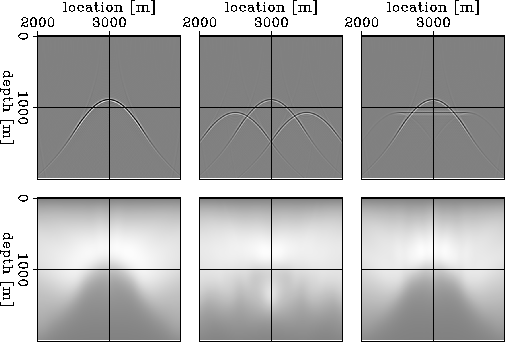 |