


Next: RELATIONS FOR ANISOTROPY IN
Up: Berryman: Poroelastic fluid effects
Previous: INTRODUCTION
In contrast to traditional elastic analysis, the presence in rock
of a saturating pore fluid introduces the possibility of
an additional control field and an additional type of strain variable.
The pressure pf in the fluid is a new field parameter that can be
controlled. Allowing sufficient time for global pressure equilibration
permits us to consider pf to be a constant throughout the
percolating (connected) pore fluid, while restricting the analysis
to quasistatic processes. (But ultimately we are not interested in such
quasi-static processes in this paper, as we are trying to reconcile
laboratory wave data with the theory.)
The change  in the amount of fluid mass contained in the pores
[see Biot (1962) or Berryman and Thigpen (1985)]
is a new type of strain variable, measuring how much of the original
fluid in the pores is squeezed out during the compression of the
pore volume while including the effects of compression or expansion
of the pore fluid itself due to changes in pf.
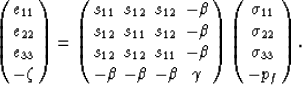
It is most convenient to write the resulting equations in terms of
compliances rather than stiffnesses, so the basic equation to be
considered takes the following form for isotropic media:
in the amount of fluid mass contained in the pores
[see Biot (1962) or Berryman and Thigpen (1985)]
is a new type of strain variable, measuring how much of the original
fluid in the pores is squeezed out during the compression of the
pore volume while including the effects of compression or expansion
of the pore fluid itself due to changes in pf.
It is most convenient to write the resulting equations in terms of
compliances rather than stiffnesses, so the basic equation to be
considered takes the following form for isotropic media:
|  |
(1) |
The constants appearing in the matrix on the right hand side
will be defined in the following two paragraphs.
It is important to write the equations this way rather than using the
inverse relation in terms of the stiffnesses, because the compliances sij
appearing in (1) are simply related to the drained
elastic constants
 and Gdr in the same way they are related in normal
elasticity, whereas the individual stiffnesses obtained by inverting
the equation in (1) must contain coupling terms through the
parameters
and Gdr in the same way they are related in normal
elasticity, whereas the individual stiffnesses obtained by inverting
the equation in (1) must contain coupling terms through the
parameters  and
and  that depend on the pore and fluid compliances.
Thus, we find that
that depend on the pore and fluid compliances.
Thus, we find that
|  |
(2) |
and
|  |
(3) |
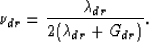
where the drained Young's modulus Edr is defined by the second
equality of (2) and the drained Poisson's ratio is determined by
|  |
(4) |
When the external stress is hydrostatic so  , equation (1) telescopes down to
|  |
(5) |
where e = e11 + e22 + e33,  is the drained bulk modulus,
 is the Biot-Willis parameter (Biot and Willis,
1957) with Km being the bulk modulus of the solid minerals present,
and Skempton's pore-pressure buildup parameter B
(Skempton, 1954) is given by
is the Biot-Willis parameter (Biot and Willis,
1957) with Km being the bulk modulus of the solid minerals present,
and Skempton's pore-pressure buildup parameter B
(Skempton, 1954) is given by
|  |
(6) |
New parameters appearing in (6) are the bulk modulus of the
pore fluid Kf and the pore modulus  where
where
 is the porosity. The expressions for
  and B can be
generalized slightly
by supposing that the solid frame is composed of more than one
constituent, in which case the Km appearing in the definition of is replaced by Ks and the Km appearing explicitly in (6)
is replaced by
and B can be
generalized slightly
by supposing that the solid frame is composed of more than one
constituent, in which case the Km appearing in the definition of is replaced by Ks and the Km appearing explicitly in (6)
is replaced by  (see Brown and Korringa, 1975;
Rice and Cleary, 1976; Berryman and Wang, 1995).
This is an important additional complication (Berge and Berryman, 1995),
but -- for the sake of desired simplicity --
we will not pursue the matter further here.
(see Brown and Korringa, 1975;
Rice and Cleary, 1976; Berryman and Wang, 1995).
This is an important additional complication (Berge and Berryman, 1995),
but -- for the sake of desired simplicity --
we will not pursue the matter further here.
Comparing (1) and (5), we find that
|  |
(7) |
and
|  |
(8) |
As we develop the ideas to be presented here, we will need to treat
Eqs. (1)-(6) as if they are true locally, but perhaps not globally.
In particular, if we assume overall drained conditions, then
pf = a constant everywhere. But, if we assume locally undrained
conditions, then  a constant in local patches, but these
local constant values may differ from patch to patch. This way of
thinking about the system is intended to mimic the behavior expected
when a high frequency wave propagates through a system having highly
variable (or just uniformly very low) fluid permeability everywhere.
a constant in local patches, but these
local constant values may differ from patch to patch. This way of
thinking about the system is intended to mimic the behavior expected
when a high frequency wave propagates through a system having highly
variable (or just uniformly very low) fluid permeability everywhere.
Next: RELATIONS FOR ANISOTROPY IN
Up: Berryman: Poroelastic fluid effects
Previous: INTRODUCTION
Stanford Exploration Project
5/23/2004