


 dependent on velocity model complexity. Orthogonal
coordinate
dependent on velocity model complexity. Orthogonal
coordinate  was parameterized as either a punctual or a plane wave
source. Point source images required a parameterization of over
shooting angle starting at radius, R. The initial 4-step coordinate
mesh was created from a circularly expanding rayfront with an angular
range bounded by
was parameterized as either a punctual or a plane wave
source. Point source images required a parameterization of over
shooting angle starting at radius, R. The initial 4-step coordinate
mesh was created from a circularly expanding rayfront with an angular
range bounded by  and
and  . Initial wavefields
consisted of constant amplitude lines separated in
. Initial wavefields
consisted of constant amplitude lines separated in  and
distributed uniformly over coordinate . Plane-wave images required
a parameterization of over surface coordinate xo. The initial
4-step coordinate system was a Cartesian mesh tilted at the dip angle
of the plane-wave being extrapolated. Initial wavefields again
consisted of constant amplitude lines separated in and
distributed uniformly over surface position, xo.
and
distributed uniformly over coordinate . Plane-wave images required
a parameterization of over surface coordinate xo. The initial
4-step coordinate system was a Cartesian mesh tilted at the dip angle
of the plane-wave being extrapolated. Initial wavefields again
consisted of constant amplitude lines separated in and
distributed uniformly over surface position, xo.
We designed the first extrapolation example to test the method on a
smooth velocity function of sufficient contrast to enable overturning
waves. The velocity model, shown in the left panel of
Figure 5, consists of a broad Gaussian velocity
anomaly that is 86 slower than the background velocity of 3000m/s.
Superposed on the Gaussian anomaly are vertical and horizontal
gradients of 0.1 and -0.05 s-1, respectively.
slower than the background velocity of 3000m/s.
Superposed on the Gaussian anomaly are vertical and horizontal
gradients of 0.1 and -0.05 s-1, respectively.
 |
slower than the
background velocity of 3000m/s. Superposed over top are vertical
and horizontal gradients of 0.1 and -0.05km/s per km, respectively,
and the 5 Hz ray-coordinate system. Middle: The 5Hz monochromatic
wavefield. Right: Broadband wavefield calculated using a 0.2-25Hz
frequency band.

The first test involved using a point source located at 3000m.
Rays were computed between  and
and  assuming an
initial radius of 200m. Phase-ray wavefield extrapolation was then
carried out with a constant spacing of 0.0005s at a
5Hz frequency. The resulting ray-coordinate system, superposed on
the left panel of Figure 5, is smooth and
triplication-free.
The middle panel presents the corresponding 5Hz monochromatic
wavefield interpolated from the ray-coordinate system to a
Cartesian mesh of spacing
assuming an
initial radius of 200m. Phase-ray wavefield extrapolation was then
carried out with a constant spacing of 0.0005s at a
5Hz frequency. The resulting ray-coordinate system, superposed on
the left panel of Figure 5, is smooth and
triplication-free.
The middle panel presents the corresponding 5Hz monochromatic
wavefield interpolated from the ray-coordinate system to a
Cartesian mesh of spacing  m.
These two panels illustrate that both the rayfield and wavefield
successfully overturn. Wavefield wavelengths are observed to compress
in the region of slow velocity about the Gaussian anomaly, and to
expand at greater depths.
The right panel presents the broadband image constructed for
frequencies between 2-35Hz.
All wavefield frequencies were extrapolated on a stationary 5Hz ray
coordinate system.
m.
These two panels illustrate that both the rayfield and wavefield
successfully overturn. Wavefield wavelengths are observed to compress
in the region of slow velocity about the Gaussian anomaly, and to
expand at greater depths.
The right panel presents the broadband image constructed for
frequencies between 2-35Hz.
All wavefield frequencies were extrapolated on a stationary 5Hz ray
coordinate system.
The second example, shown in Figure 6, is the plane-wave equivalent to Figure 5. The panels in Figure 6 are similar to those presented in the previous figure.
 |
slower than the background velocity
of 3000m/s. Superposed are vertical and horizontal
gradients of 0.1 and -0.05km/s per km, and the calculated 5Hz
ray-coordinate system. Middle: The 5Hz monochromatic
wavefield. Right: Broadband image calculated using a 0.2-25Hz
frequency band.
The initial coordinate system and wavefield tilt angle was
-10, and the spacing between individual rays was set at 20m.
The left and middle panels show the 5Hz rayfield and the
corresponding 5Hz wavefield, respectively. Again, the rayfield is
observed to compress along coordinate as it nears the center of
the Gaussian anomaly leading to increased amplitudes and shorter
wavelengths. The right panel presents the broadband wavefield
calculated in the 0.2-25Hz frequency band.
Again, all wavefield frequencies were extrapolated on a stationary 5Hz
ray-coordinate system.
As in the previous figure, the broadband result overturns and is
triplication-free.
The next example demonstrates adaptive phase-ray wavefield extrapolation in a Gulf of Mexico salt model. The background velocity of the model, shown in the left panel of Figure 7, is a typical Gulf of Mexico v(z) velocity gradient.
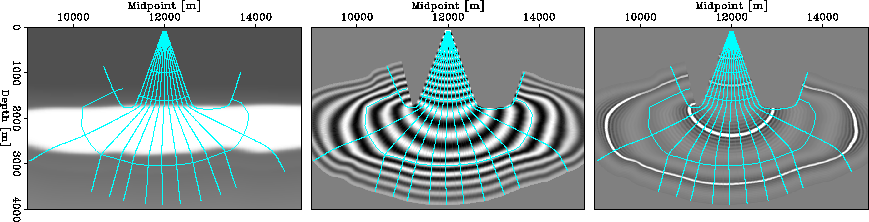 |
The superposed salt body is characterized by a higher wavespeed
(4700m/s) and a somewhat rugose bottom of salt interface.
A point source was modeled at surface position 12000m with a starting
radius of 200m.
The initial angular coverage was bounded by  and
and
 because shooting beyond this angular range lead
to ray-coordinate triplication.
The superposed rayfield in the left panel demonstrates the effect of
strong velocity contrasts and a rugose interface between the bottom of
salt body and the enveloping sediments.
At angles tending away from vertical (i.e.
because shooting beyond this angular range lead
to ray-coordinate triplication.
The superposed rayfield in the left panel demonstrates the effect of
strong velocity contrasts and a rugose interface between the bottom of
salt body and the enveloping sediments.
At angles tending away from vertical (i.e.  =0), rays
increasingly refract in accordance with Snell's law, become
horizontal, impinge on the salt-sediment interface, and eventually
refract upward at fairly steep angles.
The middle and right panels present the 5Hz monochromatic and
2-35Hz broadband wavefields, respectively.
Again, the ray-coordinate system in the right panel was assumed to be
stationary, and all frequencies were extrapolation on 5Hz rayfield.
=0), rays
increasingly refract in accordance with Snell's law, become
horizontal, impinge on the salt-sediment interface, and eventually
refract upward at fairly steep angles.
The middle and right panels present the 5Hz monochromatic and
2-35Hz broadband wavefields, respectively.
Again, the ray-coordinate system in the right panel was assumed to be
stationary, and all frequencies were extrapolation on 5Hz rayfield.