


Multiples can be imaged by Kirchhoff Reiter et al. (1991) or crosscorrelogram migration Sheng (2001), by transforming the traveltimes of multiple reflections to those of primary reflections. Multiples can be also imaged by shot-profile migration, considering the primary reflections as areal shot records and the multiple reflections as receiver wavefields Berkhout and Verschuur (1994); Guitton (2002). Instead of being transformed into primaries implicitly, multiples also can be explicitly mapped into primaries by cross-correlation Berkhout and Verschuur (2003); Shan (2003) or deconvolution Shan (2003). We call ``pseudo-primary'' any events resulting from the cross-correlation of multiples with the original dataset (primaries+multiples). The pseudo-primaries are similar to the original data and can be imaged by source-receiver migration Shan (2003).
In this paper, we estimate pseudo-primary shot gathers by cross-correlating primary and multiple reflections. These pseudo-primary shot gathers are then migrated with shot-profile migration. The images obtained from the pseudo-primaries are then compared to images of the primaries alone.
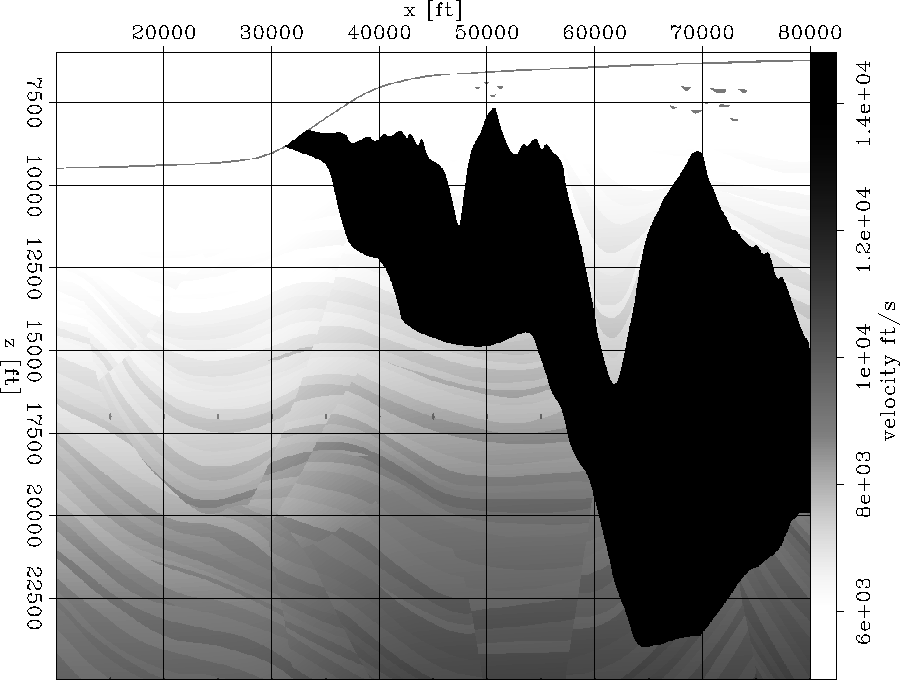
We applied our method to the Sigsbee2B synthetic dataset. This dataset is challenging because of the complex geometry of the salt body (Figure 1). Two versions of the Sigsbee2B dataset were generated: one with surface-related multiples (FS) and one without (NFS). The multiples are known and can be obtained by subtracting the two datasets (i.e. FS-NFS). But with field data, surface-related multiples need to be separated prior to the migration using the method of Verschuur et al. (1992). From this dataset, we show that multiples can (1) fill acquisition holes, (2) extrapolate data beyond the acquisition spread, and (3) provide an image of the subsurface under complex geology.
 |
