


Next: Linearization
Up: Sava and Biondi: WEMVA
Previous: Introduction
The wavefield constructed by downward continuation from the
surface to depth z,  is
is
|  |
(1) |
where  is the data at the surface and
 is the complex phase shift at one depth level.
We can write the phase at every depth level
as a Taylor expansion
around a reference medium of slowness so
is the complex phase shift at one depth level.
We can write the phase at every depth level
as a Taylor expansion
around a reference medium of slowness so
| 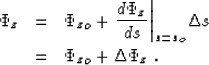 |
(2) |
| (3) |
If we plug equation (2) in equation (1) we can write
the following expression for the wavefield  :
:
|  |
(4) |
where  corresponds to the background slowness so,
and corresponds to an arbitrary spatially varying
slowness
corresponds to the background slowness so,
and corresponds to an arbitrary spatially varying
slowness  .
.
We can define a wavefield perturbation at depth z
by the expression
| ![\begin{eqnarray}
\Delta \mathcal U&=& \mathcal U- \mathcal U_o
\\ &=& \mathcal U_o\left[e^{i \sum_z \Delta \Phi_z } -1\right]\end{eqnarray}](img12.gif) |
(5) |
| (6) |
or, if we use the notation 
| ![\begin{displaymath}
\Delta \mathcal U= \mathcal U_o\left[e^{i \Delta \Phi} -1\right]\;.\end{displaymath}](img14.gif) |
(7) |
In general, we can compute a wavefield perturbation  by applying a non-linear operator
  which depends on
the background wavefield
which depends on
the background wavefield  to a slowness perturbation
  , according
to equation (7):
, according
to equation (7):
| ![\begin{displaymath}
\Delta \mathcal U= {\bf L}\left(\mathcal U_o\right)\left[\Delta s\right]\;.\end{displaymath}](img19.gif) |
(8) |