


Next: Evaluation of the image
Up: Application to a synthetic
Previous: Application to a synthetic
The transformation
to DDHOCIG
of an image  is defined as
|  |
(74) |
The transformation
to DDHOCIG
of an impulse located at  is thus (after inverse Fourier transforms):
|  |
(75) |
We now approximate by stationary phase the inner double integral.
The phase of this integral is,
| ![\begin{displaymath}
\Phi\equiv
{\vec k_h}\left[\bar{x_h}\left(1+\frac{k_{x}^2}{...
...ight] +
k_z\left(\bar{z}-z\right) +
k_{x}\left(\bar{x}-x\right)\end{displaymath}](img178.gif) |
(76) |
The stationary path is defined by the solutions of the following
system of equations:
| 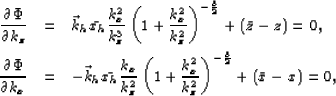 |
(77) |
| (78) |
| |
By moving both  and
and
 on the right of
equations (
on the right of
equations (![[*]](http://sepwww.stanford.edu/latex2html/cross_ref_motif.gif) ) and (),
and then dividing equation ()
by equation (),
we obtain the following relationships between
and
:
) and (),
and then dividing equation ()
by equation (),
we obtain the following relationships between
and
:
|  |
(79) |
Furthermore, by multiplying equations () by kz
and equation () by kx,
and then substituting
them appropriately in the phase function (),
we can evaluate the phase function along the stationary path as
| ![\begin{displaymath}
\Phi_{\rm stat}=
{\vec k_h}\left[\bar{x_h}\left(1+\frac{k_{x}^2}{k_z^2}\right)^{-\frac{1}{2}}-h_0\right],\end{displaymath}](img183.gif) |
(80) |
that becomes, by substituting
equation (),
| ![\begin{displaymath}
\Phi_{\rm stat}=
{\vec k_h}\left\{-\bar{x_h}\left[1+\frac{\...
...2}{\left(\bar{x}-x\right)^2}\right]^{-\frac{1}{2}}-h_0\right\}.\end{displaymath}](img184.gif) |
(81) |
Notice that the minus sign comes from the  function
in expression ().
By substituting expression ()
in equation () it is immediate
to evaluate the kinematics of the impulse response as
function
in expression ().
By substituting expression ()
in equation () it is immediate
to evaluate the kinematics of the impulse response as
| ![\begin{displaymath}
h_0=-h_x\left[1+\frac{\left(\bar{z}-z\right)^2}{\left(\bar{x}-x\right)^2}\right]^{-\frac{1}{2}}\end{displaymath}](img185.gif) |
(82) |
Next: Evaluation of the image
Up: Application to a synthetic
Previous: Application to a synthetic
Stanford Exploration Project
11/11/2002