


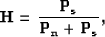
 . The so-called Wiener estimator is a filter, which when applied
to the data, produces an optimal (least-squares sense) estimate of the embedded signal
(). For the special case of uncorrelated signal and noise, the frequency
response of this filter is
. The so-called Wiener estimator is a filter, which when applied
to the data, produces an optimal (least-squares sense) estimate of the embedded signal
(). For the special case of uncorrelated signal and noise, the frequency
response of this filter is
 |
(177) |
 and
and  are the signal and noise power spectra, respectively.
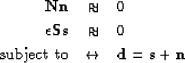
Define operators
are the signal and noise power spectra, respectively.
Define operators  and
and  , as convolution with filters which decorrelate
the unknown noise
, as convolution with filters which decorrelate
the unknown noise  and signal
  , respectively.
(), for example, show that the following least-squares
optimization problem is approximately equivalent to Wiener estimation:
, respectively.
(), for example, show that the following least-squares
optimization problem is approximately equivalent to Wiener estimation:
 |
||
| (178) | ||
![[*]](http://sepwww.stanford.edu/latex2html/cross_ref_motif.gif) ) is a regularized linear least-squares problem. The scalar
parameter
) is a regularized linear least-squares problem. The scalar
parameter  is related to the data's signal-to-noise ratio.
The conceptual model of seismic data as n locally-crossing plane waves lends itself well to parameterization by a few parameters. The multidimensional prediction-error filter (PEF) is a particularly popular option (see, for example, ()). Estimated by autoregression against the data, the PEF encodes hidden multiplicity in the data with a few filter coefficients. It has the approximate inverse spectrum of the data from which it was estimated.
By using a model of the noise to obtain a nonstationary noise PEF and deconvolving a
PEF estimated from the data by the noise PEF to obtain a signal PEF (),
many authors have solved equation () to successfully separate coherent noise
from signal
(, , , , ).
As noted by (), however, the considerable amount of parameter tuning required to create stable nonstationary PEFs (a requirement for the deconvolution step) remains a significant obstacle to their use in industrial-scale processing environments.
If the signal and noise consist of distinct slopes everywhere, then it is in theory
possible to implicitly separate signal from noise in the slope domain with a two-slope
estimation algorithm. Fomel uses estimated slope to construct plane-wave destructor
filters which are used directly as and in equation (),
without any deconvolution. The filters are guaranteed stable and insensitive to spatially
aliased data. Fomel obtains an independent estimate the noise slope from a prior noise
model, and then fixes the noise slope as the signal slope is estimated.
I take a slightly different tack at the problem. Like Fomel, I use my two-slope estimation
technique to directly obtain signal and noise slope estimates. I also exploit a prior
noise model and also a prior signal model, in cases where the signal is simpler to model
than the noise. Most importantly, I find that very simple, easily-obtainable signal or
noise models suffice. To overcome aliasing, I apply normal moveout (NMO) to the data.
Rather than plane-wave destructor filters, I (again) use 9-point Lagrange steering
filters derived by ().