


![[*]](http://sepwww.stanford.edu/latex2html/cross_ref_motif.gif) and illustrate tests of the
my nonlinear two-slope estimation algorithm. The ``textures''
() were computed by constructing nonstationary steering
filters (the 9-point Lagrange filter derived by ())
with the estimated slopes, and then using those filters to deconvolve random
noise. The textures, used also by Fomel
, provide a quick check of the
accuracy of the estimated slopes.
and illustrate tests of the
my nonlinear two-slope estimation algorithm. The ``textures''
() were computed by constructing nonstationary steering
filters (the 9-point Lagrange filter derived by ())
with the estimated slopes, and then using those filters to deconvolve random
noise. The textures, used also by Fomel
, provide a quick check of the
accuracy of the estimated slopes.
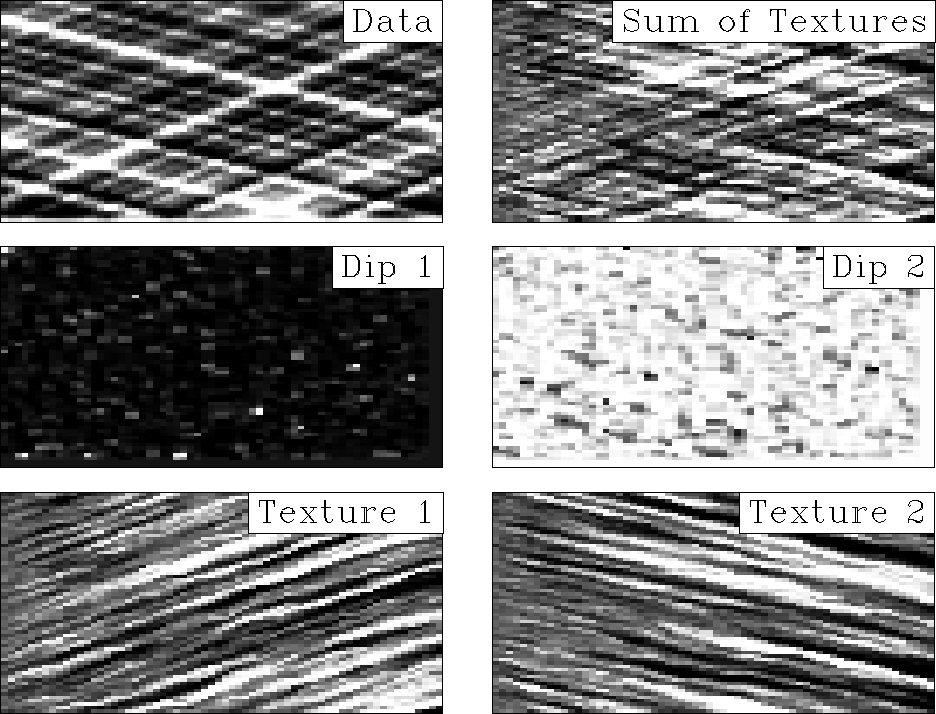
In Figure , a simple crossing-plane-wave dataset is tested.
The slope panels shown have been smoothed with a sliding weighted mean filter
(4-by-4 analysis window). The program used to compute the slopes also computes
the weights, which are either 1 or 0. If the estimated slopes at a single point
in (t,x) are equal, then the result is assumed to be trivial and the weight at
that point is set to 0. Otherwise, the weight is set to 1.
The textures in Figure illustrate that the estimated
slopes are not totally accurate. The steep positive slope in particular seems
smaller than the true positive slopes in the data, while the shallower negative
slope seems better represented.
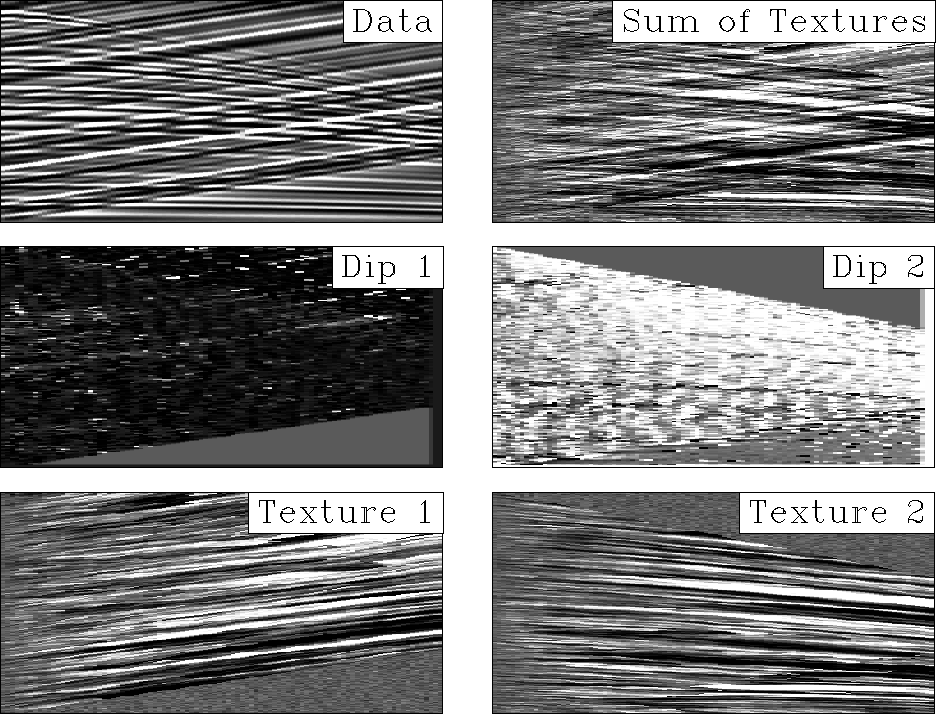
Figure illustrates a more difficult test dataset, a ``CMP
gather'' overlain by upward-sloping linear ``noise.'' Notice that some
regions of the data contain either one signal or the other. My slope estimation
program, through the use of mask operators, allows the user to specify regions where
only one slope is present in the data. In those regions, I use Claerbout's
univariate ``puck'' method to estimate that
single slope.
We notice some discontinuity in the textures in Figure
at one-slope/two-slope boundaries in the data. My two-slope algorithm slightly
underestimates the positive ``noise'' slope, while in some sections of the data,
it overestimates the magnitude of the ``CMP gather'' slope. Still, the general
trend of both slopes honors those present in the data.
At the right and bottom edges of the estimated slopes in Figure ,
notice the constant-valued regions. Because the finite-difference templates of
equation () run off the right and bottom edges of the data,
the slope cannot (easily) be computed in these regions. In this case, the slope
remains unchanged from the starting guesses, which in this case were -0.5
and 0.5. We expect the estimated slopes to exhibit some sensitivity to starting
guess. I have experimented qualitatitvely, and indeed found some sensitivity,
though it is not generally severe.
 |
![[*]](http://sepwww.stanford.edu/latex2html/movie.gif)


 |