


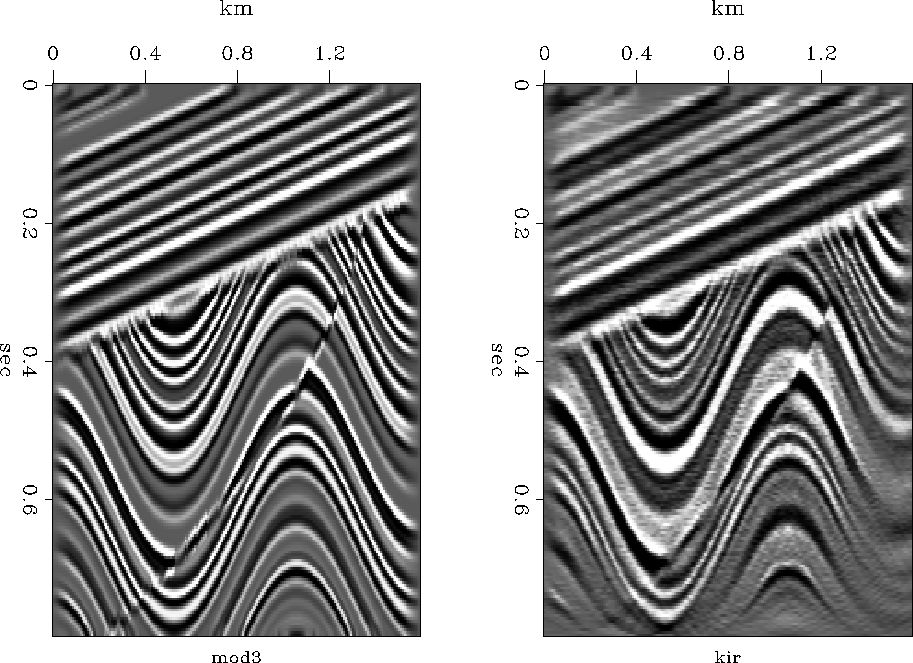
Reconstructing the earth model with the adjoint option in kirchfast() ![[*]](http://sepwww.stanford.edu/latex2html/cross_ref_motif.gif) yields the result in Figure 7.
yields the result in Figure 7.
 |
![[*]](http://sepwww.stanford.edu/latex2html/movie.gif)


Difficult migrations are well known for producing semicircular reflectors. Here we have controlled everything fairly well so none are obvious, but on a video screen I see some semicircles.
Next is the problem of the spectrum.
Notice in Figure 7 that the reconstruction
lacks the sharp crispness of the original.
It is shown in chapter
that the spectrum of our reconstruction
loses high frequencies by a scale of  .Philosophically, we can think of the hyperbola summation
as integration, and integration boosts low frequencies.
Figure 8 shows the average over x
of the relevant spectra.
.Philosophically, we can think of the hyperbola summation
as integration, and integration boosts low frequencies.
Figure 8 shows the average over x
of the relevant spectra.
|
kirspec
Figure 8 Top is the spectrum of the the model, i.e. the left side of Figure 7. Bottom is the spectrum of the the reconstruction, i.e. the right side of Figure 7. Middle is the reconstruction times frequency f. | 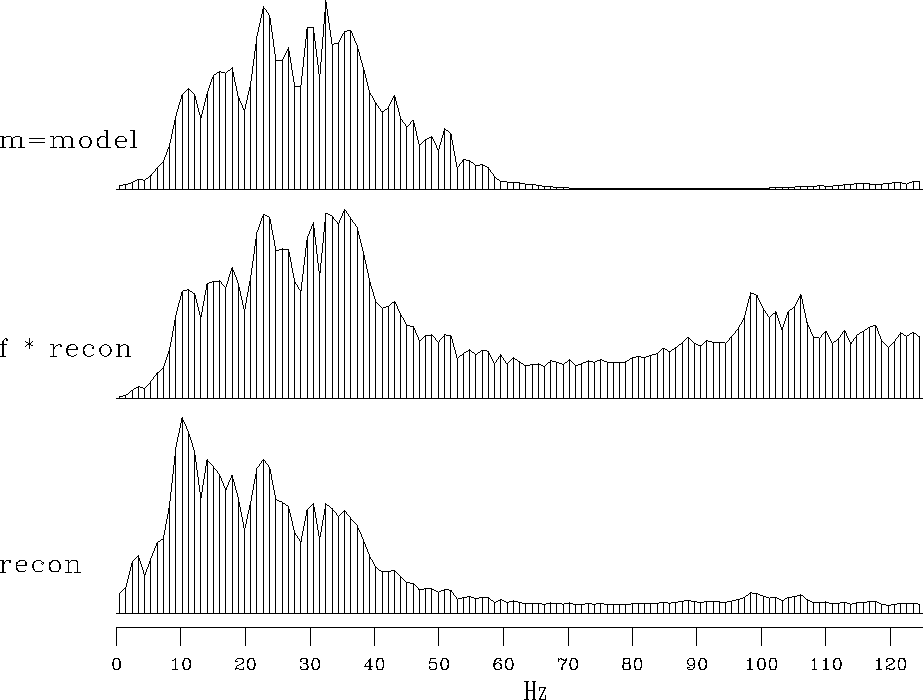 |
 filter to our reconstruction,
or
filter to our reconstruction,
or  operator to both the modeling and the reconstruction,
an idea implemented in subroutine halfdifa() .
operator to both the modeling and the reconstruction,
an idea implemented in subroutine halfdifa() .
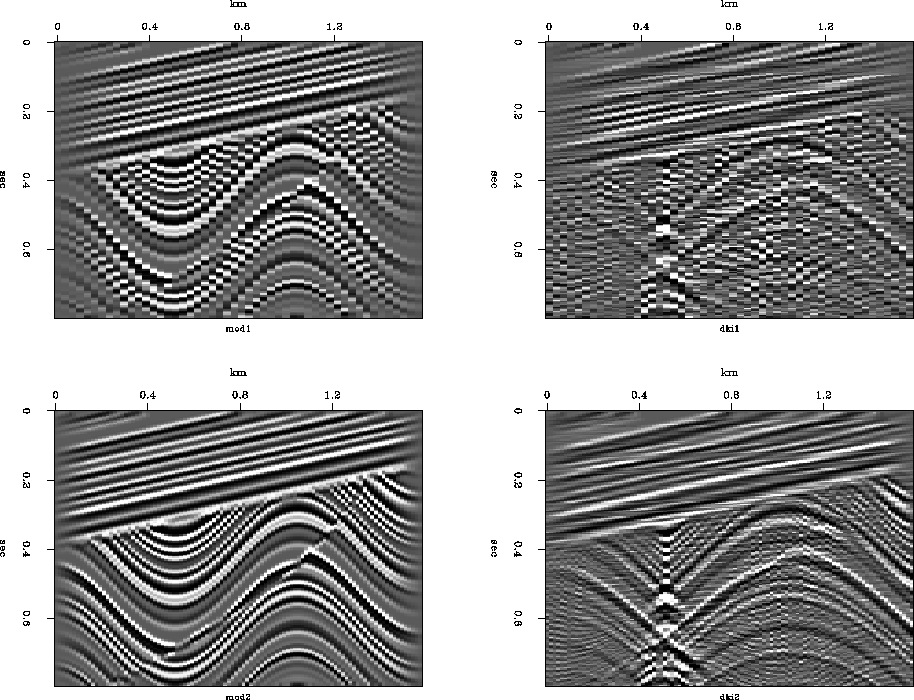
Neither of these Kirchhoff codes addresses the issue of spatial aliasing. Spatial aliasing is a vexing issue of numerical analysis. The Kirchhoff codes shown here do not work as expected unless the space mesh size is suitably more refined than the time mesh. Figure 9 shows an example of forward modeling with an x mesh of 50 and 100 points.
 |
does interpolation by moving values
to the nearest neighbor of the theoretical location.
Had we taken the trouble to interpolate the two nearest points,
our results would have been a little better,
but the basic problem (resolved in chapter ) would remain.