


Here we derive the most basic migration equation
via the dispersion relation,
equation (![[*]](http://sepwww.stanford.edu/latex2html/cross_ref_motif.gif) ).
Recall this equation basically says
).
Recall this equation basically says  .
.
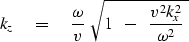 |
(1) |
.
Recall that nature extrapolates forward in time from t=0
whereas a geophysicist extrapolates information
in depth from z=0.
We get ideas for our task,
and then we hope to show that our ideas are
consistent with nature.
Suppose we substitute  into equation (1), multiply by P,
and interpret velocity as depth variable.
into equation (1), multiply by P,
and interpret velocity as depth variable.
 |
(2) |
 and we
would immediately have equation (1).
Why do we believe the introduction of v(z) in
equation (2) has any validity?
We can think about the phase shift migration method
in chapter .
It handled v(z) by having the earth velocity
being a staircase function of depth.
Inside a layer we had the solution to
equation (2).
To cross a layer boundary,
we simply asserted that the wavefield at the bottom
of one layer would be the same as the wavefield
at the top of the next
which is also the solution to
equation (2).
(Let
and we
would immediately have equation (1).
Why do we believe the introduction of v(z) in
equation (2) has any validity?
We can think about the phase shift migration method
in chapter .
It handled v(z) by having the earth velocity
being a staircase function of depth.
Inside a layer we had the solution to
equation (2).
To cross a layer boundary,
we simply asserted that the wavefield at the bottom
of one layer would be the same as the wavefield
at the top of the next
which is also the solution to
equation (2).
(Let  be the transition from one layer to the next.
Then
be the transition from one layer to the next.
Then  since
since  is finite.)
Although equation (2) is consistent
with chapter ,
it is an approximation of limited validity.
It assumes there is no reflection at a layer boundary.
Reflection would change part of a downgoing wave
to an upcoming wave and the wave that continued downward
would have reduced amplitude because of lost energy.
Thus, by our strong desire to downward continue wavefields
(extrapolate in z)
whereas nature extrapolates in t,
we have chosen to ignore
reflection and transmission coefficients.
Perhaps we can recover them,
but now we have bigger fish to fry.
We want to be able to handle v(x,z),
is finite.)
Although equation (2) is consistent
with chapter ,
it is an approximation of limited validity.
It assumes there is no reflection at a layer boundary.
Reflection would change part of a downgoing wave
to an upcoming wave and the wave that continued downward
would have reduced amplitude because of lost energy.
Thus, by our strong desire to downward continue wavefields
(extrapolate in z)
whereas nature extrapolates in t,
we have chosen to ignore
reflection and transmission coefficients.
Perhaps we can recover them,
but now we have bigger fish to fry.
We want to be able to handle v(x,z),
lateral velocity variation. This requires us to get rid of the square root in equation (2). Make a power series for it and drop higher terms.
 |
(3) |
 where
where  is the dip angle of a wavefront.
The dropped terms
increase slowly with angle,
but they do increase,
and dropping them will limit the range of angles
that we can handle with this equation.
This is a bitter price to pay
for the benefit of handling v(x,z),
and we really will return to patch it up
(unlike the transmission coefficient problem).
There are many minus signs cropping up,
so I give you another equation to straighten them out.
is the dip angle of a wavefront.
The dropped terms
increase slowly with angle,
but they do increase,
and dropping them will limit the range of angles
that we can handle with this equation.
This is a bitter price to pay
for the benefit of handling v(x,z),
and we really will return to patch it up
(unlike the transmission coefficient problem).
There are many minus signs cropping up,
so I give you another equation to straighten them out.
 |
(4) |
v(x,z).
Substitute  into equation (4)
and revise interpretation of P
from
into equation (4)
and revise interpretation of P
from  to
to  .
.
|
As with v(z), there is a loss of lateral transmission and reflection coefficients. We plan to forget this minor problem. It is the price of being a data handler instead of a modeler. Equation (5) is the basis for our first program and examples.
