


Recall the Gulf of Mexico dataset presented in chapter ![[*]](http://sepwww.stanford.edu/latex2html/cross_ref_motif.gif) .
We did a reasonably careful job of NMO velocity analysis
in order to produce the stack shown in Figure .
But is this the best possible stack?
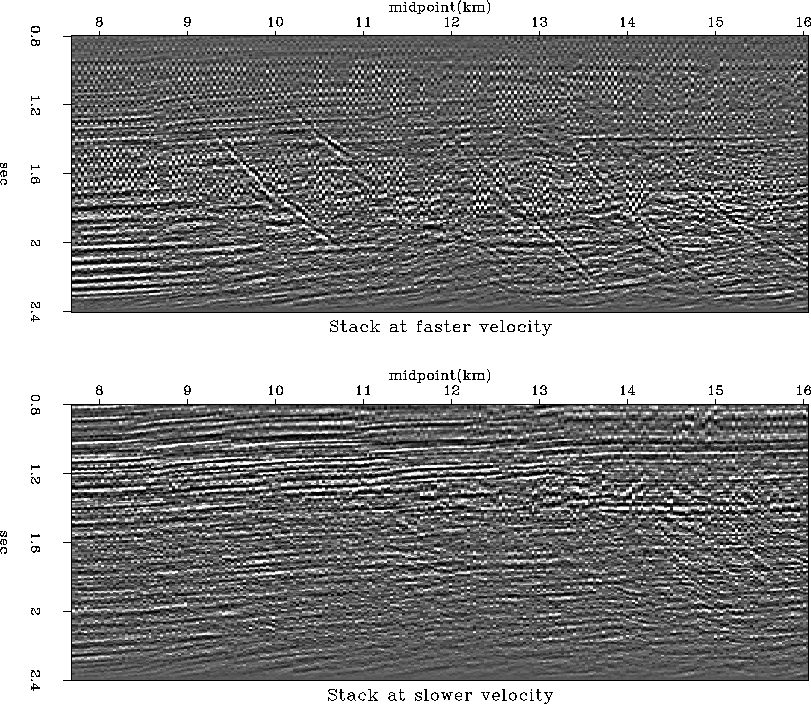
To begin to answer this question, Figure 14 shows
some constant-velocity stacks of this dataset done with subroutine
velsimp() .
This figure clearly shows that
there are some very steeply-dipping reflections
that are missing in Figure .
These steep reflections appear only when the NMO velocity
is quite high compared with the velocity
that does a good job on the horizontal reflectors.
This phenomenon is consistent with
the predictions of equation (12),
which says that dipping events
require a higher NMO velocity than nearby horizontal events.
.
We did a reasonably careful job of NMO velocity analysis
in order to produce the stack shown in Figure .
But is this the best possible stack?
To begin to answer this question, Figure 14 shows
some constant-velocity stacks of this dataset done with subroutine
velsimp() .
This figure clearly shows that
there are some very steeply-dipping reflections
that are missing in Figure .
These steep reflections appear only when the NMO velocity
is quite high compared with the velocity
that does a good job on the horizontal reflectors.
This phenomenon is consistent with
the predictions of equation (12),
which says that dipping events
require a higher NMO velocity than nearby horizontal events.
 |
![[*]](http://sepwww.stanford.edu/latex2html/movie.gif)


Another way of seeing the same conflict in the data
is to look at a velocity-analysis panel
at a single common-midpoint location
such as the panel shown in Figure 15
made by subroutine velsimp() .
In this figure it is easy to see that the velocity
which is good for the dipping event at 1.5 sec is too high
for the horizontal events in its vicinity.
|
velscan
Figure 15 Velocity analysis panel of one of the panels in Figure 14 before (left) and after (right) DMO. Notice two velocities at the same time before DMO. | 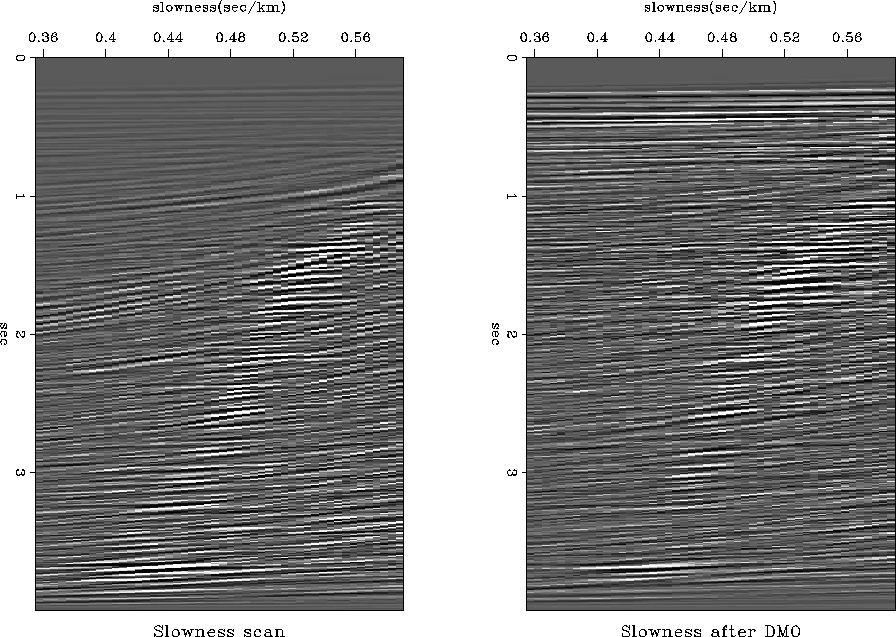 |