


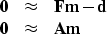
 |
(8) |
 to
to  using
using

 |
(9) |
variables
and then finding the model by using
.
A new reusable
preconditioned solver is
the module prec_solver ![[*]](http://sepwww.stanford.edu/latex2html/cross_ref_motif.gif) .
The variable x
in prec_solver refers to .Likewise the modeling operator
.
The variable x
in prec_solver refers to .Likewise the modeling operator  is called oper
and the smoothing operator
is called oper
and the smoothing operator  is called prec.
Details of the code are only slightly different from
the regularized solver
reg_solver .
is called prec.
Details of the code are only slightly different from
the regularized solver
reg_solver .
module prec_solver {
  logical, parameter, private  :: T = .true., F = .false.
contains
  subroutine solver_prec( oper, solv, prec, nprec, x, dat, niter, eps, p0) {
    optional                                                        :: p0
   interface {
       integer function oper( adj, add, x, dat) {
         logical, intent (in) :: adj, add
         real, dimension (:)  :: x, dat
       }
       integer function solv( forget, x, g, rr, gg) {
         logical             :: forget
         real, dimension (:) :: x, g, rr, gg
       }
       integer function prec( adj, add, x, dat) {
         logical, intent (in) :: adj, add
         real, dimension (:)  :: x, dat
       }
    }
    real, dimension (:), intent (in)  :: dat, p0           # data, initial
    real, dimension (:), intent (out) :: x                 # solution
    real,                intent (in)  :: eps               # scaling
    integer,             intent (in)  :: niter, nprec      # iterations, size
    real, dimension (nprec)           :: g, p              # gradient, precond
    real, dimension (size (dat) + nprec), target :: rr, gg # residual, conj grad
    real, dimension (:), pointer      :: rd, rm, gd, gm
    integer                           :: i, stat1, stat2, stat
    rm => rr (1 : nprec) ; rd => rr (1 + nprec :)          # model and data resids
    gm => gg (1 : nprec) ; gd => gg (1 + nprec :)          # model and data grads
                           rd = -dat                       # initialize r_d
    if( present( p0)) {
       stat1 = prec( F, F, p0, x)       # x = S p
       stat2 = oper( F, T, x, rd)       # r_d = L x - dat
                  p = p0 ; rm = p0*eps} # start with p0
    else {        p = 0. ; rm = 0.}     # start with zero
    do i = 1, niter {
       stat2 = oper( T, F, x, rd)
       stat1 = prec( T, F, g, x)        # g = S' L' r_d
       g = g + eps*rm                   # g = S' L' r_d + eps I r_m
       stat1 = prec( F, F, g, x)
       stat2 = oper( F, F, x, gd)       # g_d = L S g
       gm = eps*g                       # g_m = eps I g
       stat = solv (F, p, g, rr, gg)    # step in p and rr
    }
    stat1 = prec( F, F, p, x)           # x = S p
  }
}